Folgen

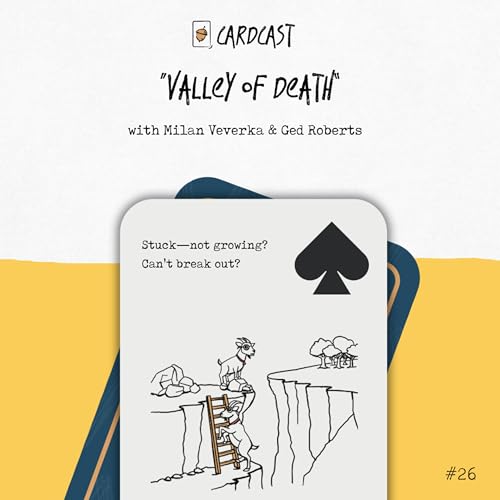
  • 26. Valley of Death with Ged and Milan
    Feb 23 2026

    Welcome back to CardCast! Today, we’re going to be talking about the Valley of Death.

    I keep coming back to this topic, not because it is a new idea, but because it is consistently encountered and often underestimated.

    At certain points in a company’s growth, what once felt natural begins to feel forced. Decisions that used to work… stop working. Leaders describe it the same way every time: “It used to be easy. Now it’s hard.”

    That is usually the signal.

    What I see most often is companies that optimize for the immediate climb. The focus becomes, “Let’s get to five million,” without asking whether the decisions made to get there will support hitting a target of 100 million.

    Systems are put in place to accelerate short-term output. Processes are layered in that solve today’s constraint while quietly hard-coding tomorrow’s ceiling. The company grows but only as far as those decisions allow.

    This is where the Valley of Death begins.

    Organizations mistake friction for failure when, in reality, they have simply reached the limits of the model that got them there.

    In order for companies to continuously grow, they have to build not for the next milestone, but for the ultimate destination and choose systems, pricing, people, and positioning that may slow early growth but sustain long-term ascent.


    Key-Card points:

    • The Valley of Death is predictable, not accidental

    • “It used to be easy, now it’s hard” is the signal

    • Build for the long term, not the next milestone

    • Friction is often misdiagnosed as failure

    • The Valley is a design consequence


    Links & Resources

    • Valley of Death

    • Veverka.ca


    Connect with Milan

    • Veverka.ca

    • LinkedIn


    Connect with Ged

    • Crystalyzer.com

    • LinkedIn


    CardCast is produced by Lovemore Media.

    Mehr anzeigen Weniger anzeigen
    20 Min.
  • 25. Lead or Leave with Ged and Milan
    Feb 16 2026

    Welcome back to CardCast! Today, we’re going to be talking about Lead or Leave.

    There’s a tension behind this card. It lives in the CEO mindset suit, but it applies to anyone leading anything. At some point, what got you here stops being enough to get you there. Founders often build companies on grit, surrounding themselves with strong executors who can manage chaos. That works in the early stages… until the business outgrows that model.

    Then the signals start. Growth stalls. Energy drains. The work stops being fun. The organization fragments in small but telling ways. It’s rarely about the market; it’s about leadership capacity no longer matching company needs.

    At that fork, there are two paths: Lead or Leave.

    To Lead means transforming and upgrading skills, unlearning survival habits, making hard decisions, and building real leadership depth. To Leave means surrendering control and stepping aside for someone better suited to scale the business, whether by exiting or moving into a different role.

    Ironically, both paths start the same way: behavior must change.

    If you’re at the plateau, the first move is honesty. The second is change.


    Key-Card points:

    • Plateaus are often leadership ceilings

    • What built the business won’t scale it

    • Burnout is often misalignment

    • Stepping aside isn’t always permanent

    • Self-awareness is the unlock


    Links & Resources

    • Lead or Leave

    • Veverka.ca


    Connect with Milan

    • Veverka.ca

    • LinkedIn


    Connect with Ged

    • Crystalyzer.com

    • LinkedIn


    CardCast is produced by Lovemore Media.

    Mehr anzeigen Weniger anzeigen
    14 Min.
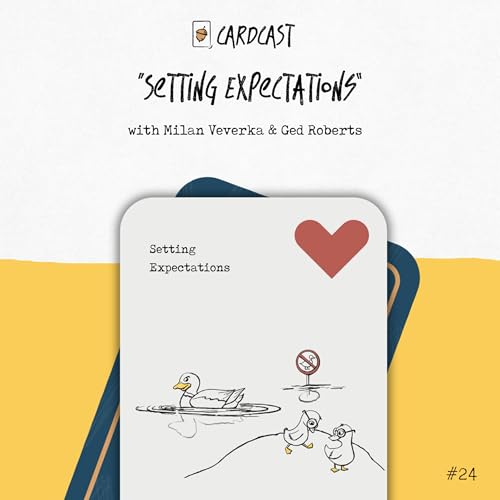
  • 24. Setting Expectations with Ged and Milan
    Feb 9 2026

    Welcome back to CardCast! Today, we’re going to be talking about Setting Expectations.

    One of the most common leadership failures is assuming that expectations are “obvious.”

    People are hired into roles, assigned projects, and even evaluated on outcomes without ever having an explicit understanding of what success looks like. When expectations are unclear or only assumed to be clear, disappointment and frustration are almost always guaranteed.

    Fear of difficult conversations or reluctance to ask clarifying questions only compounds the issue. Without deliberate checks, these issues can persist unnoticed until it shows up as underperformance or broken trust.

    The solution? Communicate! Slow down and define what the outcome is. What matters here is ensuring that both sides interpret the same words and numbers in the same way.

    Clear expectations create the foundation for trust and accountability. Expecting others to read your mind does not.


    Key-Card points:

    • Leadership by osmosis doesn’t work

    • Unclear expectations damage both sides

    • Clarity requires slowing down upfront

    • Feedback loops are essential

    • Expectation-setting is a delegation skill


    Links & Resources

    • Setting Expectations

    • Veverka.ca


    Connect with Milan

    • Veverka.ca

    • LinkedIn


    Connect with Ged

    • Crystalyzer.com

    • LinkedIn


    CardCast is produced by Lovemore Media.

    Mehr anzeigen Weniger anzeigen
    14 Min.
  • 23. Time Audit with Ged and Milan
    Feb 2 2026

    Welcome back to CardCast! Today, we’re going to be talking about Time Audits.

    Where does your time actually go, and does it align with what matters most?

    The Time Audit is a simple but revealing way to answer that question. Most people have a vague sense of which parts of their work energize them and which quietly drain them, but few ever slow down long enough to collect real evidence.

    By replacing guesswork with clarity, a time audit gives us a more honest picture of how our days are actually spent.

    At the end of the day, the goal isn’t to work less, but to work on the right things more often. When enjoyment and value overlap, work tends to feel lighter and more sustainable.

    Ultimately, the time audit is about reflection, not perfection. The insight comes from paying attention consistently, honestly, and without shortcuts.

    Those who take the time to do it tend to walk away surprised, clearer, and better equipped to make intentional changes.


    Key-Card points:

    • Time audits create clarity by replacing assumptions with real data

    • Tracking time reveals where control is being lost unintentionally

    • Value can mean dollars, impact, or long-term investment

    • Reflection matters more than rigid frameworks

    • Consistent audits reveal progress over time


    Links & Resources

    • Time Audit

    • Veverka.ca


    Connect with Milan

    • Veverka.ca

    • LinkedIn


    Connect with Ged

    • Crystalyzer.com

    • LinkedIn


    CardCast is produced by Lovemore Media.

    Mehr anzeigen Weniger anzeigen
    17 Min.
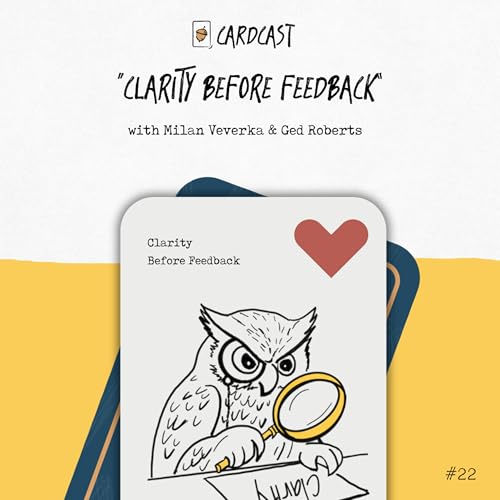
  • 22. Clarity Before Feedback with Ged and Milan
    Jan 27 2026

    Welcome back to CardCast! Today, we’re going to be talking about Clarity Before Feedback.

    Why is clarity so important? Because most of us experience the very human habit of answering too quickly, only to realize we’ve missed something important.

    We’ve all done this at some point in our lives. Especially under pressure or frustration, it’s tempting to jump straight to the answer because it feels right.

    Sometimes it can be the right thing to do, but the moments when it isn’t can be uncomfortable at best and quietly damaging at worst.

    Our conversation today looks at the ongoing practice of slowing down in those moments. Pausing just long enough to ask ourselves: Do I really have the full context? Is this obvious to them? Have they already tried this? Am I solving the problem they’re actually asking about?

    Without that clarity, even well-intended feedback can land as dismissive or condescending.

    That’s why clarity matters so much before feedback. Taking time here can be the difference between being supportive and unintentionally shutting someone down.

    Key-Card points:

    • Jumping straight to solutions can lead to wasted effort

    • Feedback given without clarity can feel dismissive or condescending

    • Slowing down creates space for better understanding

    • Inviting correction builds trust and signals respect

    • Clarity before feedback is about being more helpful.

    Links & Resources

    • Clarity Before Feedback

    • Veverka.ca

    Connect with Milan

    • Veverka.ca

    • LinkedIn

    Connect with Ged

    • Crystalyzer.com

    • LinkedIn


    CardCast is produced by Lovemore Media.

    Mehr anzeigen Weniger anzeigen
    19 Min.
  • 21. What Do You Recommend? with Ged and Milan
    Jan 19 2026

    Welcome back to CardCast! Today, we’re going to be talking about What Do You Recommend?

    Does your team come to you with every question?

    Do you feel like progress slows the moment you’re unavailable?

    This is usually not a people problem; it’s a leadership habit. Most leaders get promoted because they’re excellent at solving problems, so answering quickly feels helpful, efficient, and even generous. But over time, that instinct quietly trains teams to stop thinking and start asking for permission instead.

    The conversation centers on a simple but counterintuitive shift: stop answering and start asking. When leaders respond to questions with “What do you recommend?”, something surprising happens.

    In most cases, people already know the answer. They’re not lacking intelligence or skill; they’re lacking permission. By always providing solutions, leaders create dependency, learned helplessness, and ultimately become the bottleneck themselves.

    The next time a question lands on your desk, pause, because the fastest way forward may be giving permission, not answers.


    Key-Card points:

    • Consistently answering questions trains dependency

    • Asking, “What do you recommend?” unlocks confidence and capability.

    • Providing quick answers creates long-term bottlenecks

    • Great leadership uses results to develop people

    • Asking for recommendations reveals how your team thinks


    Links & Resources

    • What Do You Recommend?

    • Veverka.ca

    Connect with Milan

    • Veverka.ca

    • LinkedIn


    Connect with Ged

    • Crystalyzer.com

    • LinkedIn


    CardCast is produced by Lovemore Media.

    Mehr anzeigen Weniger anzeigen
    22 Min.
  • 20. The Evil of Daily Huddle with Ged and Milan
    Jan 12 2026

    Welcome back to CardCast! Today, we’re going to be talking about The Evil of Daily Huddle.

    The daily huddle often meets immediate resistance—people don’t want to do it. A daily huddle isn’t about adding meetings; it’s about creating a shared execution rhythm.

    What makes it feel “evil” to some is the accountability it introduces: when people say what they’ll do and are asked about it the next day, transparency becomes unavoidable, and patterns quickly emerge.

    Beyond accountability, daily huddles deliver powerful compounding benefits. They strengthen team cohesion, dramatically improve communication efficiency, and reduce constant interruptions by making priorities visible upfront.

    An effective daily huddle is short, held at an odd time, and tightly structured. The agenda is simple: good news, what was completed yesterday, the single most important priority for today, and any blockers or needs for help. Problems aren’t solved in the huddle; they’re identified and handled afterward, keeping the meeting fast and focused.

    When practiced consistently, daily huddles become one of the highest-return leadership habits available, and if someone isn’t willing to commit to them, it’s usually not because huddles don’t work, but because accountability makes them uncomfortable.

    Key-Card points:

    • The daily huddle feels “evil” because it creates unavoidable accountability

    • Daily huddles expose the say–do ratio

    • When teams check in daily, the truth has nowhere to hide

    • Huddles are short, structured, and focused

    • Purpose matters more than format

    Links & Resources

    • The Evil of Daily Huddle

    • Veverka.ca


    Connect with Milan

    • Veverka.ca

    • LinkedIn


    Connect with Ged

    • Crystalyzer.com

    • LinkedIn


    CardCast is produced by Lovemore Media.


    Mehr anzeigen Weniger anzeigen
    22 Min.
  • 19. The 10-80-10 Principle with Ged and Milan
    Jan 5 2026

    Welcome back to CardCast! Today, we’re going to be talking about The 10-80-10 Principle.

    Do you feel that familiar pull of “I’ll just do it myself”?

    The 10-80-10 Principle exists precisely to interrupt that reflex. Borrowed from Dan Martell’s Buy Back Your Time, it’s a simple, practical way to let go of work without letting go of standards.

    It acknowledges the very real tension leaders feel: the work needs to be done, it needs to be done well, and it feels faster to do it yourself.

    The first 10% is where most delegation quietly fails. This is the work of clarity: defining the outcome, explaining why it matters, setting expectations, and sharing context that normally lives only in our heads. The truth is, if someone “can’t do it right,” very often it’s because we never truly showed them what “right” looks like.

    The 80% is the handoff. This is where someone else does the work. It won’t be perfect, and that’s the point! As Martell puts it, 80% done is 100% awesome. The real win here isn’t just time saved; it’s breaking the pattern of “I’ll do it myself”.

    The final 10% brings it back to us for review, feedback, and refinement. We make sure the result matches the intent, we close any gaps, and we help lock in learning for next time.

    Over time, this shifts us out of doing and into designing better systems, work that scales, develops people, and unties the business from us personally. The key question is: if you didn’t have to do the middle 80%, what higher-value work could you finally focus on?


    Key-Card points:

    • The goal is to build systems, not personal dependence

    • Delegation is also about transferring learning, not just tasks

    • Most delegation fails due to unclear outcomes, not weak execution

    • Doing it yourself may feel faster, but it creates long-term dependence

    • Delegation done well grows people and frees leaders at the same time


    Links & Resources

    • The 10-80-10 Principle

    • Veverka.ca


    Connect with Milan

    • Veverka.ca

    • LinkedIn


    Connect with Ged

    • Crystalyzer.com

    • LinkedIn


    CardCast is produced by Lovemore Media.

    Mehr anzeigen Weniger anzeigen
    16 Min.