CardCast Titelbild

CardCast

CardCast

Von: Milan Veverka and Ged Roberts
Jetzt kostenlos hören, ohne Abo

Über diesen Titel

Welcome to CardCast! Inspired by Milan Veverka’s habit of jotting insights on blank playing cards, this practice grew into a digital archive and now a podcast. Hosted by Ged and Milan, each episode takes one card as a prompt to spark conversation on leadership, communication, and the human side of growth. The idea is simple: one card, one prompt, one meaningful conversation.Milan Veverka and Ged Roberts Ökonomie
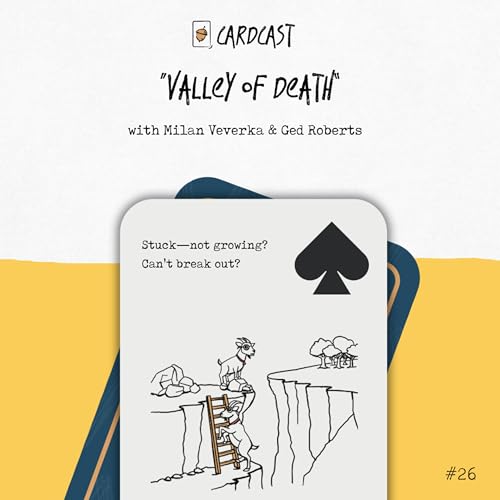
  • 26. Valley of Death with Ged and Milan
    Feb 23 2026

    Welcome back to CardCast! Today, we’re going to be talking about the Valley of Death.

    I keep coming back to this topic, not because it is a new idea, but because it is consistently encountered and often underestimated.

    At certain points in a company’s growth, what once felt natural begins to feel forced. Decisions that used to work… stop working. Leaders describe it the same way every time: “It used to be easy. Now it’s hard.”

    That is usually the signal.

    What I see most often is companies that optimize for the immediate climb. The focus becomes, “Let’s get to five million,” without asking whether the decisions made to get there will support hitting a target of 100 million.

    Systems are put in place to accelerate short-term output. Processes are layered in that solve today’s constraint while quietly hard-coding tomorrow’s ceiling. The company grows but only as far as those decisions allow.

    This is where the Valley of Death begins.

    Organizations mistake friction for failure when, in reality, they have simply reached the limits of the model that got them there.

    In order for companies to continuously grow, they have to build not for the next milestone, but for the ultimate destination and choose systems, pricing, people, and positioning that may slow early growth but sustain long-term ascent.


    Key-Card points:

    • The Valley of Death is predictable, not accidental

    • “It used to be easy, now it’s hard” is the signal

    • Build for the long term, not the next milestone

    • Friction is often misdiagnosed as failure

    • The Valley is a design consequence


    Links & Resources

    • Valley of Death

    • Veverka.ca


    Connect with Milan

    • Veverka.ca

    • LinkedIn


    Connect with Ged

    • Crystalyzer.com

    • LinkedIn


    CardCast is produced by Lovemore Media.

    Mehr anzeigen Weniger anzeigen
    20 Min.
  • 25. Lead or Leave with Ged and Milan
    Feb 16 2026

    Welcome back to CardCast! Today, we’re going to be talking about Lead or Leave.

    There’s a tension behind this card. It lives in the CEO mindset suit, but it applies to anyone leading anything. At some point, what got you here stops being enough to get you there. Founders often build companies on grit, surrounding themselves with strong executors who can manage chaos. That works in the early stages… until the business outgrows that model.

    Then the signals start. Growth stalls. Energy drains. The work stops being fun. The organization fragments in small but telling ways. It’s rarely about the market; it’s about leadership capacity no longer matching company needs.

    At that fork, there are two paths: Lead or Leave.

    To Lead means transforming and upgrading skills, unlearning survival habits, making hard decisions, and building real leadership depth. To Leave means surrendering control and stepping aside for someone better suited to scale the business, whether by exiting or moving into a different role.

    Ironically, both paths start the same way: behavior must change.

    If you’re at the plateau, the first move is honesty. The second is change.


    Key-Card points:

    • Plateaus are often leadership ceilings

    • What built the business won’t scale it

    • Burnout is often misalignment

    • Stepping aside isn’t always permanent

    • Self-awareness is the unlock


    Links & Resources

    • Lead or Leave

    • Veverka.ca


    Connect with Milan

    • Veverka.ca

    • LinkedIn


    Connect with Ged

    • Crystalyzer.com

    • LinkedIn


    CardCast is produced by Lovemore Media.

    Mehr anzeigen Weniger anzeigen
    14 Min.
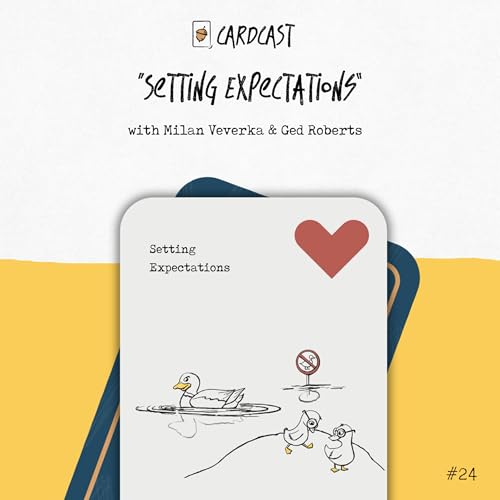
  • 24. Setting Expectations with Ged and Milan
    Feb 9 2026

    Welcome back to CardCast! Today, we’re going to be talking about Setting Expectations.

    One of the most common leadership failures is assuming that expectations are “obvious.”

    People are hired into roles, assigned projects, and even evaluated on outcomes without ever having an explicit understanding of what success looks like. When expectations are unclear or only assumed to be clear, disappointment and frustration are almost always guaranteed.

    Fear of difficult conversations or reluctance to ask clarifying questions only compounds the issue. Without deliberate checks, these issues can persist unnoticed until it shows up as underperformance or broken trust.

    The solution? Communicate! Slow down and define what the outcome is. What matters here is ensuring that both sides interpret the same words and numbers in the same way.

    Clear expectations create the foundation for trust and accountability. Expecting others to read your mind does not.


    Key-Card points:

    • Leadership by osmosis doesn’t work

    • Unclear expectations damage both sides

    • Clarity requires slowing down upfront

    • Feedback loops are essential

    • Expectation-setting is a delegation skill


    Links & Resources

    • Setting Expectations

    • Veverka.ca


    Connect with Milan

    • Veverka.ca

    • LinkedIn


    Connect with Ged

    • Crystalyzer.com

    • LinkedIn


    CardCast is produced by Lovemore Media.

    Mehr anzeigen Weniger anzeigen
    14 Min.
Noch keine Rezensionen vorhanden