Automated with Brian Heater Titelbild

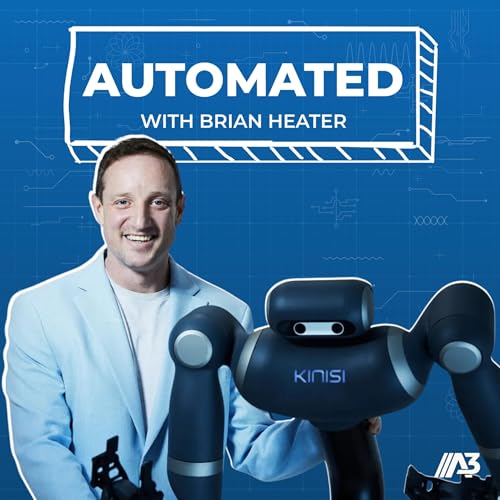
Automated with Brian Heater

Automated with Brian Heater

Von: Brian Heater
Jetzt kostenlos hören, ohne Abo

Über diesen Titel

Get a direct line to the biggest names and brightest minds in robotics, AI, and automation. Automated with Brian Heater brings you long-form conversations and unfiltered insights into how we got here, where we’re going, and what’s behind the technologies impacting how we live and work.


Hosted on Acast. See acast.com/privacy for more information.

Association for Advancing Automation
Wissenschaft
  • Colin Angle on Why Home Robots Failed Before and Why AI Changes Everything
    May 6 2026

    Home robots have been promised for decades.


    Most of them did not fail because the ambition was too small. They failed because the technology was not yet good enough to understand people, adapt to real homes, or earn a place in daily life.


    In this episode of Automated, Brian Heater speaks with Colin Angle, founder and CEO of Familiar Machines & Magic and co-founder of iRobot, about why this moment in robotics feels fundamentally different.


    After helping define consumer robotics with Roomba, Colin is now focused on a new category of robot built not just to perform tasks, but to understand context, respond with intention, and build long-term connections inside the home.


    The conversation explores why the hardest problem in robotics was never simply movement. For years, robots could hear commands and execute narrow tasks, but they struggled with situational awareness, context, and the complexity of real-world environments. Colin explains why recent advances in AI have changed that, making capabilities that once felt impossible now practical.


    Brian and Colin also revisit one of Roomba's most important lessons. A robot can technically work and still fail in the home. The real challenge is not just functionality. It is whether the product fits naturally into people’s routines. Colin shares why one of Roomba’s biggest failure modes was not a rare edge case, but something much more common: people turning it off because it was annoying at the wrong time, and never turning it back on.


    The conversation also digs into what physical presence adds to AI. Colin reflects on early iRobot experiments like My Real Baby and explains why embodied systems can create a deeper and more memorable connection than software on a screen.


    They also discuss why Colin believes the next major consumer robot will not be a humanoid trying to replicate human labor in the home. Instead, he argues the real opportunity is building machines people trust, enjoy interacting with, and want around over time.


    Privacy is another major part of that equation. Colin explains why home robots need to run on the edge, not rely on constant cloud streaming, and why trust, latency, and cost all matter just as much as technical capability.


    This conversation is a deep look at what held home robotics back, what AI has finally unlocked, and why the next breakthrough may come from building robots that feel less like tools and more like a natural part of everyday life.


    Connect with Colin Angle

    https://www.linkedin.com/in/colinangle/


    Learn more about Familiar Machines & Magic

    https://www.familiarmachines.com/


    We’d love to hear from you.

    Have thoughts or guest suggestions?

    Reach us at podcast@automate.org.


    You can find the transcript and more episodes of Automated at automated.fm.

    Unlock full access to Automated and explore everything automation.


    Subscribe today and leave a review on YouTube, Apple Podcasts, and Spotify.

    Subscribe to the Automated Newsletter:

    https://www.automate.org/automation/newsletter-automation-roundup


    You can also find us on:

    LinkedIn https://www.linkedin.com/showcase/automated-podcast-by-a3/


    Instagram https://www.instagram.com/automatedpod/

    Hosted on Acast. See acast.com/privacy for more information.

    Mehr anzeigen Weniger anzeigen
    51 Min.
  • Martial Hebert on Why Self-Driving Cars Took So Long and What Everyone Got Wrong About AI
    Apr 29 2026

    Self-driving cars were supposed to be everywhere by now.


    They are not.


    And the reason is not what most people think.


    In this episode of Automated, Brian Heater speaks with Martial Hebert, Dean of Carnegie Mellon University’s School of Computer Science, about the reality behind decades of robotics and AI development.


    Martial has spent more than 40 years at the Robotics Institute and worked on some of the earliest autonomous vehicle systems. From that perspective, the story is not about technology failing.


    It is about expectations being wrong.


    The core technology for self-driving cars has existed for years. What slowed everything down is something far less visible: validation, safety, and the challenge of proving these systems can operate reliably in the real world.


    That gap between “it works” and “it can be trusted” is where most timelines break.


    The conversation also explores why physical AI is fundamentally different from the AI most people are familiar with. Unlike software, robots have to operate in unpredictable environments, interact with people, and handle edge cases that cannot be fully simulated.


    Martial explains why simulation alone is not enough, and why real-world experimentation is still essential, even when it is slow, expensive, and difficult to scale.


    They also discuss the robotics data problem. While large language models benefit from massive amounts of internet data, robotics systems struggle to collect the kind of real-world data they actually need.


    Brian and Martial also dig into a deeper idea that often gets overlooked: progress in robotics is not just about better algorithms. It is about building long-term ecosystems of talent, culture, and expertise.


    That is part of what turned places like Carnegie Mellon into leaders in autonomy, and why many of today’s breakthroughs are the result of decades of accumulated work.


    They also explore the role of DARPA and long-term research funding, not as a way to build products quickly, but as a way to push the limits of what is possible and force entirely new breakthroughs.


    This conversation offers a grounded perspective on why progress in AI takes longer than expected and what it actually takes to move from impressive demos to systems that work in the real world.


    Connect with Martial Hebert

    https://www.linkedin.com/in/martial-hebert-76448756/


    Learn more about Carnegie Mellon Robotics

    https://www.ri.cmu.edu/


    We’d love to hear from you.

    Have thoughts or guest suggestions?

    Reach us at podcast@automate.org.


    You can find the transcript and more episodes of Automated at automated.fm.


    Unlock full access to Automated and explore everything automation.

    Subscribe today and leave a review on YouTube, Apple Podcasts, and Spotify.


    Subscribe to the Automated Newsletter:

    https://www.automate.org/automation/newsletter-automation-roundup


    You can also find us on:

    LinkedIn https://www.linkedin.com/showcase/automated-podcast-by-a3/


    Instagram https://www.instagram.com/automatedpod/

    Hosted on Acast. See acast.com/privacy for more information.

    Mehr anzeigen Weniger anzeigen
    48 Min.
  • Bren Pierce on Why Humanoid Robots Are Overhyped and What Actually Works in Robotics
    Apr 22 2026

    Humanoid robots are everywhere right now. From viral demos to bold promises about home automation, it often feels like the future has already arrived.


    But behind the scenes, the reality is far more complex.


    In this episode of Automated, Brian Heater speaks with Bren Pierce, founder of Kinisi Robotics and co-founder of Bear Robotics, about what it actually takes to build and deploy robots in the real world.


    Bren explains why many humanoid robot demonstrations are misleading. While the technology has made major advances in movement and control, real-world deployment is still limited by manipulation, reliability, and the complexity of unstructured environments.


    The conversation explores why household robotics may be further away than most people think. Despite impressive demos, creating a robot that can operate independently in a dynamic home environment remains an unsolved challenge that could take years to fully unlock.


    They also discuss the gap between robotics innovation and practical business applications. Many companies are still experimenting, often driven by internal pressure to adopt AI and automation, even when the return on investment is unclear.


    Bren shares lessons from building multiple robotics companies, including why focusing on real problems matters more than chasing hype. Instead of targeting futuristic home use cases, Kinisi is focused on warehouse and industrial environments where the technology can deliver value today.


    The episode also dives into the challenges of scaling robotics systems. From deployment complexity to training and usability, the biggest barrier is not just building the technology, but making it reliable and usable without requiring expert engineers.


    Brian and Bren also explore the parallels between robotics and autonomous vehicles, highlighting how long it can take for breakthrough technologies to transition from demos to real-world impact.


    This conversation offers a grounded perspective on where robotics actually stands today and what it will take to move from impressive demos to real deployment.


    Connect with Bren Pierce

    https://www.linkedin.com/in/brenpierce/


    Learn more about Kinisi Robotics

    https://www.kinisirobotics.com/


    We’d love to hear from you. Have thoughts or guest suggestions? Reach us at podcast@automate.org.


    You can find the transcript and more episodes of Automated at automated.fm.


    Unlock full access to Automated and explore everything automation.

    Subscribe today and leave a review on YouTube, Apple Podcasts, and Spotify.

    Subscribe to the Automated Newsletter:

    https://www.automate.org/automation/newsletter-automation-roundup


    You can also find us on:

    LinkedIn https://www.linkedin.com/showcase/automated-podcast-by-a3/


    Instagram https://www.instagram.com/automatedpod/

    Hosted on Acast. See acast.com/privacy for more information.

    Mehr anzeigen Weniger anzeigen
    57 Min.
adbl_web_anon_alc_button_suppression_c
Noch keine Rezensionen vorhanden