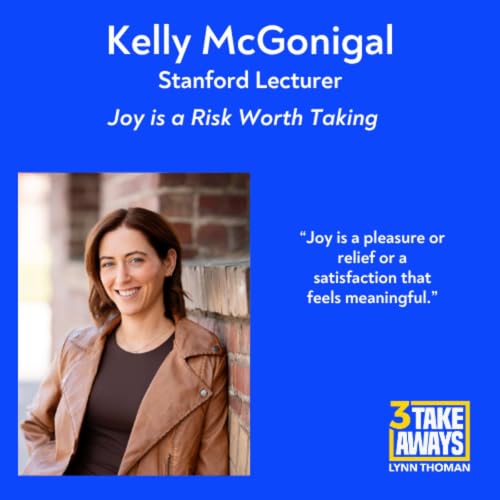
• Joy is a Risk Worth Taking (#324)
    Oct 20 2026

    What if joy isn’t a reward for when life goes well, but the thing that helps us survive when it doesn’t?

    Psychologist and Stanford lecturer Kelly McGonigal reveals that joy is not the same as happiness, and that many of us quietly push it away without realizing it.

    In this episode, you’ll learn:

    • Why happiness needs everything to be good, while joy needs just one thing
    • Why so many of us protect ourselves from joy, and why anxiety can feel safer
    • How power and success can make connection, and joy, harder to reach
    • Why people in war zones, hospitals and hospice understand joy best
    • How to follow the news without being consumed by outrage and fear
    • The simple practice of “meeting joy with joy”

    Joy is not something you wait for.

    It is something you can create for yourself and for others.

    Kelly McGonigal is the author of Joy Is a Risk Worth Taking.

    Mehr anzeigen Weniger anzeigen
    19 Min.
  • Greenland, Russia, and The Cold War for the Arctic (#323)
    Oct 13 2026

    As Arctic ice melts, the struggle for the frozen north is beginning to resemble a new Cold War.

    Russian submarine activity is rising. China is mapping the seabed and expanding its icebreaker fleet. And Greenland sits at the center of a growing contest over shipping routes, critical minerals, energy, and missiles.

    Heather Conley, a senior fellow at the American Enterprise Institute and one of America’s leading experts on the Arctic, Europe, and transatlantic security, spent years warning that this region would become critical to America’s defense.

    What did she see that America and its allies were missing and how much time is left to prepare?

    She discusses:

    • How much of what Trump wanted in the recent Greenland deal was already possible
    • Why Russia sees the Arctic as central to its military and economic future
    • Why the United States secretly offered Denmark $100 million for Greenland after WWII
    • Why Greenland’s location makes it critical to America’s missile defenses
    • How the Arctic shortens distances for missiles, submarines, ships, and undersea cables
    • Why China’s Arctic science will also have military applications
    • What Greenland’s mineral wealth means for U.S. interests
    • Why America cannot adequately defend the Arctic without its allies

    The next decade in the Arctic could determine whether America and its allies are ready for when the Cold War in the Arctic gets hot.

    Mehr anzeigen Weniger anzeigen
    19 Min.
  • How a 500 Year Old Map Still Distorts Our World (#322)
    Oct 6 2026

    The world map we grew up with makes Greenland and Africa look the same size. The problem? Africa is actually an astonishing 14 times larger.

    The even larger problem? There's no such thing as an accurate map. They all distort how we see the world.

    Jay Foreman and Mark Cooper-Jones are comedians, writers, and YouTubers with millions of followers where they are better known as Map Men. Their new book, This Way Up, explores how maps shape our understanding of the world and what happens when they inevitably get it wrong.

    They discuss:

    • Why a 500-year-old deeply-flawed map became our standard picture of the world
    • Why Greenland and other northern regions appear much larger than they really are
    • Why creating a completely accurate flat map is impossible
    • Why north being “up” is simply a convention
    • How a country’s apparent size and position may shape how important we believe it is
    • Why Google Maps can display different borders depending on where it is viewed
    • What London taxi drivers reveal about navigation, memory, and the brain
    • How relying on GPS is weakening abilities we once took for granted
    • What GPS and AI have in common

    Maps look objective, but they're actually very subjective and flawed. Where and how are they misleading us?

    And if you're looking for a more topical take on Greenland, Trump, and the recent security deal -- be sure to tune in next week for my conversation with security expert Heather Conley.

    Mehr anzeigen Weniger anzeigen
    19 Min.
  • America, War, and the Myths We Still Believe (#321)
    Sep 29 2026

    What if one of the things Americans believe most deeply about America simply isn’t true?

    Americans have a powerful story about who they are and why America acts when it does.

    Historian Robert Kagan, a senior fellow at the Brookings Institution, says America's own history tells a very different story.

    He discusses:

    ● The biggest myth Americans believe about their own country
    ● What American history looks like when you strip that myth away
    ● Why America keeps doing something it insists it doesn’t want to do
    ● Whether America’s wars were really forced upon it
    ● The unexpected connection between American power and the threats America faces
    ● What China and Russia may understand about America that Americans don’t
    ● What happens if America turns inward again

    What if the biggest thing Americans misunderstand about their role in the world isn’t the world?

    It’s America.

    Mehr anzeigen Weniger anzeigen
    20 Min.
  • Artificial Intimacy: Who We Become When We Talk to Machines (#320)
    Sep 22 2026

    What if AI becomes easier to talk to than another person?

    And what happens to us when it does?

    MIT professor Sherry Turkle has spent decades studying what technology does to the way we think, work, and love. Now she says there are two parts of our lives we should never let AI into.

    She discusses:

    • Why ordinary conversation has started to feel like work
    • The surprising reason people may prefer talking to chatbots
    • How AI will change what we expect from other people
    • Why “pretend empathy” may be more dangerous than it seems
    • What happens when relationships become frictionless
    • What it could mean for a child to have an AI friend
    • Whether AI could make us worse at being with each other

    The question isn’t just what AI can do. It’s what AI may do to us.

    Mehr anzeigen Weniger anzeigen
    23 Min.
  • Mark Cuban: What Everyone Is Getting Wrong About AI (#319)
    Sep 15 2026

    Mark Cuban told people that television would eventually be delivered over the internet.

    Everybody thought he was an idiot.

    Now, Cuban is making another prediction that runs counter to what we all believe, but this time it's about A.I.

    Few people have made as many big bets across as many industries as Mark Cuban. The billionaire entrepreneur and investor has built businesses in technology and media, transformed the NBA's Dallas Mavericks, and is now taking on prescription drug companies with Cost Plus Drugs.

    He discusses:

    ● What everyone may be getting wrong about AI
    ● What he sees happening to jobs and where the real opportunity may be
    ● The one thing he believes AI will never replace
    ● How he decides whether a seemingly crazy idea is actually an opportunity
    ● The quality he looks for after seeing thousands of entrepreneurs
    ● The mistake incredibly smart people make again and again
    ● Why one of his biggest decisions required him to become “the younger Mark Cuban” again
    ● Why being wrong repeatedly may not matter nearly as much as we think
    ● What success means to him now that money is no longer the measure
    ● What he thinks most Americans still don’t understand about healthcare

    Mark Cuban saw streaming coming and almost nobody believed him. What does he see now that the rest of us may be missing?

    Mehr anzeigen Weniger anzeigen
    23 Min.
  • Can Anyone Stop a President From Starting a War? (#318)
    Sep 8 2026

    What if the president can act before Congress has time to stop him?

    As former U.S. Secretary of Homeland Security, former General Counsel of the Department of Defense, and a member of the National Security Council, Jeh Johnson has advised presidents on war, terrorism, cyber threats, and some of the country’s most consequential national security decisions.

    He has seen what happens when the pressure to “do something” collides with incomplete intelligence, rapidly changing facts, political pressure, and enormous presidential power.

    He discusses:

    ● Why “Mr. President, do something” can be dangerous advice
    ● Why Congress has formally declared war in only five conflicts in U.S. history
    ● How much military force a president can order without first going to Congress
    ● What happens to constitutional checks and balances when weapons can strike in minutes
    ● Why presidential power looks different from inside the Oval Office
    ● What actually happens inside the Situation Room when the intelligence is incomplete and the stakes are enormous
    ● The threat that worries him the most

    The Constitution gives Congress the power to declare war. But modern military strikes and warfare can move extraordinarily fast.

    So who can stop a president from starting a war? Where are the limits on presidential power when a decision has to be made in minutes? And when the law leaves enormous discretion in the hands of one person, how much ultimately depends on that person’s judgment and restraint?

    Mehr anzeigen Weniger anzeigen
    19 Min.
  • Angela Duckworth: Grit Isn't Enough (#317)
    Sep 1 2026

    What if trying harder is sometimes exactly the wrong thing to do?

    Angela Duckworth, University of Pennsylvania psychologist, MacArthur Fellow, and author of the #1 New York Times bestseller Grit, has spent years studying achievement. In her new book, Situated, she explores why perseverance alone isn't enough.

    She discusses:

    • How Angela and her husband nearly “gritted” their way out of their marriage
    • How much your environment shapes who you become
    • The small change that can make good habits easier
    • Why parents may be asking the wrong question about their children
    • How peer pressure can become a force for good
    • Whether AI could make us worse at thinking
    • When changing your situation matters more than changing yourself

    We spend enormous energy trying to improve ourselves. Angela Duckworth asks a different question: what if the more important thing is to change what’s around us?

    Mehr anzeigen Weniger anzeigen
    18 Min.