

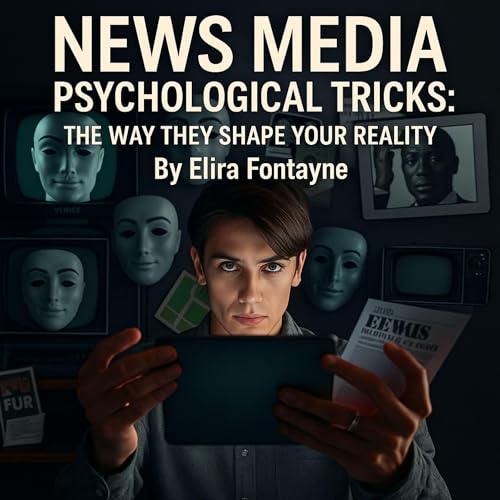
News Media Psychological Tricks
The Way They Shape Your Reality
Artikel konnten nicht hinzugefügt werden
Der Titel konnte nicht zum Warenkorb hinzugefügt werden.
Der Titel konnte nicht zum Merkzettel hinzugefügt werden.
„Von Wunschzettel entfernen“ fehlgeschlagen.
„Podcast folgen“ fehlgeschlagen
„Podcast nicht mehr folgen“ fehlgeschlagen
30 Tage Audible Standard kostenlos testen

News Media Psychological Tricks
Für 10,53 € kaufen
-
Gesprochen von:
-
Michelle Peitz
-
Von:
-
Elira Fontayne
In an age of constant headlines, 24-hour broadcasts, and endless scrolling newsfeeds, the way information is presented has never been more important—or more powerful. We like to think we consume “just the facts,” but what we actually see, hear, and read has already been filtered, framed, and shaped before it ever reaches us. The result? A version of reality crafted not only to inform, but also to engage, persuade, and sometimes manipulate.
News Media Psychological Tricks: The Way They Shape Your Reality pulls back the curtain on the hidden techniques the news uses to influence how you think and feel. From the choice of a single headline word to the order in which stories are told, the media employs subtle but highly effective methods rooted in psychology. This book explores those methods and reveals how they work, so you can become a sharper, more critical consumer of information.
Inside, you’ll discover ten of the most common and impactful techniques, including:
- Framing: How the same event can be spun into a story of triumph or tragedy depending on what’s emphasized.
- Agenda Setting: Why the topics you see every day become the ones you think about most.
- Emotional Appeals: How language and imagery tug at your heart—or play on your fears—to bypass rational analysis.
- Source Selection: Who gets quoted and why it shapes your perception of authority and truth.
- Repetition: Why ideas repeated often enough start to feel like fact.
- Priming: How earlier stories subtly influence how you interpret later ones.
- The Bandwagon Effect: The psychological pull to believe what “everyone else” seems to believe.
- Sensationalism and Clickbait: Why shocking headlines are irresistible in the fight for attention.
- Simplification: How complex issues are reduced to black-and-white narratives.
- Confirmation Bias Reinforcement: The comfort of hearing what you already believe—and the echo chambers it creates.
Drawing on insights from psychology, communication theory, and media studies, Elira Fontayne shows how these techniques exploit natural human tendencies—our love of stories, our sensitivity to emotion, our desire for belonging, and our shortcuts in thinking. Some of these methods are deliberate, others are the byproduct of a hyper-competitive media environment where attention is the most valuable commodity.
This is not a call to abandon the news. Rather, it is a guide to seeing it more clearly. By understanding these psychological tricks, you can recognise when your emotions are being manipulated, when a story is framed to push you in a certain direction, or when repetition is trying to cement an idea in your mind. You can learn to pause, reflect, and ask the right questions: Why is this story being told this way? What perspectives are missing? How might I see this differently?
In a world of information overload, media literacy is survival. Just as earlier generations learned to read and write to navigate their world, we must now learn to decode and interpret the flow of information that surrounds us every day. This book provides that toolkit.
News Media Psychological Tricks is essential listening for anyone who wants to move beyond passive consumption and take back control over how they understand the world. Whether you are a casual news reader, a student of media, or simply someone who wants to think critically in an age of spin, this book will change the way you see the news—and perhaps, the way you see reality itself.
©2025 Deep Vision Media t/a Zentara UK (P)2025 Deep Vision Media t/a Zentara UK