

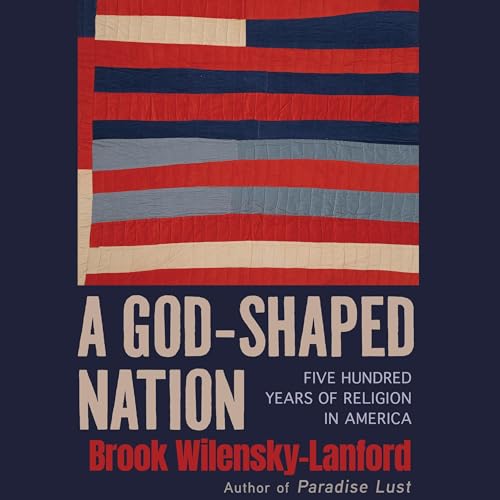
A God-Shaped Nation
Five Hundred Years of Religion in America
Artikel konnten nicht hinzugefügt werden
Leider können wir den Artikel nicht hinzufügen, da Ihr Warenkorb bereits seine Kapazität erreicht hat.
Der Titel konnte nicht zum Warenkorb hinzugefügt werden.
Bitte versuchen Sie es später noch einmal
Der Titel konnte nicht zum Merkzettel hinzugefügt werden.
Bitte versuchen Sie es später noch einmal
„Von Wunschzettel entfernen“ fehlgeschlagen.
Bitte versuchen Sie es später noch einmal
„Podcast folgen“ fehlgeschlagen
„Podcast nicht mehr folgen“ fehlgeschlagen
30 Tage Audible Standard kostenlos testen
Danach 6,99 €/Monat. Monatlich kündbar

A God-Shaped Nation
Gesprochen von:
Raquel Beattie
Für 32,27 € kaufen
-
Gesprochen von:
-
Raquel Beattie
Ever since conquistadores claimed Taino land in the name of their Catholic God and New England Puritans formed their strictly Protestant “city on a hill,” religion has been central to American life. Even as some found religious freedom—Rhode Island welcomed the Quakers, Jews, and Baptists that Massachusetts expelled as dissenters—indigenous people and Africans forced into slavery struggled to protect their religious practices. With the constitutional separation of church and state, it fell to the American people to decide: would they sharpen religion’s formidable powers of division, or reimagine its creative possibilities?
In A God-Shaped Nation, Brook Wilensky-Lanford follows this essential American tension from first contact through the 2024 election. This is an expansive history of extraordinary religious questions, told through the ordinary people who grappled with them. It is a story of defiance: Anne Hutchinson, preaching against Puritan clergy; Reform rabbi Isaac Mayer Wise serving soft-shell crab to his kosher guests at an 1883 banquet; and Wovoka, a Paiute man who envisioned the Ghost Dance movement, which persisted in the face of violent government repression at Wounded Knee. It is also a story of community: Millerites waiting together in vain for Jesus’s return on a rainy October night in 1844; Chinese immigrants bringing Daoist and Buddhist gods to their California temples; Mormons pushing westward to build their “new Zion” in Utah. And in the last fifty years, it has been a story of muscular political power, as the religious right has sought to shape the present and paint the past in its own image.
At a moment when religion penetrates even the most secular aspects of American life, understanding its history is more essential than ever before. “It is in history that the very human work of religion happens,” Wilensky-Lanford shows us, “and in ordinary time that even the most carved-in-stone tenets can and do change.”
adbl_web_anon_alc_button_suppression_t1
Noch keine Rezensionen vorhanden