Workplace Stories by RedThread Research Titelbild

Workplace Stories by RedThread Research

Workplace Stories by RedThread Research

Von: Stacia Garr & Dani Johnson
Jetzt kostenlos hören, ohne Abo

Über diesen Titel

Workplace Stories is a podcast for HR and people leaders who are tired of noise and need clarity that actually holds up. It is hosted by Stacia Garr and Dani Johnson of RedThread Research.

Each episode features candid conversations with practitioners, thinkers, and executives who are navigating real decisions inside complex organizations. Not hypotheticals. Not vendor promises. Real tradeoffs, real experiments, and real lessons learned along the way.

You’ll hear how leaders are making sense of skills, AI, organizational design, and culture when there’s no clear playbook and pressure to show progress is high. The focus is always the same: what’s actually working, what isn’t, and what leaders are doing next.

Workplace Stories helps you make sense of complexity, build credibility with evidence, and move from ideas to action with more confidence.

Want to be part of the conversation? Join our community for free and connect with others shaping the future of work.

Learn more about RedThread Research here: https://redthreadresearch.com/homeRedThread Research 2026
Management & Leadership Ökonomie
  • Strategic Workforce Planning: David Edwards
    Mar 4 2026
    Strategic workforce planning is back, and not in a nostalgic “this trend is back around” kind of way. It is back because the old staffing model, react late, hire fast, hope the market delivers, is failing more often than it works. The biggest misunderstanding is still the same one: strategic workforce planning is not long-term headcount forecasting. It is not a spreadsheet exercise dressed up with better visuals. It is a business discipline that exists for one reason, to stop leaders from committing to strategies the workforce cannot deliver.In this episode of Workplace Stories, David Edwards, author of The Strategic Workforce Planning Handbook, lays out a definition of SWP that is refreshingly usable. Strategic workforce planning is workforce planning for the strategic things in the organization, not an attempt to plan the entire workforce. That single shift makes SWP more approachable, more realistic, and far more effective.If you have not listened yet, this is one of those episodes worth hearing end-to-end. The conversation is practical, occasionally blunt, and full of the kind of “this is what actually happens inside companies” detail that most workforce planning content avoids.You will want to hear this episode if you are interested in...[00:00] A clearer, more usable definition of strategic workforce planning.[00:43] Why SWP is back right now.[03:20] How SWP supports scenario thinking without false precision.[09:50] The questions SWP must answer to be useful.[11:40] Uncertainty, talent scarcity, and skills half-life as drivers.[14:30] Why SWP is an exercise in ambiguity, not certainty.[17:20] Why SWP works best as a business process, not an HR project.[20:05] What HR should do if it is not included in strategy conversations.[22:00] How to define “strategic” beyond leadership roles.[25:10] Why tasks matter more than skills for future work.[28:00] The contextual data missing from most workforce planning.[31:15] How AI forces better workforce planning questions.[41:20] What happens when SWP forces leaders to narrow priorities.[45:30] What to do when the business will not listen.[46:45] Why this work matters at the human level.Strategic Workforce Planning Starts With One Uncomfortable QuestionStrategic workforce planning becomes useful the moment it stops pretending it can predict the future. The real starting point is simple: Is the workforce fit for the organization’s future business purpose? That framing does two things immediately. First, it moves SWP out of the “HR process” bucket and into the “business execution” bucket. Second, it forces the conversation away from false certainty and toward risk, trade-offs, and feasibility.One of the most helpful parts of this episode is how clearly the conversation draws a line between strategic and long-term. Strategic does not automatically mean five years out. In some organizations, planning 15 months ahead is strategic compared to how they have historically operated. If you want the cleanest definition of SWP in the most human language possible, it is worth listening to the early part of the conversation where this is unpacked in real time.Why Workforce Planning Has ReturnedWorkforce planning always comes and goes. It resurfaces when the world feels unstable, and it fades when leaders believe they can hire their way out of problems.Right now, hiring your way out of problems is not working.There is too much uncertainty, and it is coming from too many directions at once. Geopolitical instability affects where work can happen. Talent shortages continue to constrain hiring. Skills decay faster than most organizations can reskill. Generational shifts are changing expectations around mobility and development. And technology is changing the shape of work itself.The point is not that leaders suddenly became more disciplined. The point is that the environment is forcing discipline.Strategic workforce planning is the response to that reality. Not because it gives certainty, but because it gives options. It gives a way to talk about what might happen without having to pretend anyone knows exactly what will happen.Strategic Workforce Planning Works When It Stops Being “HR’s Thing”A lot of SWP efforts fail for a predictable reason. They are treated like an HR deliverable. A report. A deck. A spreadsheet. A set of numbers handed over to leadership. Strategic workforce planning is not a deliverable. It is a business process. It is a feasibility process. It is a risk conversation. One of the strongest through-lines in this episode is the idea that HR must initiate this conversation, not because HR owns strategy, but because HR holds the missing information. HR knows things about recruiting realities, workforce behavior, retention patterns, internal mobility, and capability development that business leaders often overlook.But knowledge is not enough. The shift HR has to make is from reporting to synthesis. People analytics without business ...
    Mehr anzeigen Weniger anzeigen
    50 Min.
  • Authentic AI Adoption and Cultural Impact: Dessalen Wood
    Feb 17 2026
    From overcoming initial anxieties through hackathons and playful experiments, to setting an ambitious organizational roadmap for AI, Dessalen Wood shares how Syntax is embedding artificial intelligence across departments, focusing on pragmatic progress rather than hype.You’ll hear stories about driving excitement, learning by doing, and the all-important challenge of measuring real impact. More than just technology, this episode dives into the culture shifts, collaboration with IT, and leadership mindsets that are pushing companies out of their comfort zones and into the future, while keeping authenticity and humanity front and center.You will want to hear this episode if you are interested in...00:00 Overcoming AI fear through collaboration03:30 Defining AI readiness today09:55 AI's role in business transformation15:46 AI anxiety in the workplace22:05 Making AI adoption fun28:11 AI expertise requires human touch36:42 AI strategy: Three layers explained41:31 True transformation vs. improvement53:21 Rethinking work, technology, and AIOvercoming AI AnxietyEarly stages of AI adoption in organizations are often marked by fear. Employees worry about being displaced, making mistakes, or failing to keep up. At Syntax, Dessalen Wood and her fellow leaders tackled these concerns by creating safe, engaging, and transparent opportunities to experiment.One of the most effective strategies was an organization-wide AI hackathon. Everyone, regardless of their role, was invited to submit ideas for automation and improvement—ideas that the tech team then built. Not only did this demystify AI, but it also provided a healthy dose of competition and excitement. Dessalen describes that, “Instead of people fearing automation, it became a competition... People were saying, please, automate my tasks!” This shift from apprehension to enthusiasm helped break through adoption barriers and foster a culture of creative problem-solving.Structuring Success: A Multi-Layered AI RoadmapSyntax’s approach moves AI from a buzzword to a set of actionable strategies. The leadership distinguished between three core areas:Department Initiatives: Leveraging AI for productivity and process improvement within teamsCustomer Value: Enhancing solutions and services delivered to external clientsBusiness Transformation: Reimagining core business models and operations for strategic advantageMany organizations mistakenly assume one AI initiative will magically improve all three—but real impact comes from tailored strategies for each. In practice, this means differentiating between continuous improvement (making existing tasks more efficient) and true reinvention (fundamentally transforming how and why work gets done).The creation of AI champions, employees trained as internal advocates and solution designers, helped ensure that innovative ideas didn’t just sit in a backlog. Instead, those not ready for large-scale investment could be adapted, piloted, and iterated by these champions, keeping the spirit of experimentation alive while prioritizing resources for the highest-value initiatives.The Human Element: Authenticity, Experimentation, and MeasurementAs AI tools become more prevalent, a new challenge emerges: maintaining authenticity in communication, development, and leadership. The team discussed the “hollowed-out leader” phenomenon—where over-reliance on AI could dilute critical thinking and personal investment. Dessalen explains why expertise, context, and human customization are more important than ever: If it doesn’t demonstrate expertise and isn’t highly curated, it just turns people off.Measurement is also evolving. Early wins in AI productivity are being tracked, not just in terms of completion rates or tool adoption, but in demonstrable business outcomes and stretch goals. Syntax uses tools that help employees articulate their productivity gains and set new impact targets, ensuring that activity translates into organizational value.Resources & People MentionedExperience Qualtrics Management Resources Connect with Dessalen WoodDessalen Wood on LinkedIn Connect With Red Thread ResearchWebsite: Red Thread ResearchOn LinkedInOn FacebookOn TwitterSubscribe to WORKPLACE STORIES
    Mehr anzeigen Weniger anzeigen
    58 Min.
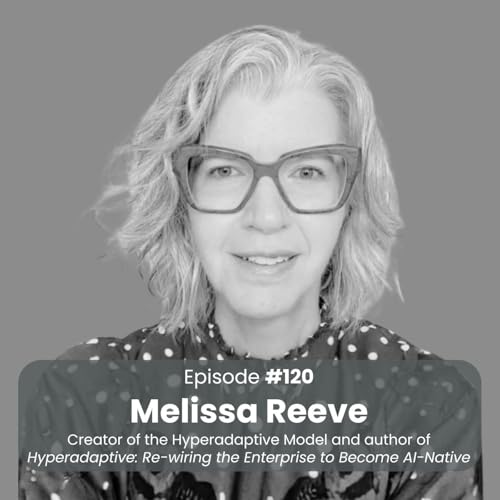
  • Five Levels of Becoming AI Native: Melissa Reeve
    Feb 4 2026
    The way organizations think about artificial intelligence (AI) in the workplace has shifted dramatically over the past few years. While early conversations centered on isolated experiments and technological hype, organizations now face the much harder task of integrating AI into the fabric of how work gets done. We welcome Melissa Reeve, author of “Hyper Adaptive: Rewiring the Enterprise to Become AI Native,” to discuss what AI adoption really means for people, processes, and culture.Melissa tackles some tough questions about organizational complexity, shifting operating models, and the critical role of culture and systems thinking in successful AI integration. Listeners will get candid advice on starting small, experimenting with purpose, and preparing for the rewiring ahead. You will want to hear this episode if you are interested in...03:38 Integrating AI into organizations12:47 AI Native enterprise structure15:51 Dynamic AI governance framework18:58 AI implementation foundations23:56 Process mapping for AI integration29:44 Balancing efficiency and leadership focus37:02 Start small with value streams40:59 Innovative organizational funding models42:14 Starting a skills-focused organization47:03 Digital Twins in Product TestingNavigating the AI Revolution at WorkMelissa Reeve’s journey began on the factory floors of Toyota, learning firsthand how small process shifts can drive system-wide change. Building on years of research and influence from Lean, Agile, and DevOps practitioners, Reeve authored a five-stage maturity model she calls hyperadaptive, designed to guide organizations through the incremental steps needed to become truly AI-native.The five stages of Melissa's model:Foundation – Build organizational understanding of AI; create dynamic governance structures and clarify guardrails. Optimization – Identify and optimize business processes for AI interactions; move beyond basic experimentation. Agents & Automation – Develop and manage AI agents that execute tasks and processes autonomously. Rewiring – Shift organizational architecture from rigid hierarchies to flexible, value-stream teams funded and incentivized differently. Hyperadaptive – Fully sense-and-respond organizations capable of real-time adaptation.Melissa splits these into two main categories: Basecamp (the first three stages, where most companies currently operate) and the Emerging Frontier (rewiring and hyper adaptivity).Why Organizations Struggle with AI IntegrationAccording to Melissa, most organizations are stuck because they underestimate the support structures required for successful AI adoption. It’s not just about updating technology, in fact, 70-80% of AI success depends on people, culture, and processes, not algorithms. Companies often rush to deploy AI agents or experiment without a clear North Star, leading to pilot fatigue and an 80% failure rate. Many organizations haven’t even finished laying the foundational groundwork, such as establishing unified governance or mapping work processes.Another common pitfall is the tendency to try everything at once. Pressure for fast results drives teams to bite off too much, resulting in burnout and costly errors.Moving from Experimentation to Purposeful TransformationPlaying with AI is not a strategy. While experimentation is necessary, organizations must put bounds on these efforts, know why they're experimenting, what hypothesis they're testing, and what success will look like.One necessary precursor is getting to grips with how your organization actually works. Many leaders lack visibility into workflows, decisions, and skillsets, making process optimization difficult. Reeve suggests collaborative process mapping—sometimes supported by AI tools—to unlock tacit knowledge and identify where AI can augment or reinvent workflows.Organizing Around Value StreamsOne of the most transformative elements is the shift from function-based silos to cross-functional value stream teams. Melissa draws on examples from Toyota, Zappos, and Unilever—organizations that reimagine workflows, funding mechanisms, and team incentives to deliver value rather than preserve hierarchy. Dynamic budgeting, focused experimentation, and flexible team structures help organizations scale AI success without tearing up everything at once.Culture, Upskilling, and Durable SuccessAI’s impact will be decided by how well organizations invest in people. Unilever’s Future Fit program exemplifies this approach, aligning reskilling efforts to individual purpose and business needs. It’s not algorithms that set successful organizations apart, but their ability to create cultures and support systems that empower people to adapt, reinvent themselves, and thrive amidst change.Start small, experiment with purpose, invest in support structures, and prepare to rewire not just technology, but how your organization thinks about work itself. AI may be the catalyst, but people, empowered and ...
    Mehr anzeigen Weniger anzeigen
    50 Min.
Noch keine Rezensionen vorhanden