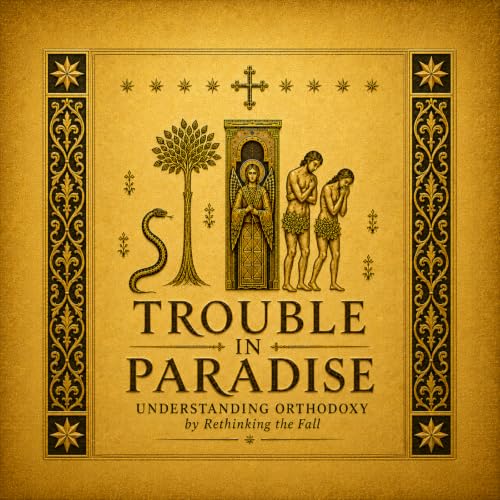
Trouble in Paradise - Understanding Orthodoxy by Rethinking the Fall Titelbild

Trouble in Paradise - Understanding Orthodoxy by Rethinking the Fall

Trouble in Paradise - Understanding Orthodoxy by Rethinking the Fall

Von: Matthew Lyon
Jetzt kostenlos hören, ohne Abo

Über diesen Titel

Trouble in Paradise explores why Eastern Orthodoxy often seems confusing to other Christians — and how rethinking Original Sin reshapes the entire Christian story.

Through personal story, historical theology, and spiritual reflection, this podcast walks listeners through the crisis and discovery that can occur when those assumptions are challenged.

For Protestants, Catholics, and Orthodox Christians seeking a deeper understanding of the Christian story.

Matthew Lyon 2026
Christentum Philosophie Sozialwissenschaften Spiritualität
  • Very Good Is a Long Way from Perfect - Part 2
    Feb 18 2026

    Episode 4

    If Adam was created perfect… why did he fall?

    And if God knew he would fall… what does that mean for evil?

    In Part 2 of Very Good Is Far from Perfect, we follow the logic of perfection all the way to the edge — into the question many people are afraid to ask:

    Does our theology accidentally make evil necessary?

    In this episode:

    • Why “perfect Adam” creates pressure in theodicy
    • A simple breakdown of free will: libertarianism, determinism, and compatibilism
    • Why Arminians and Calvinists may share more assumptions than they realize
    • What “God permitted the Fall” really means — and how that differs in Western and Orthodox theology
    • Leibniz and the “Best of All Possible Worlds”
    • Why evil becomes instrumental in some systems
    • Evil as parasitic, not necessary
    • “I am the Vine, you are the branches” — an organic vision of salvation

    This episode isn’t about attacking traditions.

    It’s about asking whether our starting assumptions — especially the idea that Adam was created perfect — force us into theological tensions that never fully resolve.

    What if the problem isn’t sovereignty versus free will?

    What if the problem is the assumption that Adam was perfect?

    Very good is far from perfect.

    And that difference changes how we speak about God.

    Mehr anzeigen Weniger anzeigen
    12 Min.
  • Very Good Is a Long Way from Perfect – Part 1
    Feb 16 2026

    Episode 3 - What if the entire Western understanding of salvation rests on a word the Bible never uses?

    Genesis does not say Adam was created perfect. It says he was very good.

    In this episode, we explore how that distinction reshapes everything:

    • Was Adam created finished — or with potential?
    • If humanity was perfect, why probation?
    • Why command Adam to subdue the earth if creation was already complete?
    • Why is Scripture filled with imagery of ascent — Jacob’s ladder, mountains, transformation “from glory to glory”?

    We examine:

    • The early Church Fathers (Irenaeus, Athanasius, Basil)
    • Conditional immortality and participation in divine life
    • Augustine’s shift toward inherited guilt
    • How Covenantal probation assumes growth
    • Calvin, decree, and the pressure toward inevitability
    • The Essence–Energies distinction and divine freedom

    We also ask uncomfortable questions:

    If you define the Gospel as “going from hell to heaven,” are you already operating inside the framework of inherited condemnation — even if you say you reject Original Sin?

    What does our treatment of children — communion, baptism, “age of accountability” — reveal about our anthropology?

    If Adam was not created perfect but called to grow into communion, then salvation is not merely legal acquittal.

    It is healing. Resurrection. Participation.

    Very good, not perfect. Communion, not probation. Freedom, not inevitability.

    And that difference changes everything.

    Mehr anzeigen Weniger anzeigen
    14 Min.
  • What Do Christians Mean by Original Sin?
    Feb 13 2026

    Episode 2 — What Do Christians Mean by Original Sin?

    Episode Overview

    The doctrine of Original Sin has shaped how Western Christianity understands salvation, grace, human nature, and the Gospel itself. But what exactly is Original Sin, and how did this doctrine develop?

    In this episode, we begin examining how different Christian traditions have understood humanity’s fall. We explore the historical development of Original Sin, how it became central to Western theology, and how Eastern Christianity approaches the problem of human brokenness differently.

    This episode lays the foundation for understanding why differences in the doctrine of the Fall lead to very different understandings of salvation.

    In This Episode

    • What the doctrine of Original Sin teaches • The historical development of Original Sin in Western Christianity • Differences between inherited guilt and ancestral corruption • How Augustine influenced Western views of sin and human nature • Why theology built on Original Sin shapes doctrines like grace, election, and atonement • How Eastern Christianity frames the human problem in terms of death, corruption, and the fear of death • Why diagnosing the human problem differently changes how salvation is understood

    Key Themes

    The Diagnosis Determines the Cure How Christians understand humanity’s fall directly shapes how they understand salvation and the Gospel.

    Historical Development of Doctrine The doctrine of Original Sin developed over time and became foundational to Western Christian theology.

    Eastern vs. Western Christian Anthropology Different understandings of sin, death, and human nature lead to different theological frameworks.

    Why This Matters

    If humanity’s primary problem is understood as inherited guilt, salvation will be understood primarily as legal forgiveness.

    If humanity’s primary problem is death and corruption, salvation becomes healing, restoration, and participation in divine life.

    Understanding this difference helps explain why Eastern Orthodoxy often approaches salvation differently than Western Christianity.

    Who This Episode Is For

    • Christians wanting to understand the doctrine of Original Sin • Listeners exploring the differences between Western and Eastern Christianity • Catechumens and theological inquirers • Anyone interested in the historical development of Christian doctrine

    Coming Next

    In the next episode, we begin exploring how early Christianity described humanity before the Fall, including the distinction between being “very good” and being fully perfected.

    Mehr anzeigen Weniger anzeigen
    12 Min.
Noch keine Rezensionen vorhanden