• Beyond Coffee Hours: The Radical Cost of Biblical Fellowship (Koinonia)
    Feb 20 2026


    Is your church's "fellowship" just coffee and donuts, or is it a radical, life-altering commitment? ☕️⛪️

    In this episode, we dive deep into the often-misunderstood concept of Christian community. The modern church has frequently diluted the profound meaning of "fellowship" into superficial social gatherings and casual sociability. But an exhaustive look at the biblical Greek word koinonia reveals that true fellowship is an ontological reality and a dynamic relationship that inescapably demands active, participatory praxis.

    Join us as we explore the deep theological roots and immense practical cost of true koinonia. We unpack how biblical community mirrors the shared life of the Trinity and why it requires radical socio-economic actions—like the early church's extreme financial generosity and shared management of wealth.

    We also examine Dietrich Bonhoeffer's stark warning about the dangers of human-engineered "emotional" communities versus the grace-filled reality of a "spiritual" community mediated solely through Jesus Christ. Finally, we tackle the formidable modern barriers to biblical fellowship, from the cultural idols of Western hyper-individualism and digital isolation to the entrenched sociological hierarchies of the caste system in India.

    True koinonia is the definitive apologetic of the Christian faith—a disruptive, self-sacrificial community that stands as a sign of salvation to a fractured world.

    👇 Let us know in the comments: How are you practicing true, costly koinonia in your local church?

    Mehr anzeigen Weniger anzeigen
    33 Min.
  • Allegorical Soteriology: The Doctrines of Grace in Bunyan’s Masterpiece
    Feb 18 2026

    While often read as a simple adventure story or a moral fable, John Bunyan’s The Pilgrim’s Progress is actually a sophisticated "experiential allegory of Reformation soteriology". Written from a prison cell, Bunyan designed the narrative to map the "Doctrines of Grace" (often summarized by the acronym TULIP) onto a physical landscape, turning abstract theology into a psychological journey.Here is how Bunyan encoded the five points of Calvinism into Christian’s journey:1. Total Depravity: The City of DestructionThe story begins with a vivid depiction of Total Depravity—the idea that humanity is spiritually dead and incapable of saving itself.• The Burden: Christian appears in rags with a massive burden on his back. Theologically, this burden represents the "psychological consciousness and forensic guilt" of sin.• Inability: The protagonist, initially named "Graceless," cannot remove this burden himself. His neighbors in the City of Destruction mock him because their minds are blinded by sin, illustrating that the unregenerate person considers spiritual truths foolish.• The False Cure: When Christian tries to find relief through Mr. Worldly Wiseman (who points him to the village of Morality), he is nearly crushed by Mount Sinai. This illustrates that seeking salvation through the Law (the Covenant of Works) only brings condemnation, not relief.2. Irresistible Grace: The Wicket GateBunyan illustrates Irresistible Grace (or the Effectual Call) through the character of Evangelist and the Wicket Gate.• The Call: Evangelist does not just offer advice; he acts as the agent of the Holy Spirit, effectually calling Christian out of the city when he is spiritually blind.• Divine Intervention: When Christian arrives at the Wicket Gate, the gatekeeper, Good-will, doesn't just open the door; he physically pulls Christian through. This symbolizes that a sinner does not enter salvation entirely by their own power but is actively drawn in and rescued from Satan (Beelzebub) by divine grace.3. Limited Atonement: The Cross vs. The GateOne of Bunyan’s most subtle theological distinctions is the separation between the Wicket Gate and the Cross.• Justification vs. Assurance: Christian enters the Gate (Salvation/Justification) early in the journey, but his burden does not fall off until he reaches the Cross much later. Bunyan is arguing that while a believer is legally justified the moment they believe (the Gate), they may still carry the psychological weight of guilt until they receive a revelation of the Atonement.• The Exchange: At the Cross, the burden falls into the sepulchre, and the Shining Ones give Christian a "sealed roll." This represents the assurance that Christ’s death was a specific, effective substitute for him personally—the core of the doctrine of Limited Atonement.4. The Danger of False Faith: Talkative and IgnoranceBunyan uses "false pilgrims" to warn against theology that rejects these doctrines.• Talkative: Represents those who have an "outward call" (intellectual knowledge) but lack the "effectual call" (heart change). He can discuss theology fluently but is a "devil at home".• Ignorance: The most tragic character. He is a "sprightly teenager" who believes he will be saved by being a good person, explicitly rejecting the need for Imputed Righteousness. His fate is terrifying: he crosses the river easily but is cast into a doorway to Hell that sits right outside the gates of Heaven. This is Bunyan’s warning that sincerity without reliance on Christ's righteousness is fatal.5. Perseverance of the Saints: Doubting CastleFinally, the narrative demonstrates that Perseverance of the Saints does not mean a believer will never fall, but that they will not fall away permanently.• Giant Despair: When Christian and Hopeful are trapped in Doubting Castle, Christian is so depressed he contemplates suicide.

    Mehr anzeigen Weniger anzeigen
    44 Min.
  • The War Within: Romans 6–8 Deep Dive (Theology, Trauma & True Freedom)
    Feb 11 2026

    Are we just "sinners saved by grace," or has something fundamental changed in our DNA? In this episode, we dive deep into the "Liberated for Life" report to explore the explosive theology of Romans 6, 7, and 8. We move beyond the "Moralistic Therapeutic Deism" of the modern age to rediscover Paul’s radical anthropology: that the believer is not merely forgiven, but "fused" with Christ.We unpack the "Me Genoito" (By no means!) of Romans 6 and why you can’t simply "try harder" to stop sinning. We tackle the fierce debate of Romans 7—is the "wretched man" a lost soul or a mature saint? Finally, we ascend to the summit of Romans 8 to discuss the "Golden Chain" of salvation and the "groaning" of a Spirit-filled life.Whether you are struggling with addiction, "religious OCD," or spiritual apathy, this deep dive explains why Union with Christ is the only sufficient answer.Key Topics:Identity: Why you are "dead to sin" and what that actually means.• The Struggle: Understanding the "Civil War" within the believer.• Trauma & The Spirit: How the Holy Spirit groans with us in our suffering.• Digital Discipleship: Fighting the "flesh algorithm" in an age of distraction

    Mehr anzeigen Weniger anzeigen
    41 Min.
  • The Great Decoupling: Is "Being Nice" the New Christianity?
    Feb 11 2026

    In the early 21st century, sociologists uncovered a silent shift in American religion. It wasn’t a decline in belief, but a mutation. They called it Moralistic Therapeutic Deism (MTD).In this episode, we dive into the "Great Decoupling"—the separation of historic Christian terminology from its actual theological substance. Based on the landmark National Study of Youth and Religion, we explore how a "parasitic" civil religion has colonized the church, replacing the Triune God with a "Divine Butler" and the call to holiness with a desire for happiness.We cover:The Diagnosis: How MTD operates as a "misbegotten stepcousin" of Christianity that inoculates people against the true Gospel.• The 5 Tenets: From the "Watchmaker God" to the "Soteriology of Niceness."• The Contrast: Why the Bible’s call to "take up your cross" is incompatible with the MTD goal of "feeling good about oneself."• The Cure: How the church can move from being an association of niceness back to the Body of Christ.Join us for a deep theological and sociological analysis of the faith many practice without even knowing it.

    Mehr anzeigen Weniger anzeigen
    37 Min.
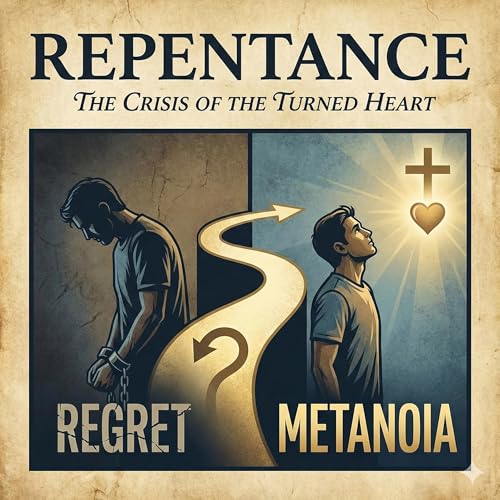
  • Is repentance just "feeling sorry," or is it something more?
    Feb 8 2026

    In this deep dive, we explore the "Doctrine of Repentance"—the fulcrum upon which the Christian life balances. We analyze how this vital concept has historically swung between two dangerous extremes: the legalistic rigor of "doing penance" and the modern reduction of "easy believism."

    Drawing from biblical exegesis and historical theology, we unpack the true meaning of the Hebrew shuv (to turn) and the Greek metanoia (a change of mind), contrasting them with the destructive force of mere regret (metamelomai).

    Key topics covered in this episode:

    • The Anatomy of Turning: Why emotion (nacham) is the precursor to repentance, but not repentance itself.

    • Judas vs. Peter: The critical difference between worldly grief that leads to death and godly grief that leads to salvation.

    • Pastoral Pathology: How the doctrine of repentance is weaponized in spiritual abuse and high-control groups.

    • Guilt vs. Shame vs. Moral Injury: Why telling a shame-ridden or morally injured person to "just repent" can be spiritually damaging.

    • Reconstructing the Practice: Moving beyond the "Sinner’s Prayer" toward a robust culture of corporate confession and covenantal allegiance.

    Join us as we navigate the "Golden Mean" of biblical repentance—a radical, grace-empowered turning that leads to salvation without regret.

    Mehr anzeigen Weniger anzeigen
    38 Min.
  • The Rise & Fall of New Calvinism: Why the "Young, Restless, and Reformed" Fractured
    Feb 8 2026

    What happened to the "Young, Restless, and Reformed"? For two decades, New Calvinism dominated the evangelical landscape, fueled by the internet, massive conferences like T4G, and a hunger for serious theology. But today, the coalition has fractured.

    This episode offers a sociological and theological autopsy of the movement. We discuss:

    • The Vacuum: Why Gen X and Millennials fled "cool" Christianity for the "Frozen Chosen".

    • The Architecture: How the movement prioritized "Gospel-Centered" unity over Confessional robustness, and why that eventually led to its undoing.

    • The Culture: The problem of "Free Agent" Christians, celebrity pastors, and the displacement of the local church.

    • The End: From the fall of Mark Driscoll to the "woke" wars—tracing the timeline of fragmentation.

    Join us as we ask: Did the YRR movement succeed in recovering the "full gospel," or did it leave us with a library of books but a legacy of broken institutions?

    Sources referenced:

    • "The Unfinished Reformation" Report

    • Analysis of the "Young, Restless, and Reformed"

    • Critiques of "Theological Triage" and Parachurch ministries

    Mehr anzeigen Weniger anzeigen
    41 Min.
  • How Reformed Theology Built a Habitable System
    Feb 5 2026

    Is systematic theology merely a dry catalog of abstract propositions, or is it something more dynamic? In this episode, we explore the concept of "architectonic" theology—the idea that doctrine possesses form, space, and structural integrity designed to create a spiritual dwelling for the church.We trace the structural evolution of Reformed theology, beginning with the definitive blueprint found in John Calvin’s Institutes, which is anchored by the "duplex cognitio"—the twofold knowledge of God the Creator and God the Redeemer. We discuss how the Reformation shifted from the "Loci Communes" (common places) method to the sophisticated "Systema" of the 17th-century scholastics, who used reason to secure the perimeter of orthodoxy.Listen in as we dismantle the 19th-century "Central Dogma" theory, which falsely claimed Reformed theology was a deterministic system deduced entirely from predestination. Finally, we examine the practical "technometry" of William Ames, who defined theology as the art of living to God, and the modern "organic" synthesis of Herman Bavinck, who viewed truth not as a machine, but as a living organism.Key Topics:The Architectonic Principle: Why theology is a "habitation" rather than a "utopia."• Calvin’s Design: The Apostles’ Creed as an external shell and the history of salvation as the internal logic.• Federal Theology: How the covenants of Works, Grace, and Redemption became the organizing scaffold of the 17th century.• Method Wars: The debate between the Analytic (ends to means) and Synthetic (causes to effects) methods.• The Organic Motif: Bavinck’s Trinitarian response to modernity.

    Mehr anzeigen Weniger anzeigen
    36 Min.
  • The Idol of Authenticity: Expressive Individualism and the Church
    Jan 30 2026

    Has the center of gravity in the church moved from Truth to Therapy?. In this episode, we dive into a socio-theological analysis of the "Therapeutic Turn" in Western Christianity. We explore how the "Psychological Man" has replaced the "Religious Man," creating a culture where doctrine is judged not by whether it is true, but by whether it feels affirming,.

    Discussion Points:

    • Moralistic Therapeutic Deism: Why sociologists identify this as the parasite colonizing the modern church, offering comfort without cost,.

    • The "Joel Osteen" Effect: How the pulpit has shifted from proclaiming "Thus saith the Lord" to offering "cotton candy theology" that ignores suffering and sin,.

    • Worship Wars: A look at how modern lyrics often mirror narcissism, focusing on "I" rather than "God," and the danger of emotional engineering in services,.

    • Digital Discipleship: How algorithms reinforce our biases and create "epistemic arrogance".

    • Reclaiming Reality: The path forward through "orthopathy" (right feeling) and "thick" communities that can withstand the spirit of the age,.

    Join us as we discuss how to abandon the idol of "feeling good" to recover the joy of "being true".

    Mehr anzeigen Weniger anzeigen
    41 Min.