Image de couverture de The Soft Rebellion Podcast

The Soft Rebellion Podcast

The Soft Rebellion Podcast

De : Flurina Thali
Écouter gratuitement

La meilleure offre de la saison | 0,99 €/mois pendant les 3 premiers mois + 15 € de crédit Audible

6,99 €/mois par la suite. Des conditions s’appliquent. Annulation mensuelle possible.
À propos de ce titre
A homecoming, a return, and a (re)discovery of the creative power of your female body. Our world uproots us from the gifts of the Feminine; the intuitive, the instinctual, the cyclical, the soft. What is the result? Patriarchal cultures of perfectionism, shame, and disconnect that leave us constantly running, never arriving. Imagine a world of women softly rebelling; claiming our cyclicity, our weirdness, and our rest as we courageously cultivate a deep and delicious relationship to our female bodies. My name is Flurina, I’m an Osteopath, dancer, writer and coach, I’ve been on my own journey sparked by an eating disorder to come home to the wild, poetic anatomy of my female body and awaken my creative power… and I invite you to join me and my guests, trailblazing teachers, healers and creatives as we each reclaim our own soft rebellion.

flurinathali.substack.comFlurina Thali
Alternative & Komplementäre Medizin Hygiene & gesundes Leben Sozialwissenschaften
épisodes
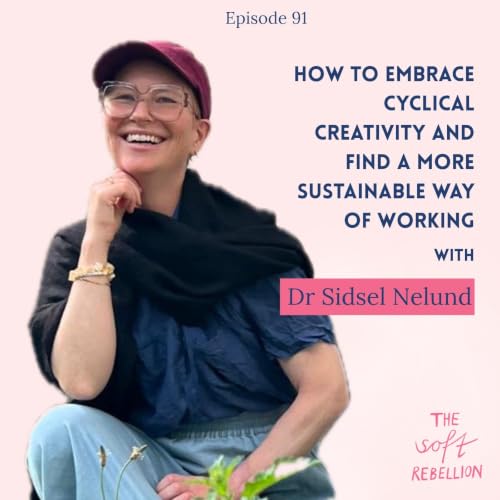
  • Ep. 91: How to Embrace Cyclical Creativity and Find a More Sustainable Way of Working.
    21 Nov 2026
    In this episode, together with my wonderful guest, Dr Sidsel Nelund, a researcher, organiser, writer, teacher and mentor with a focus on process, practice and research in contemporary art and curating, we continue weaving a softly rebellious conversation about how to navigate and harvest from all the cycles that move through us; menstrual cycles, creative-artistic cycles and the larger life cycles of the female body.Sidsel takes us on a journey through her own relationship with (menstrual) cycles and the experiences that have shaped her unique body of work at the intersection of artistic practice, research, collectivity and cyclical awareness. Together, we explore the transformative potential of rest, the courage of stepping into the unknown, and how cyclical ways of working might offer us more sustainable, caring and generative approaches to creativity.In this conversation we talked about:Growing up with permission to pause: Sidsel shares how her creative childhood, key teachers and life experiences shaped her understanding of cyclical wisdom and the importance of working with, rather than against, our natural rhythms.Illness, retreat and the transformative power of rest: How navigating critical illness led Sidsel into a profound period of retreat in nature, and why rest is not simply a privilege but can become a responsibility and a resource for transforming the things we care about.The art of working cyclically: Exploring how artistic and creative practices move through cycles of uncertainty, discovery and creation, and how cyclical awareness can offer more sustainable ways of working and living.Dream, Draft, Do, Discern: Sidsel introduces her Collective Creative Critical Care Cycle Chart, exploring its four phases and the generative potential of the centre of the cycle.The challenges of the creative cycle: Normalising the less-talked-about experiences of artistic practice, including post-production blues, rejection sensitivity and the emotional challenges of creating, while exploring how care and rest can support us through these phases.I hope you enjoy this conversation.More about Sidsel:Sidsel Nelund (PhD) is a researcher, organiser, writer, teacher and mentor with a focus on process, practice and research in contemporary art and curating. Having collaborated with artists and curators in Beirut and Santiago de Chile since the 2000s, her practice is deeply seeded with a decolonisation perspective and high context awareness. Likewise, Nelund’s practice is nourished by multiple healing modalities she has studied together with end of life-care due to several encounters with critical illness since 2016.Knowledge production in contemporary art is the focus of her PhD (2011-15), which led to an engagement with exhibition shaped civic forums for collective concerns that politicians abandon (Things in Contemporary Curating from 2023).Nelund’s engagement with organising (Head Of Young Art Workers 2011-12) and instituting (Head of Institute of Art, Writing and Research at The Royal Danish Academy of Fine Arts 2015-19) helped shape a unique organising practice between academia, cyclical process awareness and collectivity through gathering.Nelund is associate professor at PASS Center for Practice-Based Art Studies at University of Copenhagen. Here are the resources and artists Sidsel mentioned:- You can find out more about Dora Maurer`s “Seven Twists” here- You can find out more about Lygia Clark`s work “Bichos” here and retrospective at Neue Nationalgalerie here- You can buy Sidsel`s book Things In Contemporary Curating: The Aesthetics of the Right to Assemble and the Need to Withdraw here- You can find out more about the Artistic research residency Testing Ground on fear in artistic cycles at Art Hub Copenhagen here and here. ---🌟 Join my softly rebellious on Substack - subscribe here.🌟 Book a Holistic Pelvic Care session with me in person in London or online, find out more here.---💛 The Soft Rebellion Podcast is created and hosted by Flurina Dominique Thali. I love hearing from you. To contact me, email softrebellion@flurinathali.com.---Credits:- Intro/outro music – ‘Hymn for Jim’ by Aspyrian: Robin Porter – saxophone, Jack Gillen – guitar, Matt Parkinson – drums, composed by Robin Porter, listen to the full track here, graphic: Annina Thali, for more information click here This is a public episode. If you would like to discuss this with other subscribers or get access to bonus episodes, visit flurinathali.substack.com
    afficher plus Afficher moins
    1 h et 30 min
  • Dr Bee Hugh on Menstrual Art, Embodied Knowledge & Living Beyond Binaries.
    17 Oct 2026

    Dearest Listener,

    I hope this message finds you well - in good health and spirit and that you are able to enjoy this gorgeous and heart-warming autumn sun today!

    I am sending you a new podcast episode. In this conversation, I’m joined by Dr Bee Hughes (they/them), an interdisciplinary artist and researcher and Senior Lecturer in Media, Culture, Communication at Liverpool John Moores University, to explore how art can make visible the diverse, complex, and often overlooked experiences of menstruation.

    Bee shares the unexpected journey that led from a PhD in illustration education to menstrual art, including their durational artwork Cycles, and reflects on how working with their menstrual body shaped their understanding of gender and non-binary identity. Together, we explore embodied knowledge, the power of creative practice, and how menstrual art can challenge stigma, question social norms, and open up new possibilities for understanding menstruation beyond conventional narratives.

    A conversation about staying curious, embracing complexity, and allowing our bodies and creative practices to change us.

    In this episode, we explore:

    * What menstrual art is and why it matters

    * The relationship between the menstrual cycle, creativity, and embodied knowledge

    * Menstruation, gender identity, and living beyond binaries

    * Why unfinished, cyclical creative practices can challenge ideas of productivity and success

    I hope you enjoy this conversation and I am looking forward hearing from you!

    BIG LOVE,

    Flurina


    This is a public episode. If you would like to discuss this with other subscribers or get access to bonus episodes, visit flurinathali.substack.com
    afficher plus Afficher moins
    1 h et 11 min
  • Ep. 89: Cycles, Loops & Embodied Knowledge: What Unravels When We Linger – Franzi Böhm
    19 Sep 2026

    In this conversation, we follow loops and cycles: menstrual cycles, breath cycles, artistic processes, patterns we inherit, and the things that begin to unravel when we stay with discomfort rather than rushing to resolve it.

    I’m joined by scholar, artist, musician and dancer Franziska Böhm, whose practice moves between sound, movement, somatics and embodied knowledge. To record this episode with Franzi felt like a dance – between inner relating and outer responding – instantly and continuously diving deeper into what it means to linger with what cannot yet be explained, and how the body can become a site of listening, knowing and creating.

    Together we explored:

    - Franzi’s story from studying classical music and music pedagogy in Germany, the latter which opened a world of new possibilities, and eventually led her to the UK to study an MA in Creative Practice, where she encountered movement practices that have continued to reshape how she understands making, knowing, and being.

    - We spend time diving into Franzi`s recent doctoral research all about loops and looping: not simply as repetition, but as a phenomenon and a way of generating knowledge.

    - Franzi speaks about her relationship to the menstrual cycle and cycles more broadly within her artistic practice, and about Skinner Releasing Technique – “a rigorous yet playful practice” that taught her to let processes unfold in their own way and to practice being with that wordless territory where something can be sensed before it can be named.

    - We continue exploring (my favourite) question - what does it mean to know through the body? And what might embodied knowledge-making ask of us when we recognise the fact that our bodies are always already racialised and politicised?

    - And then there is the breath: its constant filling and emptying, its cycles, its relationship to voice. We explore why breath and voice cannot be separated, how the voice can become a way of accessing movement, and how Franzi approaches “the voice as connective tissue”.

    - We invite you to lean back, sense of your weight, notice your own breath and enjoy this conversation about cycles, stigma, discomfort and what we internalise - and about what can begin to move when we give ourselves permission to stay with what we don't yet have words for.

    More about Franziska:

    Franziska (she/her) is a German-born, London-based artist and researcher working across dance, music, academia and hospitality. Continuously saying no to prescribed capitalist pathways of life has made her realise her values around slowing down, sensing, trusting and collaboration. This has led her to study and investigate modalities such as Skinner Releasing Technique and other movement practices for their capacity to help us sense into ourselves, each other, the environment and beyond. She is particularly interested in politicised somatics, exploring how we can apply these modalities to intentionally cultivate power in ourselves, in our communities and how doing the repair work can allow us to choose living our lives soulfully and experience collective transformation.

    Her methodology is collaborative, intuition based and about giving space to each other and to how the work unfolds. Her work often takes the form of interconnected pieces – albums, performances, and installations. Themes of lament run through her work, exploring vulnerability, connection, and the experience of breath and voice. More recently her research extends into the shared ground between pre-semantic bodily knowledge and machine learning, currently developing through a workshop series and new work with technologist Fiona Thendean as part of her fellowship at machinaloci space, London UK.

    Webpage: https://boehmfranziska.com/

    Instagram: https://www.instagram.com/franziskaboehm__/


    This is a public episode. If you would like to discuss this with other subscribers or get access to bonus episodes, visit flurinathali.substack.com
    afficher plus Afficher moins
    1 h et 18 min
adbl_web_anon_alc_button_suppression_t1
Aucune critique pour le moment