The Levant Files Titelbild

The Levant Files

The Levant Files

Von: The Levant Files
Jetzt kostenlos hören, ohne Abo

The Levant Files (TLF) launches as a trilingual new analytical platform focused on Eastern Mediterranean affairs, offering nuanced insights beyond traditional reporting. TLF launches a groundbreaking experiment powered by the next generation of Gemini AI. With cutting-edge features like Audio Overviews, Gemini enables us to transform content into engaging podcast-style conversations. Our mission is to bring you captivating topics from various areas every week. Let's deep dive then! www.thelevantfiles.orgThe Levant Files Politik & Regierungen
  • Twilight of the Peacock Throne: The Final Hours of the Iranian Shahdom
    Jun 4 2026

    In this episode of the Levant Files Deep Dive, we zoom in on the final, agonizing hours of the Iranian Shahdom. For twenty-five centuries, the Persian monarchy stood as an enduring symbol of imperial authority. Yet, in the winter of 1979, this ancient institution unraveled with astonishing speed, culminating in a dramatic countdown that reshaped the global geopolitical landscape.

    We trace the final 1,000 hours of the regime, a period defined by systemic paralysis, desperate political compromises, and the ultimate evaporation of state authority. The narrative takes us from the quiet, tense corridors of Niavaran Palace to the snow-slicked tarmac of Mehrabad Airport on January 16, 1979. Here, we witness the departing Shah, physically weakened and politically isolated, handing the keys of a struggling kingdom to Shapur Bakhtiar—a prime minister whose authority existed largely on paper.

    This episode deconstructs the mechanisms of this rapid collapse. We explore how a highly sophisticated military apparatus of 400,000 men became completely immobilized, and how the psychological barrier of fear, which had sustained the throne for decades, dissolved in the streets of Tehran. It is a study of the final moments when the complex machinery of absolute power suddenly lost its leverage, leaving behind an empty palace and a transformed nation.

    Listeners can catch up with this new episode on Spotify or the preferred podcast platform of their choice.

    Mehr anzeigen Weniger anzeigen
    30 Min.
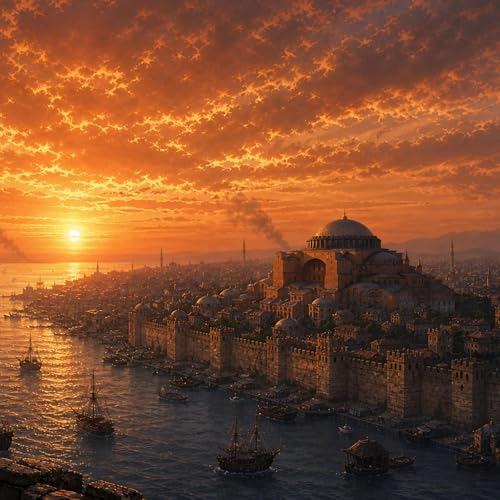
  • SPECIAL EPISODE: The Last Sunrise of Byzantium: How 1453 Reshaped the World
    May 29 2026

    On the night of May 28, 1453, the light of an eleven-hundred-year-old empire began to fade. Inside Constantinople, a coalition of Greek defenders and Italian volunteers prepared for a final stand against Sultan Mehmed II’s massive Ottoman army. This was not merely a battle for a city, but the collision of two eras.


    For centuries, the triple-layered Theodosian Walls were deemed impregnable. However, they faced a new reality: early modern gunpowder warfare. Orban's massive bronze super-cannon systematically fractured the stone defenses, while Ottoman forces executed the remarkable feat of dragging seventy warships overland to bypass the harbor's defensive chain.


    The city’s defense, coordinated by the Genoese commander Giovanni Giustiniani, held for seven weeks. But in the pre-dawn hours of May 29, fortune shifted. Giustiniani was gravely wounded and evacuated. Simultaneously, Ottoman scouts discovered the Kerkoporta—a minor tactical sally port left unlocked in the chaos.


    Realizing the city was lost, Emperor Constantine XI cast aside his imperial robes, choosing to die fighting in the breaches as an ordinary soldier.


    The fall of Constantinople marked the symbolic end of the Middle Ages. As Greek scholars fled westward with ancient manuscripts, they helped lay the intellectual foundations of the Renaissance. Meanwhile, the closure of traditional eastern trade routes compelled European powers to look toward the Atlantic, triggering the Age of Exploration.


    Artwork: Perplexity


    Catch up with the latest Levant Files Deep Dive episode on Spotify or your preferred podcast platform.

    Mehr anzeigen Weniger anzeigen
    47 Min.
  • Sands of Fire: Mali’s Existential Crisis and the Sahel-Levant Terror Arc
    May 2 2026

    Mali, once heralded as a beacon of democratic stability in West Africa, now stands on the precipice of total collapse. In the early hours of April 25, 2026, the sounds of war shattered the silence of Bamako as suicide car bombs and coordinated assault teams struck six major cities. By dawn, the country’s Defence Minister, General Sadio Camara, was dead—assassinated in his own home—and the military junta led by Colonel Assimi Goïta was plunged into its gravest security crisis to date. This offensive, a joint operation between al-Qaeda affiliate JNIM and the Tuareg-led Azawad Liberation Front (FLA), has effectively dismantled years of precarious security gains and discarded the remains of the 2015 Algiers Peace Accords.

    The fall of Kidal, a symbolic northern stronghold, marks a humiliating retreat for Russia’s Africa Corps, proving that Moscow’s model of trading military muscle for mineral access is failing its existential test. The human cost is staggering; thousands have fled into Mauritania, joining a generation of children raised in tents who have never known home. But this is not merely a regional African disaster. Analysts warn of a "Sahel-Levant Terror Arc," where weapons, tactics, and ideological direction flow along a corridor stretching from the Iraqi-Syrian border through Libya and into the Sahel. JNIM’s ability to besiege a capital of four million people serves as a dangerous "proof-of-concept" for global jihadist nodes in the Levant and beyond. As governance dissolves, Mali has become the world’s deadliest theatre of jihadist violence.

    You can catch up with the new Deep Dive episode on Spotify or your preferable podcast platform.


    Bibliography


    Haney, Antoine, and Carter M. Nicholson, eds. Conflict Zones: Syria and Mali. New York: Nova Science Publishers, Inc., 2013.


    Heusch, Luc, Yves Person, John Middleton, Jan Jansen, and Sheila Walker. History of Mali. Mauritius: Alphascript Publishing, 2011.


    The Levant Files. "IMPORTANT: Mali Erupts as Coordinated Jihadist Assault Echoes Across the Sahel-Levant Terror Arc." April 25, 2026.


    The Levant Files. "IMPORTANT: Mali Reels After Coordinated Jihadist–Separatist Offensive; Tuareg Rebels Claim Kidal." April 26, 2026.


    The Levant Files. "IMPORTANT [WITH THE LATEST DEVELOPMENTS]: Mali Junta in Crisis as Defence Minister Killed and Northern City Falls to Rebels." April 26, 2026.


    The Levant Files*. "ONLY IN TLF: Mali On The Brink. A Nation Under Siege And The Echoes Felt Across The Broader Middle East." 2026.


    The Levant Files. "Russia's African Gamble Crumbles: Mali Junta Loses Kidal as Africa Corps Retreats." April 28, 2026.


    The Levant Files*. "The Arc of Instability: From the Sahel to the Horn, the Levant's Southern Borders in Flames." November 06, 2025.


    Venter, Al J. Al-Qaeda in the Islamic Maghreb: Shadow of Terror over the Sahel from 2007. Barnsley, South Yorkshire: Pen & Sword Military, 2018.

    Mehr anzeigen Weniger anzeigen
    56 Min.
adbl_web_anon_alc_button_suppression_t1
Noch keine Rezensionen vorhanden