The Elusive pod - Behind the Roast Titelbild

The Elusive pod - Behind the Roast

The Elusive pod - Behind the Roast

Von: Elusive Coffee
Jetzt kostenlos hören, ohne Abo

Über diesen Titel

Ever wondered what really happens between the farm and your cup? Host George—alongside a couple of quick-witted AI companions—lifts the lid on every step of the journey. Each fortnight we crack open the roaster drum, spotlight the growers and importers who make specialty coffee possible, and taste our way through the latest drops before they hit the shelf. Expect first-crack science, flavour-note storytelling, rapid-fire brew tips, and plenty of nerd-level insights for anyone chasing a better brew. Pull up a chair, grab your favourite mug, and join us Behind the Roast.Copyright 2025 All rights reserved. Ökonomie
  • The Pursuit of Clarity: A Sensory and Technical Guide to Understanding and Tasting Coffee
    Jul 19 2025
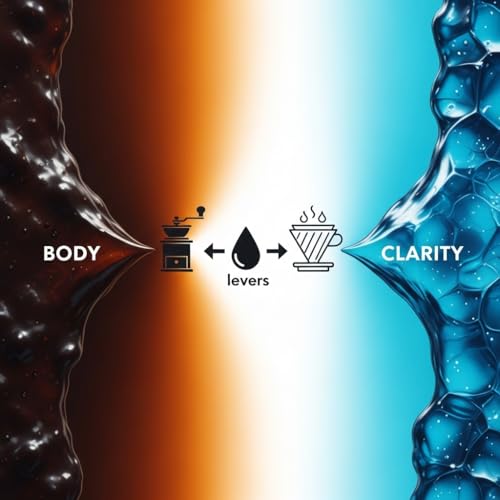
    In this episode, we unpack Clarity, a prized yet often misunderstood attribute of coffee. You'll discover its dual nature: physical clarity, referring to the visual lightness and clean mouthfeel of the brew, and sensory clarity, also known as flavour separation, which is your ability to distinctly identify individual flavour notes like citrus or florals without them blurring together. We explain the fundamental Clarity-Body Spectrum, revealing how these two dimensions are inversely related and shaped by your brewing choices. We also make a crucial distinction between clarity and a 'Clean Cup', demonstrating how a coffee must first be free of defects before its positive attributes can truly shine. Learn how factors from bean processing and roast level to grind consistency, water chemistry, and brewing technique all act as levers you can pull to influence the clarity of your final cup. Finally, we guide you through practical exercises for palate development, including comparative tastings and intentional daily habits, empowering you to actively perceive and control clarity in your coffee. Shift from passively drinking to actively tasting and brewing with purpose.
    Mehr anzeigen Weniger anzeigen
    31 Min.
  • The Liquid Gold: Mastering Coffee Water
    Jul 18 2025
    Unlock the ultimate secret to extraordinary coffee: water. This podcast dives deep into the unseen 98% of your brew, revealing it as the fundamental medium of extraction that dictates the potential and defines the limits of your final cup. Even the most exceptional beans cannot overcome the constraints imposed by chemically unsuitable water. We begin by deconstructing brewing water, explaining that it's far more than just hydrogen and oxygen; it's a complex solution of dissolved minerals, salts, and other compounds. While some elements like chlorine are undesirable and must be removed, others are essential for extraction. The science of coffee brewing water primarily revolves around two key groups of dissolved minerals: hardness and alkalinity. An imbalance in either can lead to disappointing results, from weak and sour to dull, chalky, or bitter coffee. The goal is not the "purest" water, but the optimal water—a carefully balanced solution for complete and balanced extraction. Next, we explore the hardness ions: calcium and magnesium, which are the primary engines of flavour extraction. These positively charged ions bond with negatively charged flavour molecules, pulling them from the coffee grounds into the water. Without sufficient hardness, water lacks the chemical "grip" needed to extract the full spectrum of flavors. While often grouped together, calcium and magnesium play distinct and complementary roles in shaping coffee's sensory profile: Calcium (Ca2+): The architect of body and sweetness. It creates a fuller, creamier mouthfeel and enhances the perception of sweetness. It particularly accentuates red, pink, and purple fruit notes. However, excessive calcium can lead to a heavy, dull, or chalky brew.Magnesium (Mg2+): The catalyst for brightness and complexity. It accentuates citrus, tropical, and stone fruit flavours. Magnesium elevates perceived acidity in a positive way, creating a lively and crisp quality. Too much magnesium can introduce bitterness, a salty taste, or a dry sensation. The ratio of magnesium to calcium is crucial; two water samples with the same General Hardness (GH) can produce vastly different coffees if their Mg/Ca ratio varies. This allows brewers to "sculpt" the water's extractive properties, for instance, using higher-magnesium water for bright, citrusy coffees or higher-calcium water for those with deep fruit sweetness and body. Then, we delve into the acidity regulator: alkalinity (bicarbonate buffer), which acts as the steering and braking system for extraction. Alkalinity measures water's capacity to neutralise acid, primarily through bicarbonate ions. Coffee is naturally acidic, and these ions temper its intensity, preventing an excessively sharp or sour final cup. Many experts consider alkalinity the single most important factor for water chemistry's effect on taste. Insufficient alkalinity: Results in an unpleasantly sharp, sour, and thin-bodied cup.Excessive alkalinity: Over-neutralises desirable acids, leading to a flat, dull, heavy, or chalky/muddy taste. We clarify that alkalinity is vastly more important than pH for coffee brewing, as alkalinity dictates the water's capacity to absorb and neutralise incoming coffee acids, which overwhelmingly dictate the final beverage's pH. We then define core terminology for clarity: General Hardness (GH): Concentration of calcium and magnesium, expressed in ppm as CaCO3.Carbonate Hardness (KH) / Alkalinity: Water's buffering capacity from carbonate and bicarbonate ions, regulating perceived acidity, also expressed in ppm as CaCO3.Total Dissolved Solids (TDS): Gross measurement of all dissolved substances, expressed in ppm. It is a "blunt instrument" that cannot tell you which solids are present or in what proportion.Potential Hydrogen (pH): Measures current acidity or basicity. Minimal impact on final coffee flavour compared to alkalinity. The podcast moves on to the global standard: ideal water composition according to the Specialty Coffee Association (SCA). These standards provide a "core zone" for brewers, ensuring water is clean, safe, and chemically optimised for high-quality extraction. A fundamental requirement is zero chlorine, which imparts a harsh chemical taste. We present the SCA's specific chemical targets and acceptable ranges for parameters like TDS, Total Hardness, Total Alkalinity, pH, and Sodium. The SCA standards should be viewed as a "safe and ideal brewing zone," implying that the optimal point within that range is context-dependent, varying with coffee origin, processing, roast level, and brewing method. For example, darker roasts may benefit from softer water, while lighter roasts can be balanced by harder water. We then explore method-specific water formulation, acknowledging that different brewing methods require nuanced approaches due to varying brew ratios and contact times: Pour-Over (V60 & General Filter Coffee): These percolation methods aim for flavour clarity and use a high ...
    Mehr anzeigen Weniger anzeigen
    25 Min.
  • The Art and Science of the Brew: A Deep Dive into Coffee Extraction
    Jul 17 2025

    Join us for a comprehensive exploration into the art and science of coffee extraction, designed to move you beyond simple recipes towards a fundamental understanding of your brew. We demystify controlled extraction, breaking down the three core methods: percolation, immersion, and pressure. Discover the four crucial variables – grind, water quality and temperature, coffee-to-water ratio, and contact time and agitation – that empower you to master your coffee. Learn how to diagnose your brew by taste, identifying under- or over-extraction, and explore the unique characteristics of popular brewers like the Hario V60, Kalita Wave, Chemex, French Press, AeroPress, Espresso, Moka Pot, and Cold Brew. We also guide you on how to choose the perfect brewer based on your taste preferences, coffee bean type, and lifestyle. This episode provides the toolkit you need to experiment intentionally, troubleshoot common issues, and consistently craft your ideal cup.

    Mehr anzeigen Weniger anzeigen
    35 Min.
Noch keine Rezensionen vorhanden