Folgen

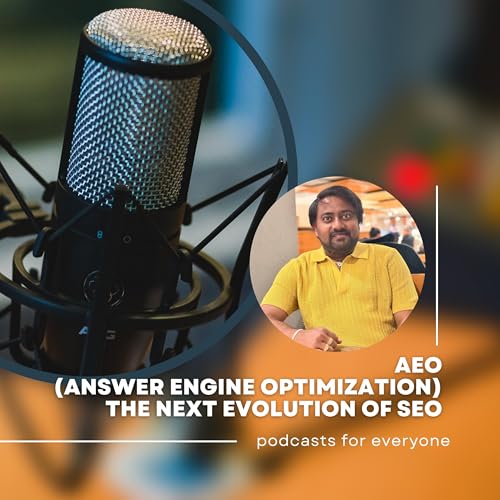
  • SEO Is Dead? No. AEO Is Taking Over
    Jan 28 2026

    Search is changing fast and most SEO strategies haven’t caught up.


    Google AI Overviews, ChatGPT, Bing Chat, Perplexity, and voice assistants no longer show ten blue links. They give one answer.


    In this video, you’ll learn:

    • What Answer Engine Optimization (AEO) really is

    • How AEO is different from traditional SEO

    • Why traffic can drop while influence and revenue grow

    • How AI decides which content becomes the answer

    • The role of schema, E-E-A-T, and question-first content

    • How AEO, SEO, and GEO work together

    • Practical steps to optimize for AI search and zero-click results


    If you’re an SEO professional, content marketer, or founder and your content isn’t showing up in AI responses, this video will show you exactly what to fix.


    Search isn’t dying.

    It’s becoming answer-first.

    Mehr anzeigen Weniger anzeigen
    15 Min.
  • GEO Explained: How to Optimize for ChatGPT, Google Gemini & AI Search (Beyond SEO)
    Jan 25 2026

    Search has changed — and most marketers haven’t noticed yet.


    Users are no longer clicking through search results.

    They’re asking ChatGPT, Google Gemini, and Perplexity… and getting instant answers.


    So the real question is:

    When AI answers, does it mention your brand?


    In this video, I break down Generative Engine Optimization (GEO) — the next evolution of SEO — and explain how to optimize your content so AI systems retrieve, trust, and cite it inside generated answers.


    You’ll learn:

    • What GEO is and how it differs from traditional SEO

    • How ChatGPT, Google Gemini, and Perplexity actually source answers

    • Why rankings alone are no longer enough

    • Content structures AI engines prefer

    • Practical GEO tactics you can apply immediately

    • The biggest mistakes marketers make with AI search


    This video is for SEO professionals, content marketers, founders, and product leaders who want to stay visible in an AI-first search world.


    If SEO drives clicks, GEO drives citations.


    Watch till the end to future-proof your search strategy.


    #GEO #GenerativeEngineOptimization #SEO #AISEO #AIsearch #ChatGPT #GoogleGemini #PerplexityAI #DigitalMarketing #ContentStrategy #SearchMarketing #FutureOfSearch

    Mehr anzeigen Weniger anzeigen
    15 Min.
  • How to Identify High-Impact AI Opportunities in SaaS Products (Product Strategy Guide)
    Jan 22 2026

    Most SaaS products fail with AI not because the models are weak, but because the problems are poorly chosen.


    In this video, I break down a clear, product-led framework to identify where AI actually adds value in SaaS products. You’ll learn how to audit your product workflows, spot high-impact AI use cases, and avoid building AI features that look impressive but don’t move real metrics.


    We’ll cover:

    • How to find AI opportunities by studying user workflows

    • Repetitive and data-heavy tasks that are perfect for AI

    • Using AI for personalization and recommendations

    • Turning product data into predictive insights like churn and forecasting

    • When to build AI-native features like assistants or chatbots

    • How to validate AI ideas quickly with prototypes


    If you’re a product manager, SaaS founder, or product leader thinking about AI, this video will help you focus on the right problems before writing a single line of code.

    Mehr anzeigen Weniger anzeigen
    15 Min.
  • The Role of the AI Product Manager: Skills, Mindset, and Responsibilities
    Jan 17 2026

    AI Product Management is not just traditional PM work with AI added on top. It’s a fundamentally different way of building products.


    In this video, we break down the real role of an AI Product Manager and what aspiring PMs need to succeed in this space. You’ll learn how AI PMs define the right problems, work with data scientists and ML engineers, interpret model performance, and take responsibility for ethics, bias, and data quality.


    We’ll also cover the mindset shift required to move from feature-driven roadmaps to outcome-driven, data-informed decision making. If you’re coming from product management, engineering, analytics, or even digital marketing and want to move into AI product roles, this video will give you a clear and practical starting point.


    By the end, you’ll understand:

    • How AI Product Management differs from traditional PM roles

    • The core responsibilities of an AI PM

    • The key skills and technical literacy you need without coding

    • Why ethics and trust are product decisions

    • How to prepare for an AI PM career


    This is a must-watch for anyone serious about building products with AI.


    #AIProductManager #AIProductManagement #ProductManagement #AICareers #MachineLearning #ResponsibleAI #TechCareers #DataDrivenProducts

    Mehr anzeigen Weniger anzeigen
    16 Min.
  • AI for Product Managers: Foundations You Must Understand (No Coding Required)
    Jan 6 2026

    AI is no longer a future bet. It’s already shaping search, recommendations, support, pricing, and content across products we use every day.


    The mistake many PMs make is thinking they need to become data scientists. They don’t. What they do need is a clear mental model of how AI creates value and where it can fail.


    Here’s the foundation every product manager should have 👇


    1. AI vs Machine Learning

    Artificial Intelligence is the broader goal: systems that simulate human intelligence.

    Machine Learning is one of the main ways we get there by training models on data instead of hard-coding rules.


    Think: AI is the destination. ML is the engine.


    2. The core AI workflow

    Every AI product follows the same loop:

    Data → Model → Prediction → User Impact


    If you can’t clearly explain how your data turns into user value, your AI feature is still a demo.


    3. Training vs inference

    Training is where models learn from historical data. It’s slow, expensive, and mostly invisible.

    Inference is where models make predictions on new inputs. That’s what users experience.


    PMs need to care about both, even if users only see one.


    4. NLP and Computer Vision

    NLP enables products to understand and generate language: summarization, chat, ticket routing, sentiment.

    Computer Vision allows systems to interpret images and video: OCR, object detection, photo enhancement.


    These capabilities are now table stakes in many products.


    5. Generative AI changes product design

    Generative models don’t return a single “right” answer. They produce probabilistic outputs.

    This means UX, trust, evaluation, and guardrails matter more than ever.


    Designing for uncertainty is now a core PM skill.


    6. Data matters more than models

    Most AI effort goes into data collection, labeling, cleaning, and maintenance.

    Strong data beats sophisticated models every time.


    7. Why AI initiatives fail

    Not because the model is bad.

    But due to fragmented data, unrealistic expectations, missing talent, and poor product framing.


    The PM’s real role in AI

    Define the right problem.

    Understand data constraints.

    Translate model outputs into user value.

    Set realistic expectations.

    Build trust into the experience.


    You don’t need to code to lead AI products well.

    You need strong foundations and clear thinking.


    #ArtificialIntelligence #MachineLearning #ProductManagement #AIProductManagement #GenerativeAI #TechLeadership #ProductStrategy #DataDriven #PMInsights

    Mehr anzeigen Weniger anzeigen
    11 Min.
  • Introduction to AI in Product Management: Transform Your Product Strategy
    Dec 29 2025

    Discover how AI is reshaping the world of product management. In this video, we explore the fundamentals of AI in PM, including how it enhances decision-making, improves product roadmaps, and drives better customer experiences. Whether you’re a product manager or an aspiring one, learn how to integrate AI tools into your workflow and stay ahead in the rapidly evolving tech landscape.


    #ProductManagement #AIinPM #ArtificialIntelligence #ProductStrategy #TechInnovation #ProductManager #AIForBusiness #DigitalTransformation #PMTools #FutureOfWork

    Mehr anzeigen Weniger anzeigen
    16 Min.
  • Feature-by-Release Roadmaps Done Right
    Dec 10 2025

    Most roadmaps drown teams in dates, assumptions, and wishful thinking. A Feature-by-Release roadmap takes a different route. It gives structure, predictability, and a realistic view of what’s coming without pretending every detail is locked in stone.


    In B2B environments, where customers depend on timelines to plan their own workflows, this format works especially well. It tells stakeholders what to expect, why it matters, and how releases connect to business goals.


    The heart of a Feature-by-Release roadmap is simple. Each release groups a set of meaningful customer outcomes. No clutter. No noise. Just a clear picture of progress.


    It also forces alignment. When engineering, marketing, design, sales, and support see the upcoming releases mapped in this way, they understand what’s coming and prepare accordingly. Marketing can shape messaging, sales can position upcoming value, customer teams can forecast questions, and engineering can sequence work with fewer surprises.


    This format keeps priorities honest. When you plan by release instead of endless backlogs, tough decisions surface early. You can’t hide low-impact features. You can’t push everything as “high priority.” The roadmap becomes a truth-telling tool instead of a political battlefield.


    Another advantage: it’s easier for customers and executives to absorb. Releases are familiar. They reflect how users experience the product. They also let you frame progress as a series of value drops instead of one giant undefined future.


    Just remember, even this structure needs flexibility. Market shifts, customer feedback, and experiments may reshape releases. That’s fine. A Feature-by-Release roadmap guides you without freezing your strategy.


    When you build it well, you get faster alignment, clearer communication, a calmer engineering team, stronger stakeholder trust, and a product narrative that makes sense to both internal teams and external buyers.


    A roadmap isn’t a contract. It’s a communication tool. Feature-by-Release is the format that keeps teams moving together.

    Mehr anzeigen Weniger anzeigen
    14 Min.
  • Agile Roadmaps for B2B Product Managers: The Ultimate Guide to Alignment, OKRs, and GTM Strategy
    Nov 21 2025

    If you’re a B2B Product Manager or Product Marketer, this video breaks down exactly how advanced teams build Agile Roadmaps that actually work.


    Most roadmaps fail because they’re treated like rigid timelines and feature lists.

    Great teams do the opposite — they use agile roadmapping as a living strategic tool that aligns product vision, OKRs, engineering execution, and go-to-market plans.


    In this video, you’ll learn:

    • Why outcome-driven roadmaps outperform feature-driven ones

    • How to use a simple Now / Next / Later structure

    • The smartest way to align stakeholders across sales, engineering, marketing, and leadership

    • How to integrate OKRs directly into your roadmap

    • How to sync product plans with GTM and cross-functional launch timelines

    • Practical examples from real B2B product workflows


    Whether you’re scaling a SaaS platform, launching enterprise features, or managing complex B2B roadmaps, this guide helps you build clarity, alignment, and momentum across your organization.

    Mehr anzeigen Weniger anzeigen
    15 Min.