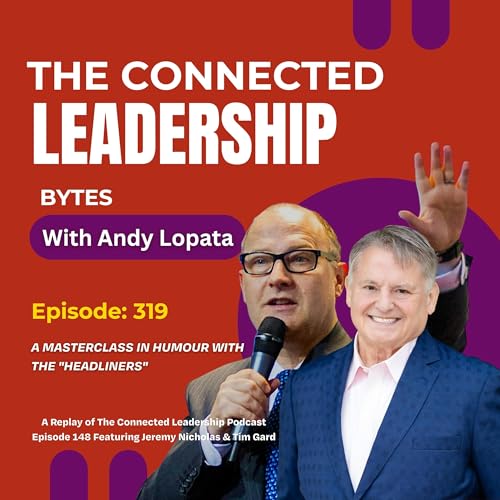
The Connected Leadership Podcast Titelbild

The Connected Leadership Podcast

The Connected Leadership Podcast

Von: Evergreen Podcasts
Jetzt kostenlos hören, ohne Abo

Über diesen Titel

Speaker and author on professional relationships, Andy Lopata, explores great connections with experts and high achievers worldwide.Andy Lopata, H & A Lopata ltd 2020 Erfolg im Beruf Management & Leadership Ökonomie
  • The Leader's Job is the Easy Part with Anna Wardley
    Feb 23 2026
    What does it take to swim across the world’s most dangerous stretches of water with no wetsuit? For record-breaking endurance swimmer Anna Wardley, the answer isn’t just physical grit—it’s the power of her invisible team. In this week's episode of Connected Leadership Bytes, Andy Lopata revisits his episode with Anna Wardley, who went from being a novice swimmer in her 30s to conquering the English Channel, the Strait of Gibraltar, and much more. She shares the harrowing story of her first Channel attempt, which ended in failure and a hypothermic trip to the hospital, and the powerful leadership lessons she learned from it. This is a masterclass in building and leading a high-stakes team. Anna reveals that her success isn't made in the water; it's forged in the months of meticulous planning by a team of experts she trusts with her life. Discover the "rules of engagement" for making life-or-death decisions, the psychology of pushing past your limits, and why the leader's job is sometimes the "easy part." Key Takeaways from This Episode What is the harrowing story of Anna's first Channel swim failure, and what crucial lesson did she only learn after being rushed to the hospital? Why does Anna say her part—swimming for 26+ hours—is "magnificently straightforward" compared to the complex work of her support team? What is the one non-negotiable rule her team follows before making the life-or-death decision to pull her from the water? How does Anna use the negative comments from doubters as a powerful source of motivation in her darkest moments? Actionable Insights Build Your Specialist Team: Realise that your success as a leader depends on the experts you surround yourself with. Like Anna, whose team includes meteorologists and marine logistics specialists, identify the critical skills your mission requires and rally the best people you can find. Your job is to inspire the mission, not to be an expert in everything. Establish "Rules of Engagement" Before a Crisis: Define clear lines of command and decision-making authority with your team before you're in a high-pressure situation. Knowing exactly who makes the final call and under what circumstances builds absolute trust and eliminates confusion when seconds count. Embrace the "No Plan B" Mindset: For high-stakes challenges, a "no room for doubt" attitude can be your greatest asset. Anna believes that entering a challenge with the possibility of failure in mind makes it almost certain. As a leader, fully committing to the goal without an escape route can be the key to pushing through a difficult period. SELECTED LINKS FROM THE EPISODE Connect with Andy Lopata: Website | Instagram | LinkedIn | X/Twitter | YouTube Connect with Anna Wardley: Website | LinkedIn | Facebook The Financial Times Guide to Mentoring Episode 159 Featuring Anna Wardley
    Mehr anzeigen Weniger anzeigen
    23 Min.
  • Welcome to The Nowhere Office with Julia Hobsbawn OBE
    Feb 16 2026
    The battle over the office is raging. Leaders like Elon Musk and Alan Sugar are demanding a full return, calling remote workers lazy. But are they fighting a losing battle against the biggest shift in work in 100 years? In this episode from the archive, Andy Lopata revisits his conversation with author and thinker Julia Hobsbawm OBE about her game-changing concept: "The Nowhere Office." This isn't an argument for no office, but a radical rethinking of why we gather. Julia dismantles the myth of presenteeism, exposing the pre-pandemic workplace as deeply dysfunctional and unproductive. She argues that leaders must move beyond their "passion for presenteeism" and embrace a new, flexible reality. Discover the three new, essential purposes of the physical office and learn how leaders can navigate this moment of "ultra-transparency" to build a more trusting and high-performing culture. The future of work is here. Are you ready? What You will Learn From This Episode What is the real, psychological reason so many leaders are desperate to force everyone back to the office (and why is it based on a broken model)? What shocking percentage of time were employees actually productive when they were in the office full-time? What are the only three things you should be using your physical office for in the "Nowhere Office" era? How has remote work offered an unexpected refuge from the daily microaggressions of the traditional commute and office environment? 3 Actionable Insights Challenge Your "Passion for Presenteeism": Before mandating a return to the office, ask yourself: "What is the work, and where and how does it need to be done?" Shift your focus from watching people work to trusting them to deliver results, and question whether your desire for an in-person workforce is based on tradition rather than strategy. Redefine Your Office as a Destination: Repurpose your physical workspace for specific, high-value activities. Intentionally schedule in-person time for the three key pillars: informal social networking, collaborative learning (including mentoring), and critical face-to-face meetings like conflict resolution. Embrace Customisation Over Mandates: Move beyond a rigid "3 days in, 2 days out" policy. Acknowledge that your team has diverse needs (introverts/extroverts, different home setups) and work towards a "fully customised" approach. Start open conversations about what works for the individual and the team to build a culture of genuine flexibility and trust. SELECTED LINKS FROM THE EPISODE Connect with Andy Lopata: Website | Instagram | LinkedIn | X/Twitter | YouTube Connect with Julia Hobsbawn OBE: Website |X Formerly Twitter | The Financial Times Guide to Mentoring Episode 158 Featuring Julia Hobsbawn OBE
    Mehr anzeigen Weniger anzeigen
    22 Min.
  • A Masterclass in Humour with the "Headliners" Jeremy Nicholas & Tim Gard
    Feb 9 2026
    What happens when a joke bombs in the boardroom? In this episode from the archives on humour, Andy Lopata brings in the headliners: two of the world's funniest keynote speakers, Jeremy Nicholas from the UK and Tim Gard from the US. This isn't just about telling jokes; it's a masterclass in the strategic use of humour to enhance leadership. Discover why the most successful leaders aren't afraid to be playful, how humour can defuse conflict and reduce stress, and why the most memorable lessons are wrapped in laughter. From their fascinating and unconventional journeys—from a BBC newsdesk and a US welfare office to the global stage—Jeremy and Tim reveal their secrets. Learn how to navigate today's sensitive culture without causing offence, what to do in the terrifying moment a joke falls flat, and why your sense of humour might be the most powerful tool in your leadership toolbox. Key Takeaways From This Episode What is the "punch up, never punch down" filter, and why is it the golden rule for using humour in today's corporate culture? Are the funniest leaders extroverts? The answer from a former BBC broadcaster and self-proclaimed introvert will surprise you. What should you do in the terrifying moment your joke falls completely flat in front of an important audience? Why did one of the world's top humourists turn down a career in stand-up comedy because of a very simple, physical aversion? 3 Actionable Insights Embrace Playfulness, Not Punchlines: You don't have to be a comedian to use humour. Start by being more playful. Go slightly "off-piste" in conversations and meetings. Use a light-hearted aside or a self-deprecating comment. This releases endorphins, makes you more memorable, and builds rapport without the pressure of telling a formal joke. Turn Stress into Material: The next time you're in a frustrating situation—a delayed flight, a tech mishap—reframe it in your mind as "material." As Jeremy Nicholas says, "It's much cheaper than having an analyst." This mental shift not only reduces your own stress but also gives you a relatable story to share that builds connection with your team. Create a Humour First-Aid Kit: Identify a few videos, skits, or memories that are guaranteed to make you laugh. When you're feeling stressed or overwhelmed, use them intentionally to break the negative pattern. As Tim Gard explains, using humour for yourself is a vital stress-reduction tool that renews your energy and perspective. SELECTED LINKS FROM THE EPISODE Connect with Andy Lopata: Website | Instagram | LinkedIn | X/Twitter | YouTube Connect with Jeremy Nicholas: Website |LinkedIn | Connect with Tim Gard: Website |LinkedIn | The Financial Times Guide to Mentoring Episode Featuring Jeremy Nicholas and Tim Gard
    Mehr anzeigen Weniger anzeigen
    25 Min.
Noch keine Rezensionen vorhanden