The Big Experiment Titelbild

The Big Experiment

The Big Experiment

Von: Mark Davison
Jetzt kostenlos hören, ohne Abo

Nur 0,99 € pro Monat für die ersten 3 Monate

Danach 9.95 € pro Monat. Bedingungen gelten.

Über diesen Titel

Ever wondered how technology start-ups, well, start-up? For most founder entrepreneurs, it is the biggest experiment they'll ever run. Like most experiments, the result isn't known beforehand and it often doesn't work first time. On a bigger scale, how do big tech companies turn innovative science into profit?

Mark Davison interviews founder scientists, executives, investors, communicators, and others in the technology start-up and corporate science ecosystems.

Learn how great ideas turned into thriving businesses (or not) from those who made it happen (or didn't). Get business tips, lessons learned, and life lessons straight from the people who know.

Inspiring, disastrous, funny: hear what life in a science-driven company is really like.

Straight-talking, no nonsense, but conversational style. All technical content is explained for the non-specialist - you don't need a PhD or fluency in jargon and technobabble.

© 2025 The Big Experiment
Management & Leadership Wissenschaft Ökonomie
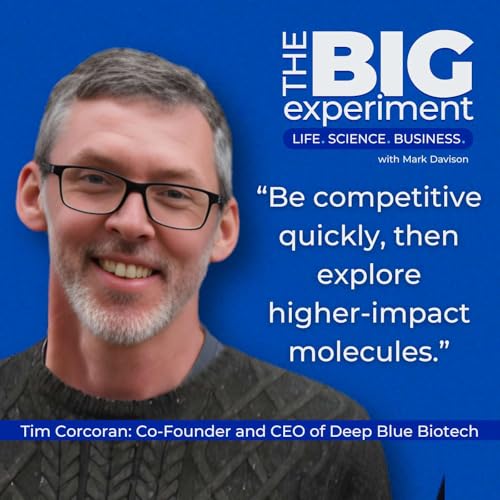
  • Tim Corcoran: Cosmetics from Cyanobacteria
    Nov 10 2025

    Is the answer to sustainable chemical manufacturing floating in our oceans?

    Ocean cyanobacteria, like plants, use sunlight as power to help them make complex chemicals. Traditional industrial chemistry requires a lot of power and can be quite polluting. Cyanobacteria are actually more efficient at producing high-value chemicals, while capturing carbon dioxide rather than releasing it.

    In this episode I am joined by Tim Corcoran, Founder and CEO at Deep Blue Biotech, who's proving this remarkable claim with a novel approach. His company produces hyaluronic acid, a premium skincare ingredient, using nothing but CO2, sunlight, and seawater-based nutrients. For every tonne produced, approximately 7 tonnes of CO2 are captured. Ingredient costs drop by 50%, and it creates the world's first "ocean-derived" hyaluronic acid, which personal care companies are eager to market.

    Beyond the compelling science, Tim reveals the strategic thinking that sets Deep Blue apart from failed synthetic biology startups. Rather than chasing commodity markets and competing on price and sustainability, they targeted expensive products first to prove their technology works and generate revenue quickly. We explore the practical realities of photobioreactor design, genetic engineering challenges, and scaling from 5-litre lab batches to 100,000-litre industrial facilities.

    This venture extends beyond skincare. By starting with high-value products, Deep Blue is building toward their ultimate goal: producing butanol biofuels that could transform Europe's automotive industry while avoiding the land-use competition that plagues ethanol production.

    " Start with something expensive, be competitive quickly, then explore higher-impact molecules.." – Tim Corcoran

    You'll Hear About

    • Fast-growing ocean cyanobacteria discovered near Singapore
    • Why expensive hyaluronic acid beat commodity biofuels
    • Photobioreactors: growing bacteria with light and CO2
    • Genetic engineering to optimize microbial metabolism
    • 50% cost reduction plus 7 tonnes CO2 captured
    • Scaling from lab to 1,000 litres in Portugal
    • Technology licensing instead of manufacturing company
    • Personal care's lower regulatory barriers versus pharma
    • Managing runway while raising £3-4 million seed round
    • £25 million Series A for commercial-scale production
    • Future applications: butanol biofuels for European cars
    • Portugal versus Iceland for photobioreactor facilities


    Connect with Tim Corcoran

    LinkedIn - https://www.linkedin.com/in/tim-corcoran-5b10121/

    Website - https://deepbluebiotech.com/


    Connect with me:

    LinkedIn: https://www.linkedin.com/in/markdavison100/

    If you need any lab equipment:

    Grant Instruments: https://www.grantinstruments.com/

    Grant Instruments on LinkedIn: https://www.linkedin.com/company/grant-instruments-cambridge-ltd/


    Produced by Between Tracks - https://www.betweentracks.com/

    Mehr anzeigen Weniger anzeigen
    34 Min.
  • From Jellyfish to Wound Healing with Dr Andrew Mearns-Spragg
    Oct 12 2025

    What if the solution to chronic wound healing has been floating in our oceans for 600 million years?

    Jellyfish collagen isn't just different from the cow and pig-derived materials used in medicine today. It's actually better at healing human tissue.

    I sit down with Dr Andrew Mearns-Spragg, Founder and Chief Scientific Officer at Jellagen, who's proving this remarkable claim with hard data. His research shows jellyfish collagen outperforms traditional materials in vocal fold repair, triggers faster transitions from inflammation to healing, and creates longer-lasting tissue structure. The secret lies in what Andrew calls "collagen type zero," an evolutionarily ancient form that our bodies recognise differently, prompting superior healing responses without the prolonged inflammatory reactions seen with mammalian sources.

    Beyond the compelling science, Andrew reveals how he built the world's first ISO-certified medical device manufacturing plant for jellyfish collagen from scratch. We explore the practical realities of sustainable harvesting (achieving near-zero bycatch), navigating FDA regulations for an entirely novel biomaterial, and convincing investors to back marine biotechnology.

    This venture extends beyond the laboratory. By harvesting jellyfish blooms caused by overfishing, Jellagen addresses an ecological problem while creating advanced wound care solutions and providing alternative income for local fishing communities struggling with depleted fish stocks.

    "The jellyfish collagen transition to healing was much quicker and longer lasting." - Dr Andrew Mearns-Spragg

    You'll Hear About

    • Why jellyfish collagen outperforms mammalian collagen in tissue healing
    • The challenges of building ISO-certified jellyfish manufacturing
    • How ancient collagen triggers better immune responses
    • Sustainable harvesting methods with near-zero bycatch
    • Translating marine biology research into medical devices
    • The cost of chronic wound management in healthcare
    • Navigating the FDA regulatory pathway for novel biomaterials
    • Supporting local fishing communities through jellyfish harvesting
    • From angel investment to medical device commercialization
    • Platform opportunities beyond wound healing applications

    Connect with Dr Andrew Mearns-Spragg


    LinkedIn - https://www.linkedin.com/in/andrew-m-006bb41/

    Website - https://jellagen.co.uk/


    Connect with me:


    LinkedIn: https://www.linkedin.com/in/markdavison100/

    If you need any lab equipment:

    Grant Instruments: https://www.grantinstruments.com/

    Grant Instruments on LinkedIn: https://www.linkedin.com/company/grant-instruments-cambridge-ltd/

    Mehr anzeigen Weniger anzeigen
    38 Min.
  • Jenny Barnett: New tests and drugs for schizophrenia
    Aug 10 2025

    Can neuroscience finally catch up with the complexity of mental illness?

    Society faces a huge and growing burden from mental illness and impairment. Schizophrenia, for example, is a bigger socioeconomic burden than all cancers put together.

    We have medicines for some of these conditions, but typically they work well for some, not at all for many, and cause side-effects for others. One of medicine's greatest challenges has been identifying exactly which patients will benefit from a treatment before they even start their pills.

    In this episode I am joined by Jenny Barnett, neuroscientist and CEO of Monument Therapeutics, to explore one of the most pressing challenges in modern medicine: how to develop truly effective treatments for complex, multi-factorial mental health conditions like schizophrenia and cognitive impairment.

    Jenny shares the work they are doing on neuroscience drug development, revealing how Monument Therapeutics is using cognitive tests and precision psychiatry to target pharmaceutical treatments more effectively.

    She explains why the current "one-size-fits-all" model of psychiatric medication is failing patients, and how a diagnostic-therapeutic approach could transform lives and health systems alike.

    We discuss the state of funding for the research, clinical trial challenges and bottlenecks, and the urgent economic and social need for accessible mental health solutions.

    Don't miss this fascinating glimpse into the next frontier of neuroscience.


    “Schizophrenia costs society more than all cancers put together.” – Jenny Barnett

    You’ll hear about:

    ● How digital biomarkers are revolutionising psychiatric drug development and patient selection

    ● Why current mental health medications only work for one-third of patients

    ● The groundbreaking computer-based tests that rats and humans can both perform

    ● How Monument Therapeutics is targeting cognitive impairment in schizophrenia patients

    ● The staggering economic impact of mental health disorders on society

    ● Why precision psychiatry could catch up neuroscience to cancer treatment advances

    Connect with Jenny Barnett

    LinkedIn - https://www.linkedin.com/in/jenny-barnett-4b035826/

    Website - https://monumenttx.com/

    Connect with me:

    LinkedIn: https://www.linkedin.com/in/markdavison100/

    If you need any lab equipment:

    Grant Instruments: https://www.grantinstruments.com/

    Grant Instruments on LinkedIn: https://www.linkedin.com/company/grant-instruments-cambridge-ltd/

    Mehr anzeigen Weniger anzeigen
    39 Min.
Noch keine Rezensionen vorhanden