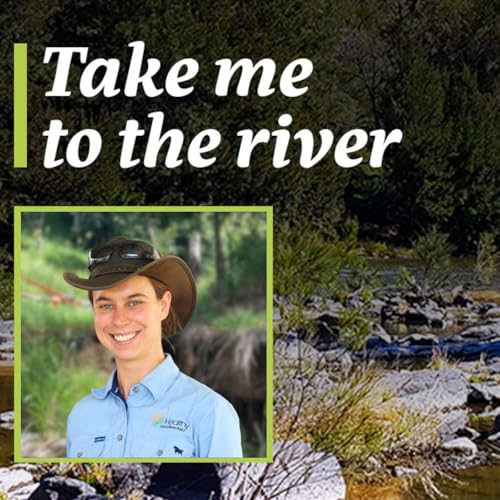
Take me to the River Titelbild

Take me to the River

Take me to the River

Von: Siwan Lovett
Jetzt kostenlos hören, ohne Abo

Über diesen Titel

Join social ecologist and river restoration expert Dr. Siwan Lovett in conversations about the ideas, issues and opportunities that relate to our connections with nature and each other. This podcast offers open, honest and practical insights for us to reflect on in our daily lives.

© 2025 The Australian River Restoration Centre
Beziehungen Sozialwissenschaften Wissenschaft
  • The Art of Healing Rivers: Kirstie Fryirs on Reading Rivers to Recover Them
    Oct 20 2025

    Questions, comments, feedback? Tap here to send us a message!

    In this episode of Take Me to the River, Dr. Siwan Lovett sits down with renowned fluvial geomorphologist Professor Kirstie Fryirs—co-developer of the globally adopted River Styles Framework—to explore how rivers are shaped, damaged, and healed.

    This jam-packed episode breaks down the science of river restoration through the lens of fluvial geomorphology. But what is geomorphology? As Kirstie explains, it’s all about understanding how rivers take shape — how water, mud, plants, and even animals like carp and platypus help form the way a river looks and behaves.

    To make sense of this, Kirstie co-developed the River Styles Framework, a way of identifying different types of rivers, understanding their condition, and working out how they might recover. It’s now used all over the world to help river managers speak the same language when deciding how to care for waterways.

    Kirstie challenges conventional thinking about river restoration, emphasising that knowing when NOT to intervene is just as important as knowing when to act. Through the concept of "recovery potential," she explains how each river must be treated individually with realistic expectations. In a world where rivers cannot return to pre-colonisation conditions, she shows us how to let rivers self-heal when possible.

    A pioneer for women in the waterway industry, Kirsty became the second female professor of geomorphology in Australia. She shares her remarkable career journey from studying post-colonisation river disturbance in the Bega catchment to researching heavy metal contamination in Antarctica where she experienced true silence. She discusses her innovative teaching approaches and the advice that shaped her leadership style.

    From icy Antarctic stations to the wild beauty of Tasmania's Franklin River, Kirstie's passion for rivers is infectious and you can hear it in every moment of this conversation. Whether you're a conservationist, scientist, or simply someone who loves waterways, this episode offers invaluable insight into river recovery — and the experience of being a pioneering woman in environmental science.

    If you enjoyed this episode, please consider leaving a rating and review wherever you listen to your podcasts.

    ✉️ Subscribe to our newsletter (no spam, we promise!) to keep up with new episodes of the show!
    🎙️ Listen to our other episodes: https://arrc.au/podcast/
    🌱 Learn more about the Australian River Restoration Centre: arrc.au

    Take Me to the River is an Australian River Restoration Centre podcast production, hosted by Dr. Siwan Lovett and produced by Chris Walsh, with support from the rest of the ARRC Team. ✨

    If you'd like to support the Australian River Restoration Centre and our work restoring rivers and supporting others to do the same, visit our shop for some of the best gift ideas for nature-lovers. You can also make a tax-deductible direct donation to help support our the health and resilience of our rivers 🌱

    We acknowledge and honour Aboriginal and Torres Strait Islander Peoples as the Traditional Custodians of the country on which we work, learn, and live. We respect and learn from Elders past, present and emerging, valuing their knowledge, insights and connections to the waterways we love and care for. 🖤💛❤️

    Mehr anzeigen Weniger anzeigen
    1 Std.
  • Protecting Platypuses with Josh Griffiths
    Aug 4 2025

    Questions, comments, feedback? Tap here to send us a message!

    Did you know that a nursing platypus mother must eat up to her entire body weight in food every day to support her and her young? Or that male platypuses have venomous spurs near their back legs that can cause intense pain which is immune to conventional opioid painkillers? Or did you know that technically, based on the word's greek etymology, the plural of platypus is in fact 'platypodes'? These fascinating creatures are more than beloved icons and evolutionary marvels—they're indicator species whose health reflects the condition of our waterways.

    The mysterious platypus is one of Australia's most beloved creatures, but these remarkable mammals face increasing threats. Josh Griffiths, Senior Technical Advisor at EnviroDNA and leading expert on platypuses, joins us to share his insights from 17 years studying these enigmatic mammals.

    Josh reveals the concerning pattern threatening platypus populations across southeastern Australia. While showing remarkable adaptability to modified environments, platypuses face critical challenges from reduced water flows, habitat fragmentation, and climate change. The Millennium Drought triggered population crashes from which some areas have never recovered, creating a troubling pattern of localized extinctions and genetic isolation.

    Siwan and Josh discuss environmental DNA, a tool that allows the precise detection of genetic material left behind by various species in the water. It’s non-invasive and allows for the monitoring of platypus populations on a much higher scale, while opening up opportunities for citizen science.

    There are simple actions anyone can take to protect platypuses, like conserving water, cleaning hooks, lines and snags when fishing, and keeping your dog away from platypuses. Josh emphasizes that protecting platypuses isn't just about saving a charismatic species; it's about preserving the ecological systems that sustain all life, including our own.

    Ready to become a platypus protector? Listen now to discover how you can help ensure the survival of our beloved platypodes (and their babies, called 'puggles'!) and the rivers they call home.

    If you enjoyed this episode, please consider leaving a rating and review wherever you listen to your podcasts.

    ✉️ Subscribe to our newsletter (no spam, we promise!) to keep up with new episodes of the show!
    🎙️ Listen to our other episodes: https://arrc.au/podcast/
    🌱 Learn more about the Australian River Restoration Centre: arrc.au

    Take Me to the River is an Australian River Restoration Centre podcast production, hosted by Dr. Siwan Lovett and produced by Chris Walsh, with support from the rest of the ARRC Team. ✨

    If you'd like to support the Australian River Restoration Centre and our work restoring rivers and supporting others to do the same, visit our shop for some of the best gift ideas for nature-lovers. You can also make a tax-deductible direct donation to help support our the health and resilience of our rivers 🌱

    We acknowledge and honour Aboriginal and Torres Strait Islander Peoples as the Traditional Custodians of the country on which we work, learn, and live. We respect and learn from Elders past, present and emerging, valuing their knowledge, insights and connections to the waterways we love and care for. 🖤💛❤️

    Mehr anzeigen Weniger anzeigen
    54 Min.
  • How mangroves are saving Queensland's Caboolture River, with Margie Dickson
    Jul 1 2025

    Questions, comments, feedback? Tap here to send us a message!

    In today's episode, Margie Dickson, Environmental Project Manager at Healthy Land and Water, takes us on a journey through her experience leading an innovative project on the Caboolture River which re-establishes mangroves for long-term bank stabilisation and ecosystem resilience. This effort combines her engineering expertise with nature-based solutions, including the use of hardwood logs, strategic earthworks and mangrove revegetation to combat erosion. The project is not only addressing critical environmental risks like acid sulphate soils but also exploring how nature-based solutions can serve as alternatives to traditional 'hard' engineering approaches, increasing climate resilience and creating fish habitats.

    Our favourite thing about this project, and Margie's approach, is the way she combines immediate engineering solutions with long-term ecological thinking — rather than building the concrete barriers of the past, the goal is to reinforce banks by creating stable angles, placing strategic barriers, and establishing mangrove communities that will eventually take over the protective role naturally. As Margie explains, "Vegetation is always the long-term strategy for keeping our rivers stable and keeping them healthy."

    We also explore the fascinating world of mangroves - from their unusual root systems to their vital role as nurseries for fish and habitat for endangered species like the elusive water mouse. Margie shares how these remarkable plants propagate, sending floating "propagules" (not seeds!) up and down waterways, ready to take root and transform mudflats into thriving forests.

    Margie is a civil and environmental engineer with a passion for protecting and regenerating Southeast Queensland’s waterways. She works on delivering on-ground projects that stabilise riverbanks, reduce sediment and nutrient runoff, and support healthier ecosystems and communities. Today, Margie shares the story of this fascinating project, the challenges of balancing engineering precision with ecological needs, and the importance of working with nature to protect our waterways.

    If you enjoyed this episode, please consider leaving a rating and review wherever you listen to your podcasts.

    ✉️ Subscribe to our newsletter (no spam, we promise!) to keep up with new episodes of the show!
    🎙️ Listen to our other episodes: https://arrc.au/podcast/
    🌱 Learn more about the Australian River Restoration Centre: arrc.au

    Take Me to the River is an Australian River Restoration Centre podcast production, hosted by Dr. Siwan Lovett and produced by Chris Walsh, with support from the rest of the ARRC Team. ✨

    If you'd like to support the Australian River Restoration Centre and our work restoring rivers and supporting others to do the same, visit our shop for some of the best gift ideas for nature-lovers. You can also make a tax-deductible direct donation to help support our the health and resilience of our rivers 🌱

    We acknowledge and honour Aboriginal and Torres Strait Islander Peoples as the Traditional Custodians of the country on which we work, learn, and live. We respect and learn from Elders past, present and emerging, valuing their knowledge, insights and connections to the waterways we love and care for. 🖤💛❤️

    Mehr anzeigen Weniger anzeigen
    53 Min.
Noch keine Rezensionen vorhanden