Folgen

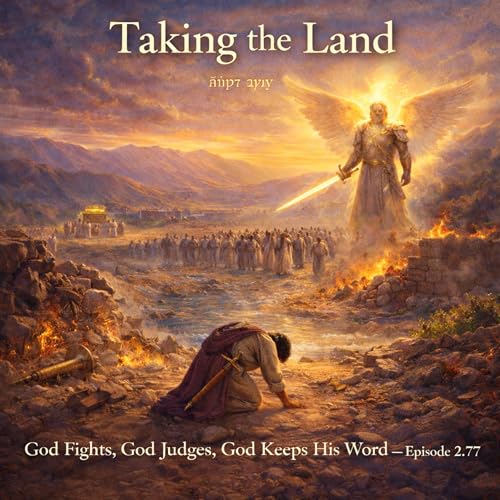
  • Joshua 4 | Taking the Land: God Fights, God Judges, God Keeps His Word
    Jan 27 2026

    Episode 2.77


    How does God give victory—and what happens when His people forget who the battle belongs to?


    In this episode, Michael and Zach walk through Joshua 5:13–12:24, the heart of Israel’s conquest of the Promised Land. Beginning with Joshua’s encounter with the Commander of the LORD’s army, the episode makes a crucial point: Joshua never wins by strategy or strength—God fights for His people.


    From the fall of Jericho to the defeat at Ai, the text shows that victory depends on obedience and dependence, not confidence or cleverness. The sin of Achan reveals the seriousness of God’s holiness and the corporate weight of covenant faithfulness. The covenant renewal at Mount Ebal reminds listeners that conquest is never separated from worship and God’s Word.


    The episode also addresses difficult questions—divine judgment, total warfare, archaeology, and the justice of God—while keeping the focus where Joshua does: Yahweh as Divine Warrior, Judge, and Promise-Keeper. Even as Israel “takes the land,” the book makes clear that the victory is partial, pointing forward to a greater rest still to come.


    Joshua isn’t about how great Israel was—it’s about how faithful God is, even when His people stumble.


    Find our videocast here: https://youtu.be/RSksvCyu3zM


    Merch here: https://take-2-podcast.printify.me/


    Music from #Uppbeat (free for Creators!):

    ⁠https://uppbeat.io/t/reakt-music/deep-stone⁠

    License code: 2QZOZ2YHZ5UTE7C8


    Find more Take 2 Theology content at http://www.take2theology.com

    Mehr anzeigen Weniger anzeigen
    45 Min.
  • What Makes Worship Music Faithful? Lyrics, Sources, and Discernment
    Jan 22 2026

    Episode 2.76


    What makes a worship song good—and who gets to decide?


    In this episode, Michael and Zach sit down with Tim Bryant, fellow elder at Charleston Bible Church and worship coordinator, to talk through a thoughtful, pastoral philosophy of worship music. Rather than debating style or preference, the conversation focuses on theological content, spiritual formation, and pastoral responsibility.


    The discussion tackles questions many churches wrestle with but rarely slow down to address clearly:

    -What actually makes a worship song good or bad?

    -Should churches sing exclusively from the Psalms?

    -Is it acceptable to sing a theologically solid song that comes from a problematic source?

    -Do church leaders have a responsibility to warn congregations about unfaithful or harmful influences behind certain music?


    Drawing from Scripture, pastoral experience, and Tim’s work in biblical counseling, this episode frames worship music not as neutral background but as teaching, shaping, and discipling content. The goal is not fear or gatekeeping, but wisdom—helping churches sing in a way that forms hearts, guards doctrine, and honors Christ.


    Tim also serves as founder and president of the Lowcountry Biblical Counseling Center (lcbcc.org), bringing a unique counseling lens to how repeated lyrics shape belief, emotion, and spiritual health.


    Find our videocast here: https://youtu.be/DoKzXExynoQ


    Merch here: https://take-2-podcast.printify.me/


    Music from #Uppbeat (free for Creators!):

    ⁠https://uppbeat.io/t/reakt-music/deep-stone⁠

    License code: 2QZOZ2YHZ5UTE7C8


    Find more Take 2 Theology content at http://www.take2theology.com

    Mehr anzeigen Weniger anzeigen
    41 Min.
  • Joshua 3 | Crossing the Jordan: Faith, Fear, and the God Who Goes Before Us
    Jan 20 2026

    Episode 2.75


    What does it really take for God’s people to step into His promises?


    In this episode, Michael and Zach walk through Joshua 1:1–5:15, tracing Israel’s crossing of the Jordan and uncovering how the text teaches faith, obedience, and remembrance. Along the way, they slow down on two pivotal moments: Rahab’s unexpected confession of Yahweh and the miraculous crossing of the Jordan at flood stage.


    Rather than reading Joshua as simple conquest history, this episode highlights the book’s theological depth. A carefully placed chiasm centers the story on Rahab’s confession—showing that faith, not ethnicity or status, marks those who belong to God. The Jordan crossing then echoes the Exodus, confirming that the same God who redeemed Israel from bondage now brings them into rest and inheritance.


    The episode also explores why God commands Israel to pause and remember—setting up memorial stones not just to defeat enemies, but to guard against forgetfulness. Before a single battle is fought, God emphasizes covenant faithfulness, dependence on His presence, and obedience rooted in trust.


    Joshua’s message is clear: victory comes not from strength or strategy, but from a people who believe God’s promises, remember His works, and follow where He leads—even when the waters are at their highest.


    Find our videocast here: https://youtu.be/MEUpus3Cu5M


    Merch here: https://take-2-podcast.printify.me/


    Music from #Uppbeat (free for Creators!):

    ⁠https://uppbeat.io/t/reakt-music/deep-stone⁠

    License code: 2QZOZ2YHZ5UTE7C8


    Find more Take 2 Theology content at http://www.take2theology.com

    Mehr anzeigen Weniger anzeigen
    37 Min.
  • I Think, Therefore I Am | Part 3
    Jan 15 2026

    Episode 2.74 (This time for real.)


    Can Descartes Escape Solipsism?


    In this episode, Michael and Zach tackle one of the most common—and serious—objections to Descartes’ project: the Thomist charge that radical doubt collapses into solipsism. If all that survives the doubt is “I am a thinking thing,” how do we ever get back to the real world, other minds, or trustworthy knowledge?


    Rather than stopping at the cogito, this conversation traces Descartes’ actual escape strategy, step by step. From the certainty of the thinking self, to contingency, to the necessity of a self-existent God, the discussion focuses on the critical move: God’s moral perfection as the foundation for epistemic trust. Without a non-deceptive God, solipsism wins. With one, Descartes claims a narrow—but real—bridge back to reality.


    Along the way, the episode weighs:

    -Why Thomists argue Descartes starts in the wrong place

    -Whether the “Cartesian Circle” is fatal or misunderstood

    -If moral perfection can legitimately follow from necessity

    -Why radical doubt is a method, not a lifestyle

    -Where the real fault line lies between Thomist and Cartesian epistemology


    The conclusion is deliberately careful: Cartesian doubt does not entail solipsism—but it risks it unless its theistic rescue succeeds. The road out is narrow, but it is not imaginary.


    Find our videocast here: https://youtu.be/khbWIDw2VcA


    Merch here: https://take-2-podcast.printify.me/


    Music from #Uppbeat (free for Creators!):

    ⁠https://uppbeat.io/t/reakt-music/deep-stone⁠

    License code: 2QZOZ2YHZ5UTE7C8


    Find more Take 2 Theology content at http://www.take2theology.com

    Mehr anzeigen Weniger anzeigen
    41 Min.
  • Joshua 2 | The Bookends of Joshua: Four Funerals That Teach Us How to Read the Book
    Jan 13 2026

    Episode 2.73


    What if the key to reading the book of Joshua isn’t the battles—but the burials?


    In this episode, Michael and Zach look at Joshua through an unexpected lens: four funerals that frame the book and quietly preach its theology. From the opening words after Moses’ death to the closing scene with Joshua, Joseph, and Eleazar laid to rest, these funerals function as bookends that teach us how to read Joshua rightly.


    Rather than a man-centered story of conquest, Joshua presents a God-centered testimony of promise, presence, and perseverance. The land is a gift from Yahweh, courage flows from His nearness, and obedience is rooted in His Word—not personal greatness. Even the final burials are not anticlimactic; they are theological monuments, planted in the promised land as physical proof that God keeps His word.


    This episode explores:

    -Why Joshua opens and closes with death—and why that matters

    -How Joshua is intentionally framed as a “new Moses,” without replacing Yahweh

    -What the burial of Joseph’s bones reveals about long-term faith and God’s patience

    -Why Israel’s unity is emphasized in moments of leadership transition

    -How the book ends with both confidence in God’s faithfulness and longing for final victory


    The book of Joshua isn’t just reporting history—it’s preaching through history. And when read this way, the funerals don’t close the story. They point forward, reminding us that God’s promises outlive His servants, and that the final rest is still ahead.


    Find our videocast here: https://youtu.be/gGFI_HUs85E


    Merch here: https://take-2-podcast.printify.me/


    Music from #Uppbeat (free for Creators!):

    ⁠https://uppbeat.io/t/reakt-music/deep-stone⁠

    License code: 2QZOZ2YHZ5UTE7C8


    Find more Take 2 Theology content at http://www.take2theology.com

    Mehr anzeigen Weniger anzeigen
    29 Min.
  • I Think, Therefore I Am | Part 2
    Jan 8 2026

    Episode 2.72


    Descartes, Doubt, and the Birth of Modern Certainty


    What can be known with absolute certainty?


    In Part 2 of I Think; Therefore I Am, Michael and Zach walk through René Descartes’ most famous move—the cogito—and why it reshaped the entire history of philosophy. Faced with the collapse of Aristotelian certainty and the rise of radical doubt, Descartes wasn’t trying to be clever. He was trying to survive an intellectual crisis.


    By doubting everything that could possibly be doubted—senses, mathematics, the external world, even his own body—Descartes discovers one truth that cannot be denied: the very act of doubt proves the existence of the doubter.


    This episode explores:


    -Why Descartes adopted methodological doubt in the first place

    -What the cogito actually claims—and what it carefully avoids claiming

    -Why “I think, therefore I am” is not a syllogism, but an immediate insight

    -How the cogito becomes the foundation for clarity, certainty, and reason

    -How this moment launches modern philosophy and reshapes the God-question


    Far from being a throwaway slogan, the cogito marks a turning point: the shift from inherited authority to subject-centered certainty. Whether you admire Descartes or see his move as the beginning of philosophical trouble, understanding the cogito is essential for understanding the modern world—and the questions it still can’t escape.


    Find our videocast here: https://youtu.be/9sCu1pq-2HE


    Merch here: https://take-2-podcast.printify.me/


    Music from #Uppbeat (free for Creators!):

    ⁠https://uppbeat.io/t/reakt-music/deep-stone⁠

    License code: 2QZOZ2YHZ5UTE7C8


    Find more Take 2 Theology content at http://www.take2theology.com

    Mehr anzeigen Weniger anzeigen
    33 Min.
  • Joshua 1 | Not Just History — A Prophetic Story of Promise, Obedience, and Rest
    Jan 6 2026

    Episode 2.71


    When most people think of the book of Joshua, they think of battles, land allotments, and famous lines like “Be strong and courageous.” But Joshua is doing far more than recording Israel’s history.


    In this episode, Michael and Zach reframe Joshua the way the Jewish Scriptures do—not as mere history, but as prophetic theology. As the first book of the Former Prophets, Joshua isn’t just telling Israel what happened; it’s preaching what covenant faithfulness looks like when God’s people live in the land.


    The discussion explores:


    -Why Joshua belongs with the Prophets, not just the “history books”

    -How obedience to God’s Word, not military strength, drives victory

    -Why the land is a gift, not a trophy

    -The tension between promise fulfilled and promise still incomplete

    -How Joshua exposes Israel’s need for something greater than land—a new covenant and a better mediator


    From Eden to Abraham to the Promised Land, Joshua advances the Bible’s larger story of salvation while leaving us longing for final rest. The book points beyond itself—to Jesus, the greater Joshua, who brings true inheritance, lasting obedience, and eternal rest.


    Joshua isn’t just about how Israel conquered.

    It’s about what kind of God keeps His promises—and what kind of people can dwell with Him.


    Find our videocast here: https://youtu.be/Prv4M30fZvg


    Merch here: https://take-2-podcast.printify.me/


    Music from #Uppbeat (free for Creators!):

    ⁠https://uppbeat.io/t/reakt-music/deep-stone⁠

    License code: 2QZOZ2YHZ5UTE7C8


    Find more Take 2 Theology content at http://www.take2theology.com

    Mehr anzeigen Weniger anzeigen
    34 Min.
  • Crossing the Jordan: New Beginnings and the Slow Work of Grace
    Jan 1 2026

    Episode 2.70


    Every New Year feels like standing at the edge of something new. Fresh starts. New resolutions. Another chance.


    But Scripture reminds us that real change rarely comes through dramatic leaps—it comes through faithful steps.


    In this episode, Michael and Zach reflect on the biblical meaning of the Jordan River as a place of transition, renewal, and obedience. From Israel entering the Promised Land, to Elijah and Elisha, to Naaman’s healing, to Jesus’ own baptism, the Jordan marks moments where God brings His people through change, not around it.


    Using the New Year as a natural pause for reflection, the conversation explores:


    -Why we’re drawn to fresh starts

    -Why New Year’s resolutions often fail

    -How sanctification works through ordinary, repeated obedience

    -The difference between chasing goals and walking faithfully in a direction

    -Why God’s grace transforms us slowly—but surely


    This is a reminder that the Christian life isn’t about instant arrival, but steady movement—crossing the water one step at a time, trusting the God who goes with us.


    If you’re entering a new year feeling hopeful, hesitant, or worn out, this episode is an invitation to begin again—not with pressure, but with presence.


    Find our videocast here: https://youtu.be/QZKkJDKypE8


    Merch here: https://take-2-podcast.printify.me/


    Music from #Uppbeat (free for Creators!):

    ⁠https://uppbeat.io/t/reakt-music/deep-stone⁠

    License code: 2QZOZ2YHZ5UTE7C8


    Find more Take 2 Theology content at http://www.take2theology.com

    Mehr anzeigen Weniger anzeigen
    30 Min.