Surgical Ergonomics Titelbild

Surgical Ergonomics

Surgical Ergonomics

Von: Geeta Lal MD
Jetzt kostenlos hören, ohne Abo

Über diesen Titel

This podcast will discuss everything relating to surgical and procedural ergonomics i.e. the people, ideas and technology that will help enhance your physical wellness and career longevity.

© 2026 Surgical Ergonomics
Hygiene & gesundes Leben
  • Why loupes are hurting your neck and what to do about it with pediatric ophthalmologist Dr. Donny Suh
    Feb 10 2026

    This episode of the podcast is sponsored by Q-optics. You can learn about them, the special rates they are offering for podcast listerners and schedule a demo via : https://q-optics.com/pages/surgicalergonomics-drlal

    Disclosure:

    Q-optics is a paid sponsor and the affiliate link above supports the podcast at no cost to you. It also provides you with a discount and a giveaway to listeners of the podcast, so we hope that it is a win-win!

    Dr. Donny W. Suh a Professor and Chief of Pediatric Ophthalmology and the Eye Mobile Program at the University of California, Irvine. He works at UCI Gavin Herbert Eye Institute and the Children’s Hospital of Orange County (CHOC). He also volunteers with ORBIS Global Health Programs, providing medical care and training ophthalmologists in underserved regions across South America, Europe, Asia, and Africa. In addition, he is the Chair of the American Academy of Pediatrics Ophthalmology Section Membership Committee , an inductee of the American Ophthalmological Society and was awarded “Inventor of the Year” in 2019 by the University of Nebraska Medical Center.

    In this episode Dr. Suh:

    - Shares that he became interested in ergonomics about 10-15 years into his practice because he started to have MSK symptoms and noticed many colleagyes with the same due to awkward posture while operating

    - Explains that loupes are essentially telescopes and that there are 2 main types, Galilean and Keplerian. The former have a convex and concave lens and the latter contain 2 or more convex lenses. Keplerian loupes are able to provide higher magnifications but are heavy due to the higher number of lenses.

    - Elaborates on why the use of loupes is an independent risk factor for the development of work-related MSK symptoms among surgeons and dentists.

    - Clarifies that here has't been a lot of change in loupe design until very recently, with the major change being prism deflection. Other changes include lighter titanium frames, plastic lenses and strap design.

    - Discusses the difference between Galilean and Prismatic loupes. The former are limited by the extent of how deep a declination angle one can achieve. Deflection loupes are technically a subtype of Prismatic loupes but for all practical purposes, they can be considered similar.

    - Explains why Prismatic/Deflection loupes need customization (to our face and working distance) or the image will be blurred. Therefore, it is important to simulate your surgical experience when getting fitted for them.

    - Advises individuals that there are some challenges associated with using Prismatic/ Deflection loupes, such as image displacement and image distortion, and it is important to give time to get used to working with them

    You can learn about ergonomic loupes straps developed by Dr. Suh here: https://suhhermsen.com/ergonmic-loupe-strap

    You can reach Dr. Suh on Linked In and Instagram

    Follow us on LinkedIn, X, Instagram and Facebook and please reach out to us if you have any suggestions regarding episode ideas and guests or if you'd like to be a guest on the show

    Mehr anzeigen Weniger anzeigen
    48 Min.
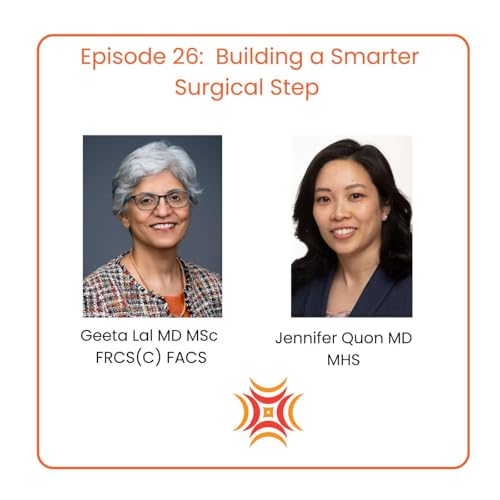
  • Building A Smarter Surgical Step with Pediatric Neurosurgeon Dr. Jennifer Quon
    Jan 26 2026

    Episode details:

    Dr. Jennifer Quon is a pediatric neurosurgeon at the Hospital for Sick Children and an Assistant Professor at the University of Toronto. She is also the Co-founder and Chief Medical Officer of Smartstep Surgical LLC. Dr. Quon completed medical school at Yale School of Medicine and neurosurgical training at Stanford Hospital. She did her pediatric neurosurgery fellowship at the Hospital for Sick Children prior to starting as faculty. Dr. Quon has broad clinical interests in pediatric neurosurgery, with expertise in skull base brain tumors, vascular disorders and fetal surgery. Her research program focuses machine learning applications in pediatric neurosurgery and neuroimaging, and surgical innovation.

    In this episode Dr. Quon:

    - Shares the challenges she faced using standing stools/steps in the operating room which in turn, inspired her ergonomics and innovation journey

    - Discusses how she started her innovation journey by thinking about what features she would want an ideal step stool to have

    - Explains that Surgistep is a motorized surgical stool/step which can adjust height in 1mm increments using a scissor-lift mechanism and allows surgeons the ability to make adjustments without asking other team members to stack steps https://www.smartstepsurgical.com/collections/surgistep

    - Elaborates on the various steps during her innovation journey i.e. background research, finding a partner familiar with devices, meeting with engineers, raising funding, getting additional partners, making a prototype and learning legal and regulatory requirements

    - Shares some of the frustrations during her innovator journey including the timelines being longer than anticipated and getting conflicting feedback to make engineering modifications

    - Describes the basics of getting funding for aspiring surgeon-innovators

    - Highlights that she is working on other safety products for the OR

    You can reach Dr. Quon directly via email: jennifer.quon@sickkids.ca

    Smart Step Surgical LLC is offering a 20% discount for listeners of the podcast which you can access here: https://www.smartstepsurgical.com/blogs/news/surgical-ergonomic-podcast-promotional-discount

    -

    Follow us on LinkedIn, X, Instagram and Facebook and please reach out to us if you have any suggestions regarding episode ideas and guests or if you'd like to be a guest on the show

    Mehr anzeigen Weniger anzeigen
    34 Min.
  • Introduction to Cognitive Ergonomics and the OR Black Box with Dr. Patricia Trbovich
    Jan 12 2026

    This episode of the podcast is sponsored by Q-optics. You can learn about them, the special rates they are offering for podcast listerners and schedule a demo via : https://q-optics.com/pages/surgicalergonomics-drlal

    Disclosure:

    Q-optics is a paid sponsor and the affiliate link above supports the podcast at no cost to you. It also provides you with a discount and a giveaway to listeners of the podcast, so we hope that it is a win-win!

    Episode details:

    Dr. Patricia Trbovich is an Associate Professor in the Institute of Health Policy, Management and Evaluation and cross appointed at the Institute of Biomedical Engineering at the University of Toronto. She holds the Badeau Family Research Chair in Patient Safety and Quality Improvement at North York General Hospital. She is the Research and Scholarship lead, Centre for Quality Improvement & Patient Safety (C-QuIPS).

    Patricia leads HumanEra, a team dedicated to enhancing healthcare safety and performance through human factors research. With over 15 years of experience, she's implemented health technologies and trained professionals worldwide. Now, she’s focused on advancing surgical safety through innovative tools such as the OR Black Box to identify safety threats to provider and patient safety, apply human factors principles to operationalize resilience, and prototype and test human factors informed interventions.

    In this episode Dr. Trbovich:

    - Shares her training background and how she arrived at her current role

    - Defines cognitive ergonomics as a branch of Human Factors that focuses on how we design systems to support the way people think, the way they make decisions and how they manage information, especially under pressure

    - Describes the consequences of not paying attention to workers' cognitive ergonomics in the OR, such as, creating conditions where they are overloaded and forced into task-switching (often mistaken for multi-tasking) which then increases the risk of errors

    - Discusses her work where her team have identified the most interrupted time for anesthesiologists (i.e. emergence) and nurses (i.e. closing counts)

    - Elaborates on the OR black box and other tools (surveys such as the NASA-Task Load Index, observations, objective measures of physiologic responses and behavior markers) that are used to study interruptions and understand work as it is done, and not as it is imagined

    - Shares Black box data is useful to look at not only safety threats but also resilience supports and psychological safety.....

    - Discusses strategies for preserving cognitive bandwidth of various team members in the OR e.g. calling out increasing cognitive load prior to it reaching a critical point, using checklists and other visual indicators and looking at how often staff are task-switching

    You can learn more about the work references in this episode in these articles:

    1) https://bmjopen.bmj.com/content/15/10/e104713.long

    2)https://journals.lww.com/annalsofsurgery/fulltext/2024/07000/using_the_operating_room_black_box_to_assess.13.aspx

    You can reach Dr. Trbovich on Linked In


    Follow us on LinkedIn, X, Instagram and Facebook and please reach out to us if you have any suggestions regarding episode ideas and guests or if you'd like to be a guest on the show

    Mehr anzeigen Weniger anzeigen
    41 Min.
Noch keine Rezensionen vorhanden