Soundwalk Titelbild

Soundwalk

Soundwalk

Von: Chad Crouch
Jetzt kostenlos hören, ohne Abo

Über diesen Titel

Soundwalk combines roving field recordings with an original musical score. Each episode introduces you to a sound-rich environment, and embarks on an immersive listening journey.

chadcrouch.substack.comChad Crouch
Musik Persönliche Entwicklung Persönlicher Erfolg
  • Dosewallips Soundwalk
    Feb 13 2026
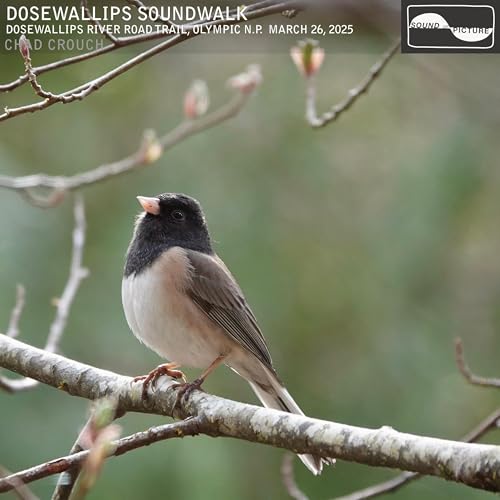
    Olympic National Park is the 8th most visited National Park in the US. About 95% of the park is roadless and designated wilderness, making it one of the most wild and undeveloped parks in the entire National Park system. Many of these most-visited parks have a significant road footprint, which makes much of their interior accessible. In contrast, Olympic National Park is largely one big wilderness, absent of roads. There are highways encircling it, and a few spur roads reaching in a few miles, but none passing through the interior. Dosewallips River Trail is the remains of one such spur road that washed out in 2002. The road reroute/repair proved too costly, and so has added to the relative inaccessibility of the canyon. When paired with the East Fork Quinault River Trail, this makes an enticing 35-mile multi-day backpack traverse through Enchanted Valley in the southern interior of the park. The Enchanted Valley offers lush old-growth rainforests, towering mountains with countless waterfalls, and an iconic chalet, nestled in an absolutely stunning valley.This soundwalk barely scratches the surface of the wilderness soundscape that awaits the visitor here, but it’s an appealing teaser. In these lower reaches, small wetlands thrive, fed by creeks coming down the mountain, making for ideal frog habitat. Trilliums burst through the resplendent mosses found here. A Great Blue Heron perches above a creek channel. The name Dosewallips derives from a Twana Indian myth about a man named Dos-wail-opsh who was turned into a mountain at the river's source. Twana is the umbrella term for nine bands of Coast Salish groups that lived around Hood Canal, the largest being the Skokomish. As with so many tribes of the Pacific Northwest, a defining conflict the Skokomish faced over the last century was the salmon fishery collapse.The ironically-named 1855 Treaty of Point No Point established a roughly 5000-acre reservation at the Skokomish River delta for the Twana bands, roughly 30 miles south of where the Dosewallips meets the Salish Sea (Hood Canal). The 1920’s-era Cushman Dam projects on the North Fork of the Skokomish not only blocked fish passage to the upper river, they also removed the water from the river, tunneled it through a mountain, and dumped it directly into Hood Canal. From 1930 to 2008 the North Fork of the Skokomish ran nearly dry. And, because lower river flows no longer flushed sediment and debris in the lower river, it caused a devastating pattern of flooding in the Skokomish valley where two-thirds of the Skokomish Reservation is within the floodplain. After decades of legal struggle, the tribe reached a settlement in 2009 with Tacoma Power that resulted in a 2010 amendment to the dam’s federal license. This restored about 40% of natural river flows and gave the tribe joint management authority. The river now has considerably more water, a salmon restoration effort is in place on the North Fork, and the delta benefits from increased flows. Still, it’s just the first step toward restoration. The Skokomish valley is still flood-prone after 80 years of sediment aggradation, and the fish passage solutions are as yet underperforming. So, what does this have to do with listening to the sounds of the Dosewallips River? For me, listening to a place just naturally arouses my curiosity. Who is making the sound? Why is it called Dosewallips? Who named it? Where are they now? What will I find upriver, downriver? How will the sound change? How has it changed over time?That the mountain, river, and tribe were named after a mythical chief who was transformed into a mountain tells us something about a worldview tied to the language, where the landscape itself is imbued with not only personhood, but ancestry. Twana people viewed the river not as a resource, the land not as property, but as a living entity, as family. Coast Salish people spoke of animals with a similar non-hierarchical framing. Salmon were seen as gift-bearing relatives.This was such a departure from the Euro-American worldview it was, and is, both hard to grasp and easy to dismiss. With the benefit of hindsight, though, it’s worth questioning how the English language encodes a worldview that can lead to short-sighted outcomes.My score for the Dosewallips soundwalk is very relaxed and minimal; just four instrument voices in all. I drew inspiration from the frog choruses. It’s unusual for me to rest on an undulating single chord arpeggio for several minutes, but that’s what felt right for “Part 7, Frog Chorus”. Now that I know a little more about the area, I’m eager to make a return. Thanks for reading and listening. Dosewallips Soundwalk is available on all music streaming services today, February 13th, 2026. This is a public episode. If you'd like to discuss this with other subscribers or get access to bonus episodes, visit chadcrouch.substack.com/subscribe
    Mehr anzeigen Weniger anzeigen
    32 Min.
  • Mt. Tabor Rain Soundwalk
    Jan 15 2026
    This is a free preview of a paid episode. To hear more, visit chadcrouch.substack.com When I first heard a radio piece about Mt. Tabor Park being awarded America’s first Urban Quiet Park I have to admit I was incredulous. Don’t get me wrong, I’m all for it, but of all the parks I visit to make field recordings in the Portland area, this one might be the most frustrating. That is, if you’re hoping to get away from anthropogenic sounds—people and their machines.It was just last October that I introduced you to Mt. Tabor (if you weren’t already acquainted.) I described it as a “island of green in a patchwork of grey.” And so it is: all 176 acres of it. The deal with mountains, though, is they only give the listener more acoustic vantage as you venture further up and in. There are few folds in the park’s contours, so getting out of earshot of boulevards pulsing with machine energy and airplanes raining down sound waves on approach to PDX, just 5 miles to the north, is nearly impossible. It’s also a well-loved, well-used park. Runners and cyclists breathe heavy scaling its slopes. People talk. On phones. It is not packed on a weekday, but it sure isn’t lonely either. All this sound energy is not a bad thing, don’t get me wrong, but why the first urban quiet park in the US? This is an exemplar?It’s all about framing isn’t it? I mean yeah, you walk up the mountain and there’s downtown looking like a diorama set against the green West Hills. It looks quiet. It seems quiet. Quiet is so slippery, so subjective. Maybe it’s the signal-to-noise ratio of the near field soundscape—of being able to key in on small sounds because the background noise is just a wash—that lends itself to the perception of quiet. When you can hear little birds, with their little bird-whisper sounds. Or rain. Yes, rain with its crowd-suppressing effect; it makes the park seem quieter. Rain and wind in the trees masks the city din. Like passing through a veil, moving through the rain can feel transportive. It sounds a sizzle on the reservoirs, a diffused and hushed drum circle played on millions of leaves. But still, the first quiet urban park in the whole of the USA? I love the sentiment, but the logic seemed imprecise. Unearned, even.And then a few weeks ago, on a Wednesday, I went up there for a walk. Something was different. The gate to one of several lanes leading to one of several parking areas was locked shut. “Park Closed to Vehicles on Wednesday” a sign read. I don’t remember this. Is this new? Then a thought occurred to me: maybe this is why it’s the first urban quiet park. Maybe it is earned. After all, cordoning off whole interior parking lots, even one day a week is sure to rankle some folks. This is what intention looks like, I thought. This is a place that, at least on Wednesdays, sounds different. Measurably quieter. It came with a cost. People can’t vroom in and out. They have to enter from the perimeter and use good old-fashioned human power to move through it. Mt. Tabor Park, I’m sorry I ever doubted you. But how long has this been going on? A while, it seems. According to a 2013 article, which references the closure policy, it’s been well over a decade; so long even the internet doesn’t know. I love it when the internet—and AI, when it’s not hallucinating— doesn’t know something. That’s when I let my fingers do the walking through the maze of research tools the Multnomah County Library provides: not quite microfiche, but as close to it as digital gets. Could the policy go back to the 1980’s? Conceivably. In a bulletin of Matters to be Considered by City Council, the Apr. 6, 1981 Oregonian references “an ordinance authorizing Parks to install 5 traffic control gates in Mt. Tabor Park” up for consideration. I found no events programmed for the park on a Wednesday thereafter, save for Audubon bird walks embarking from a perimeter entrance in 2006.If it goes back that far, what really motivated no-vehicle-Wednesdays? Was a day of peace and quiet? Wilderness-in-the-city-Wednesdays? I’d like to think so.On several spring and summer Wednesday nights, however the quiet park is jolted to life. Established in 2020, Mount Tabor Dance Community (aka MTDC or Tabor Dance) saw another role that the closure policy could lend itself to in summertime: Insulating their outdoor music-fueled events from the dense neighborhoods of SE Portland, while also minimizing potential conflicts of park users. Tracing its roots to the pandemic and dancing in chalk circles drawn for distancing, the event grew over the years to draw crowds in the hundreds. Last spring and summer MTDC started again at Mt. Tabor, then hopped around to at least five other Portland parks, making good on the motto “Portland is our dance floor.”My score for Mt. Tabor Rain Soundwalk is very gauzy: mostly languorous synth pads and drones. Electric piano only enters the instrumentation in the final third of ...
    Mehr anzeigen Weniger anzeigen
    5 Min.
  • Coastal Forest
    Jan 1 2026

    And so we start again. Happy New Year everyone!

    I picked this album to coincide with the new year because the field recording it is built on is, to me, a kind of tonic. It pulses with the sound of distant surf, wildlife, and a spring rain shower.

    Recorded on April 10th last year at Agnes Creek Open Space, a 57 acre woodland in the heart of Lincoln City, Oregon, this soundscape features the low din of the ocean, the ebullient Pacific Wren, and a very nice ensemble of Varied Thrush adding their ethereal single-note song. In the distance we hear cheerful American Robins and Song Sparrows. In time, a Purple Finch and a Douglas’ squirrel take positions in the soundstage. Mixed flocks—bushtits and Chestnut-backed Chickadees primarily—pass through. It sounds like a thriving habitat, but it was not always this way.

    The area was clear-cut in the 1960s. After that, it regenerated naturally, resulting in a very dense thicket of young conifers that became draped with invasive species. By 2000, when the city purchased the property with funds from an open space acquisition bond, it was overgrown and trash-strewn.

    In 2013 the city conducted a selective forest thinning project, which improved forest health, and provided wood chips for a new loop trail. In 2016 a ribbon cutting ceremony celebrated carved benches and a footbridge created by local groups.

    This environmental recording serves as a testament to the forces of both neglect and attention to create renewal. Yes, neglect. Don’t we all have issues we don’t tend to? We make resolutions and then fail to act on them. Sometimes that’s just a necessary step in natural rejuvenation, creating the necessary conditions for real transformation.

    My composition takes cues from the low moan of the surf, with a variety of sampled and synthesized instrument voices selected to preserve space in the higher frequencies for the wildlife.

    Coastal Forest is available under the artist name Listening Spot on all streaming platforms Friday, January 2nd, 2026. I’ve made it available here in its entirety with the idea it might be somehow useful. Thanks for reading and listening. And, again, may the promise of a fresh new year be a boon to us all!

    Thanks for reading Soundwalk! This post is public so feel free to share it.

    ps. For a deeper dive from, see also Field Report Vol 26: Nelscott by Chad Crouch available on all-but-one streaming services.


    This is a public episode. If you'd like to discuss this with other subscribers or get access to bonus episodes, visit chadcrouch.substack.com/subscribe
    Mehr anzeigen Weniger anzeigen
    38 Min.
Noch keine Rezensionen vorhanden