Ship It Weekly - DevOps, SRE, and Platform Engineering News Titelbild

Ship It Weekly - DevOps, SRE, and Platform Engineering News

Ship It Weekly - DevOps, SRE, and Platform Engineering News

Von: Teller's Tech - DevOps SRE Podcast
Jetzt kostenlos hören, ohne Abo

Nur 0,99 € pro Monat für die ersten 3 Monate

Danach 9.95 € pro Monat. Bedingungen gelten.

Über diesen Titel

Ship It Weekly is a short, practical recap of what actually matters in DevOps, SRE, and platform engineering.

Each episode, your host Brian Teller walks through the latest outages, releases, tools, and incident writeups, then translates them into “here’s what this means for your systems” instead of just reading headlines. Expect a couple of main stories with context, a quick hit of tools or releases worth bookmarking, and the occasional segment on on-call, burnout, or team culture.

This isn’t a certification prep show or a lab walkthrough. It’s aimed at people who are already working in the space and want to stay sharp without scrolling status pages and blogs all week. You’ll hear about things like cloud provider incidents, Kubernetes and platform trends, Terraform and infrastructure changes, and real postmortems that are actually worth your time.

Most episodes are 10–25 minutes, so you can catch up on the way to work or between meetings. Every now and then there will be a “special” focused on a big outage or a specific theme, but the default format is simple: what happened, why it matters, and what you might want to do about it in your own environment.

If you’re the person people DM when something is broken in prod, or you’re building the platform everyone else ships on top of, Ship It Weekly is meant to be in your rotation.

Brian Teller
Politik & Regierungen
  • curl Shuts Down Bug Bounties Due to AI Slop, AWS RDS Blue/Green Cuts Switchover Downtime to ~5 Seconds, and Amazon ECR Adds Cross-Repository Layer Sharing
    Jan 24 2026

    This week on Ship It Weekly, Brian looks at three different versions of the same problem: systems are getting faster, but human attention is still the bottleneck.

    We start with curl shutting down their bug bounty program after getting flooded with low-quality “AI slop” reports. It’s not a “security vs maintainers” story, it’s an incentives and signal-to-noise story. When the cost to generate reports goes to zero, you basically DoS the people doing triage.

    Next, AWS improved RDS Blue/Green Deployments to cut writer switchover downtime to typically ~5 seconds or less (single-region). That’s a big deal, but “fast switchover” doesn’t automatically mean “safe upgrade.” Your connection pooling, retries, and app behavior still decide whether it’s a blip or a cascade.

    Third, Amazon ECR added cross-repository layer sharing. Sounds small, but if you’ve got a lot of repos and you’re constantly rebuilding/pushing the same base layers, this can reduce storage duplication and speed up pushes in real fleets.

    Lightning round covers a practical Kubernetes clientcmd write-up, a solid “robust Helm charts” post, a traceroute-on-steroids style tool, and Docker Kanvas as another signal that vendors are trying to make “local-to-cloud” workflows feel less painful.

    We wrap with Honeycomb’s interim report on their extended EU outage, and the part that always hits hardest in long incidents: managing engineer energy and coordination over multiple days is a first-class reliability concern.

    Links from this episode

    curl bug bounties shutdown https://github.com/curl/curl/pull/20312

    RDS Blue/Green faster switchover https://aws.amazon.com/about-aws/whats-new/2026/01/amazon-rds-blue-green-deployments-reduces-downtime/

    ECR cross-repo layer sharing https://aws.amazon.com/about-aws/whats-new/2026/01/amazon-ecr-cross-repository-layer-sharing/

    Kubernetes clientcmd apiserver access https://kubernetes.io/blog/2026/01/19/clientcmd-apiserver-access/

    Building robust Helm charts https://www.willmunn.xyz/devops/helm/kubernetes/2026/01/17/building-robust-helm-charts.html

    ttl tool https://github.com/lance0/ttl

    Docker Kanvas (InfoQ) https://www.infoq.com/news/2026/01/docker-kanvas-cloud-deployment/

    Honeycomb EU interim report https://status.honeycomb.io/incidents/pjzh0mtqw3vt

    SRE Weekly issue #504 https://sreweekly.com/sre-weekly-issue-504/

    More episodes + details: https://shipitweekly.fm

    Mehr anzeigen Weniger anzeigen
    16 Min.
  • n8n Auth RCE (CVE-2026-21877), GitHub Artifact Permissions, and AWS DevOps Agent Lessons
    Jan 16 2026

    This week on Ship It Weekly, the theme is simple: the automation layer has become a control plane, and that changes how you should think about risk.

    We start with n8n’s latest critical vulnerability, CVE-2026-21877. This one is different from the unauth “Ni8mare” issue we covered in Episode 12. It’s authenticated RCE, which means the real question isn’t only “is it internet exposed,” it’s who can log in, who can create or modify workflows, and what those workflows can reach. Takeaway: treat workflow automation tools like CI systems. They run code, they hold credentials, and they can pivot into real infrastructure.

    Next is GitHub’s new fine-grained permission for artifact metadata. Small change, big least-privilege implications for Actions workflows. It’s also a good forcing function to clean up permission sprawl across repos.

    Third is AWS’s DevOps Agent story, and the best part is that it’s not hype. It’s a real look at what it takes to operationalize agents: evaluation, observability into tool calls/decisions, and control loops with brakes and approvals. Prototype is cheap. Reliability is the work.

    Lightning round: GitHub secret scanning changes that can quietly impact governance, a punchy Claude Code “guardrails aren’t guaranteed” reminder, Block’s Goose as another example of agent workflows getting productized, and OpenCode as an “agent runner” pattern worth watching if you’re experimenting locally.

    Links

    n8n CVE-2026-21877 (authenticated RCE) https://thehackernews.com/2026/01/n8n-warns-of-cvss-100-rce-vulnerability.html?m=1

    Episode 12 (n8n “Ni8mare” / CVE-2026-21858) https://www.tellerstech.com/ship-it-weekly/n8n-critical-cve-cve-2026-21858-aws-gpu-capacity-blocks-price-hike-netflix-temporal/

    GitHub: fine-grained permission for artifact metadata (GA) https://github.blog/changelog/2026-01-13-new-fine-grained-permission-for-artifact-metadata-is-now-generally-available/

    GitHub secret scanning: extended metadata auto-enabled (Feb 18) https://github.blog/changelog/2026-01-15-secret-scanning-extended-metadata-to-be-automatically-enabled-for-certain-repositories/

    Claude Code issue thread (Bedrock guardrails gap) https://github.com/anthropics/claude-code/issues/17118

    Block Goose (tutorial + sessions/context) https://block.github.io/goose/docs/tutorials/rpi https://block.github.io/goose/docs/guides/sessions/smart-context-management

    OpenCode https://opencode.ai

    More episodes + details: https://shipitweekly.fm

    Mehr anzeigen Weniger anzeigen
    12 Min.
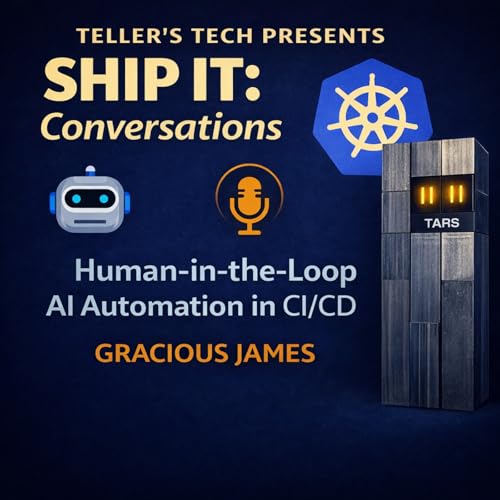
  • Ship It Conversations: Human-in-the-Loop Fixer Bots and AI Guardrails in CI/CD (with Gracious James)
    Jan 12 2026

    This is a guest conversation episode of Ship It Weekly (separate from the weekly news recaps).

    In this Ship It: Conversations episode I talk with Gracious James Eluvathingal about TARS, his “human-in-the-loop” fixer bot wired into CI/CD.

    We get into why he built it in the first place, how he stitches together n8n, GitHub, SSH, and guardrailed commands, and what it actually looks like when an AI agent helps with incident response without being allowed to nuke prod. We also dig into rollback phases, where humans stay in the loop, and why validating every LLM output before acting on it is the single most important guardrail.

    If you’re curious about AI agents in pipelines but hate the idea of a fully autonomous “ops bot,” this one is very much about the middle ground: segmenting workflows, limiting blast radius, and using agents to reduce toil instead of replace engineers.

    Gracious also walks through where he’d like to take TARS next (Terraform, infra-level decisions, more tools) and gives some solid advice for teams who want to experiment with agents in CI/CD without starting with “let’s give it root and see what happens.”

    Links from the episode:

    Gracious on LinkedIn: https://www.linkedin.com/in/gracious-james-eluvathingal

    TARS overview post: https://www.linkedin.com/posts/gracious-james-eluvathingal_aiagents-devops-automation-activity-7391064503892987904-psQ4

    If you found this useful, share it with the person on your team who’s poking at AI automation and worrying about guardrails.

    More information on our website: https://shipitweekly.fm

    Mehr anzeigen Weniger anzeigen
    22 Min.
Noch keine Rezensionen vorhanden