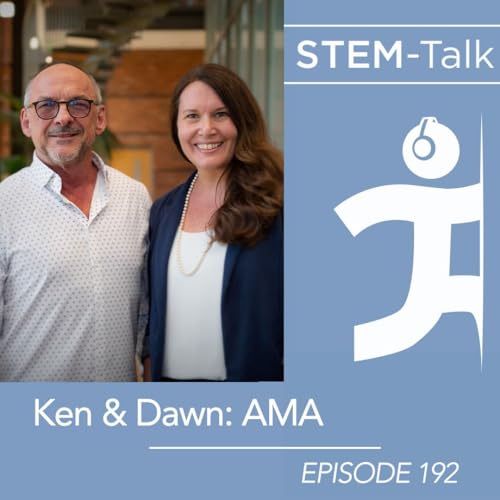
STEM-Talk Titelbild

STEM-Talk

STEM-Talk

Von: Dawn Kernagis and Ken Ford
Jetzt kostenlos hören, ohne Abo

Über diesen Titel

The most interesting people in the world of science and technologyFlorida Institute for Human and Machine Cognition Alternative & Komplementäre Medizin Hygiene & gesundes Leben Wissenschaft
  • Episode 192: Ken and Dawn weigh in on ChatGPT, ketamine, urolithin-A, rapamycin, and more in wide-ranging AMA
    Mar 5 2026
    ChatGPT has been in the news a lot lately and, as a result, quite a few STEM-Talk listeners have tossed us questions about the reliability and limitations of generative-artificial intelligence chatbots as well as large-language models more broadly. Ken and Dawn tackle this question and a number of others in today’s Ask Me Anything episode. We have listeners wondering why astronauts train in underwater conditions for spacewalks; icebreakers in antarctica; the value of supplementing with urolithin-A; and the effectiveness of L-citrulline in helping aging blood vessels. Ken also weights in on questions related to lithium deficiency and the onset of Alzheimer’s disease; a study that found mTOR activation may not be necessary for ketamine’s beneficial effects in the context of depression; and a paper that demonstrated short-term mTOR inhibition by rapamycin improved cardiac and endothelial function in older men. Show notes: [00:02:49] Ken opens our AMA with a listener question for Dawn, which asks why, despite the differences between diving and zero-gravity environments, why do astronauts train in underwater conditions for spacewalks. The listener goes on to mention an article they read about NASA’s neutral buoyancy lab in Houston, which contains a partial replica of the International Space Station. [00:07:42] A listener asks Ken if he is still optimistic about the value of supplementing with urolithin-A, and if so, is there a brand he recommends. Ken mentions episodes 118, with Julie Anderson, and 173, with Anurag Singh. Ken also discusses a paper titled “Effect of the mitophagy inducer urolithin A on age related immune decline, a randomized placebo-controlled trial” co-authored by Anurag. Ken also mentions clinical research supporting the urolithin-A supplement Mitopure. [00:10:53] A listener asks Ken about a paper titled “Short-term mTOR inhibition by rapamycin improves cardiac and endothelial function in older men: a proof-of-concept pilot study.” [00:14:29] Ken discusses a 2020 paper from a research group at Yale, which suggested that mTOR activation may not be necessary for ketamine’s beneficial effects in the context of depression. The paper also reported that m-TOR suppression via rapamycin might prolong ketamine’s antidepressant effects. [00:18:47] A research scientist formerly working in Antarctica asks Ken about Russia’s dominance in the realm of ice breakers. [00:23:55] A listener mentions that for some people, when they used ChatGPT to ask about the assassination of political commentator Charlie Kirk, ChatGPT sometimes responded by denying the assassination occurred. The listener asks Ken about the credibility and reliability of generative AI and large-language models. [00:28:49] Several listeners have submitted questions for Ken regarding a paper published in Nature in August of last year titled “Lithium deficiency in the onset of Alzheimer’s disease.” Ken gives his thoughts on this paper. [00:31:56] For our final question this AMA, a listener asks Ken about the arginine paradox, which regards L-arginine, which is used by the body to make nitric oxide, which is necessary to relax and maintain flexibility of blood vessels. However, several papers have reported that supplementation of arginine does not reliably improve aging blood vessels. In contrast, recent research suggests that L-citrulline might be more effective. The listeners sent questions asking about the possible effects of citrulline in vascular health and aging. In his answer, Ken cites the following papers: — Administration of L-arginine plus L-citrulline or L-citrulline alone successfully retarded endothelial senescence. — Effects of L-Citrulline Supplementation on Endothelial Function, Arterial Stiffness, and Blood Glucose Level in the Fasted and Acute Hyperglycemic States in Middle-Aged and Older Adults with Type 2 Diabetes. — Citrulline Supplementation Improves Microvascular Function and Muscle Strength in Middle-Aged and Older Adults with Type 2 Diabetes. — Effects of L-citrulline supplementation and watermelon intake on arterial stiffness and endothelial function in middle-aged and older adults: a systematic review and meta-analysis of randomized controlled trials. — Citrulline regulates macrophage metabolism and inflammation to counter aging in mice. If you have questions for Ken and Dawn after listening to today’s episode or any episode of STEM-Talk, please email our producer, Randy Hammer, at rhammer@ihmc.org. Links: Learn more about IHMC STEM-Talk homepage Ken Ford bio Ken Ford Wikipedia page Dawn Kernagis bio
    Mehr anzeigen Weniger anzeigen
    40 Min.
  • Episode 191: Francisco Gonzalez-Lima discusses methylene blue & noninvasive human brain stimulation
    Feb 2 2026
    Today we have Dr. Francisco Gonzalez-Lima, a behavioral neuroscientist who was our guest in episodes 106 and 107 back in 2020. Since those 2020 interviews, Francisco and his colleagues at the Gonzalez-Lima Lab have produced dozens of more studies and papers that have advanced their work on methylene blue, transcranial lasers, memory enhancement, neuroprotection and neurocognitive disorders. Francisco and his lab at the University of Texas Austin are recognized as world leaders for their research on the relationships between brain energy metabolism, memory and neurobehavioral disorders. In today’s interview, we talk to Francisco about his lab’s most recent research on the beneficial neurocognitive and emotional effects of noninvasive human brain stimulation in healthy, aging and mentally ill populations. This research primarily uses transcranial infrared laser stimulation and multimodal imaging, which we will discuss in today’s interview. Be sure to check out our earlier interviews with Francisco where he talked aobut his work on brain metabolic mapping and Alzheimer’s, episode 106, and his research into methylene blue and near-infrared light as therapies for cognitive disorders, episode 107. Show notes: [00:04:32] Dawn and Ken open our interview with Francisco by mentioning that his lab has been very productive pursuing new research avenues since he was last on STEM-Talk. Ken mentions that Francisco has recently begun collaborating with his sister who has a PhD in computational and applied mathematics and asks Francisco to talk about the work they’re doing together. [00:06:21] Dawn shifts to talk about the roadblocks that Francisco and his team have been dealing with, particularly that the review process for academic papers is unusually slow, not just for Francisco’s team but at large. Dawn asks Francisco to discuss this issue. [00:10:37] Dawn recaps that in our previous interview with Francisco in 2020, the discussion focused on his research into methylene blue, which has been primarily used to treat methemoglobinemia, however, the potential for methylene blue to treat declining cognitive function is an active area of research. Despite Francisco’s successful work with methylene blue, he often gets asked about its safety, largely due to various misconceptions. Dawn asks Francisco to talk about the misconceptions about methylene blue. [00:14:57] Ken asks if Francisco what some other misconceptions about methylene blue are. [00:20:43] Given the discussion of dosing, Ken asks Francisco what the safe dose range is for methylene blue in humans. [00:28:15] Ken mentions an article published a few months ago titled “Beyond plaques: How methylene blue and ketones address vascular hypometabolism in Alzheimer’s disease” Ken goes on to mention that the article did a good job of summarizing Francisco’s work as well as the work of Steve Cunnane, who was our guest on episode 59. Ken asks Francisco to discuss his thoughts on the article. [00:34:25] Dawn shifts focus to discuss Francisco’s work on photobiomodulation, specifically transcranial infrared laser stimulation, which is a non-invasive method for neuroprotection and cognitive enhancement. Dawn explains that Francisco has written two chapters on this topic that summarizes his work in the area, one of which appeared in the Oxford handbook on transcranial stimulation, and the other is in a book on augmentation of brain function, based on a series of presentations he gave in Switzerland. Dawn asks Francisco to give a broad overview of his work on photobiomodulation and transcranial infrared laser stimulation. [00:43:52] Ken asks Francisco to talk about a paper titled “Light buckets and laser beams” that he and other researchers composed after attending a photobiomodulation workshop convened in 2023 by the director of the National Institute on Aging and several NIH lab directors. [00:51:25] Ken asks Francisco if there are any commercially available photobiomodulation devices that he thinks have substantial utility. [00:56:27] Ken asks Francisco to discuss mitochondrial disfunction in the context of neurodegeneration and his work on targeted stimulation of the mitochondria with photo biomodulation. [01:06:58] Ken asks Francisco to talk about the potential benefits of photobiomodulation on the aging process outside of neurodegenerative conditions. [01:17:16] Dawn mentions that transcranial infrared stimulation stimulates prefrontal energy metabolism and oxygenation, which produces cognitive enhancing effects. Dawn goes on to ask Francisco about his recent paper exploring this phenomenon in the context of depression titled “Augmenting internet based cognitive behavioral therapy for major depressive disorder with transcranial infrared laser stimulation.” [01:23:08] In light of the promising results of this study, Ken asks Francisco what he sees as the next research step to further this progress. [01:30:15] Ken comments on how Francisco ...
    Mehr anzeigen Weniger anzeigen
    1 Std. und 45 Min.
  • Episode 190: Judith Curry and the Consequences of Climate Alarmism
    Jan 7 2026
    Dr. Judith Curry, a climatologist known for her criticism of alarmist, doomsday rhetoric about climate change, returns to STEM-Talk for her second appearance. Judy most recently was one of five researchers commissioned by the U.S. Department of Energy to draft a Climate Assessment Report summarizing the current state of climate science with a focus on how it relates to the United States. In this interview, Judy summarizes the climate report’s key points, including the finding that that carbon-dioxide induced warming of the planet appears to be less damaging economically than has been commonly believed. The report, which was released this past summer, also argues that aggressive mitigation strategies for carbon dioxide emissions could be more harmful than helpful. Our interview comes on the heels of the prestigious journal Nature retracting a study that predicted climate change and carbon emissions would cause catastrophic economic damage by the end of the century. Our conversation with Judy also followed an about-face from Microsoft co-founder Bill Gates, who wrote last fall that it’s time to tamp down the alarmist rhetoric that climate change will lead to humanity’s demise. Curry is president of the Climate Forecast Application Network and host of the blog, Climate Etc, which you can find at JudyCurry.com. Her blog provides a forum for climate researchers, academics and technical experts from other fields as well as citizen scientists to discuss topics related to climate science and science policy. Her research interests include hurricanes, remote sensing, atmospheric modeling, polar climates, air-sea interactions, climate models, and the use of unmanned aerial vehicles for atmospheric research. She has published more than 100 scientific papers and is the author of “Climate Change and Uncertainty: Rethinking Our Response,” a book that provides a framework for understanding and rethinking the climate-change debate. Show notes: [00:03:59] Ken opens the interview explaining that Judy was one of the five authors of a climate assessment report commissioned by the U.S. Department of Energy. Before diving into the key findings of the report and the response it has received, Ken asks Judy to explain how she became one of the five authors. [00:06:21] Ken mentions that critics of the climate working group have accused the authors of being hand-picked skeptics of the effects of climate change. Judy argues that she and her co-authors are scientists determined to get the science right. Ken asks Judy to talk about her co-authors and the working relationship of the group. [00:09:18] Ken asks Judy to talk about how she and her co-authors came to their key finding that the economic impacts of climate change are less severe than typically thought. [00:13:08] Ken asks Judy to provide examples that demonstrate how climate mitigation strategies can be more harmful than helpful. [00:16:08] Ken follows up by asking about the report’s proposal to shift climate science from alarmism to focus more on a better understanding of natural climate variability. [00:18:14] Ken asks Judy what her thoughts are on the next steps that should be taken for a better understanding climate variability. [00:20:06] Ken asks Judy to elaborate on the findings of chapter six of the report regarding global warming and extreme weather events. In particular, Ken asks about the problems with associating specific extreme weather events like hurricanes to climate change, and the issues created by the short historical records we have at our disposal. [00:24:20] Ken asks Judy to talk about chapter nine of the report, which is about the need to focus on reducing vulnerabilities in our infrastructure instead of mitigating carbon emissions. [00:28:43] Ken asks Judy to comment on the accusations that she is a “climate change denier.” [00:31:18] Ken asks Judy to talk about a paper she co-authored with her colleague Dr. Harry DeAngelo titled “A critique of apocalyptic climate narrative.” [00:36:27] Ken brings up Bill Gates’ recent about-face on climate change and the need to pivot away from doomsday views of cataclysmic climate disasters. Ken asks Judy to elaborate on what she has dubbed “climate alarmism fatigue.” [00:39:32] Ken asks Judy to give her thoughts on the issue of sea level rise, particularly in light of the pushback that the DOE report faced on this topic. He also asks her to discuss the recent paper that was released after the DOE report titled “A global perspective on local sea level changes” which proports that there is no statistically significant acceleration of the rate of sea level rise for 98% of the suitable global locations. [00:50:47] Ken points listeners to Judy’s blog, Judycurry.com, where she discusses many of these same issues. Ken goes on to explain that his perspective as well as Judy’s perspective is that climate change has become a scapegoat for many issues. He asks Judy to talk about this...
    Mehr anzeigen Weniger anzeigen
    1 Std. und 5 Min.
Noch keine Rezensionen vorhanden