Red Dirt Agronomy Podcast Titelbild

Red Dirt Agronomy Podcast

Red Dirt Agronomy Podcast

Von: Brian Arnall Ph.D. Dave Deken Josh Lofton Ph.D.
Jetzt kostenlos hören, ohne Abo

Über diesen Titel

The Red Dirt Agronomy Podcast is your source for in-depth discussions on agronomy explicitly tailored for the unique challenges and opportunities in Oklahoma and the Southern Plains. Hosted by a team of university experts, this podcast dives into soil health, crop production, pest management, and innovative farming practices, all with a regional focus. Whether you're a seasoned agronomist, a dedicated farmer, or simply passionate about agriculture in the Red Dirt region, this podcast offers practical advice, expert insights, and the latest research to help you thrive in your field. Tune in and stay connected to the heart of agronomy in the Southern Great Plains.2026 - Ag Now Media LLC Wissenschaft
  • Ask Better Questions of Your Soil - RDA 506
    Feb 17 2026
    Episode 506 dives into soil nutrition and the real-world decisions behind soil testing with Jace Whitehead of EnviroAg Laboratories, an OSU Plant & Soil Sciences grad who built a soil testing lab from his hometown roots and now supports producers across the Southern Plains. The crew breaks down what soil test “extractions” actually measure, why Mehlich-3 and Bray phosphorus numbers can disagree (especially in low pH soils), and why saturated paste is equal parts chemistry and “perfect brownie mix.” They also sort through base saturation talk, potassium response drivers, rooting depth, and why tissue test numbers can swing with weather more than soil supply.Up front, you’ll also hear a quick crop update recorded at the Oklahoma Cattle Conference: wheat and canola are starting to respond, diamondback moths are showing up in canola, and the big message for 2026 is to protect flexibility—make informed fertility calls, watch moisture conditions, and don’t spend like it’s a “maximum yield” year if the economics don’t pencil.10 TakeawaysIn 2026 economics, flexibility matters—don’t lock in every fertility decision early.Use in-rich strips and real field info to guide N rates, especially in a “cost-cutting year.”Phosphorus is the troublemaker: pH and soil chemistry can make test results look contradictory.Mehlich-3 vs Bray disagreements often come down to what chemical pools each extractant can access.If pH is low, fix that first—otherwise you can “chase P” without getting the response you expect.Saturated paste is useful for salinity/salt issues, but it’s a technique-sensitive, “art + science” test.Base saturation ratios sound appealing, but often don’t pay to chase compared to bigger constraints.Heavy clay and shallow rooting can masquerade as “cation ratio problems”—look for the real limiting factor.Potassium response may be tied to rooting zone depth/limitations more than a simple top-6-inch soil test.Tissue test numbers can swing with the environment; treat them as clues, not automatic prescriptions.Timestamped Rundown00:00:00–00:01:35 — Welcome + episode setupDave previews the topic: soil nutrition deep dive and an interview with Jace Whitehead, OSU Plant & Soil Sciences alum and soil-testing lab owner.00:01:35–00:22:44 — Crop update (recorded Feb. 13, 2026)Wheat/canola starting to respond; moisture “patchy,” with rain hopes and a reminder not to overreact early.Nitrogen timing: don’t feel forced to put “all eggs in the basket” early; use information and flexibility.Push for in-rich strips and better decision-making in a “cost-cutting year.”Pre-plant planning: soil test now for summer crops; consider partial replacement strategies on P & K if economics demand it.Canola scouting note: diamondback moth reports.Market reality check: wheat may look good but price is weak; “hot crops” might be four-legged.00:22:44–00:24:30 — Guest introductionBrian introduces Jace Whitehead and the unusual path: starting a soils lab and building sample volume through precision ag services.00:24:30–00:29:30 — Environmental testing + saturated pasteJace explains oilfield-related soil testing and salinity work; one-to-one extracts and saturated paste use cases.Brian’s saturated paste explanation: “perfect brownie mix” consistency as the endpoint.00:29:30–00:36:10 — Why phosphorus tests disagree (Mehlich vs Bray)Jace raises a producer-facing problem: Bray numbers low at low pH while Mehlich can run higher.Brian breaks down the chemistry: extractants differ in what forms they pull, and acidity complicates interpretation.Practical takeaway: address pH first; be cautious about overconfidence in a single number.00:36:10–00:40:45 — Business realities + soil trendsJace talks scale (thousands of samples/year) and why “one-off” conversations are hard to fund at low per-sample pricing.Trend discussion: rotation can drive better management attention to pH and nutrients; canola helped push rotation thinking.00:40:45–00:49:30 — Base saturation, K response, and rooting depthBase saturation & ratios: strong theory, but often weak economic payoff to chase in practice.High-magnesium soils: often a “correlation not causation” story tied to heavy clay/rooting restrictions.Big idea: we’ve over-focused on a 6-inch slice; better fertility management looks at the rooting zone and limiting layers.Tech wish list: on-the-go tools (even GPR-style concepts) to map depth/limitations.00:49:30–00:57:15 — What it means for producers + tissue testing reality“Find trusted advisors” who can handle both plant and soil chemistry questions, and keep asking questions.Tissue tests: Brian explains how nutrient concentrations can swing with weather/conditions, making blanket recs risky. RedDirtAgronomy.com
    Mehr anzeigen Weniger anzeigen
    57 Min.
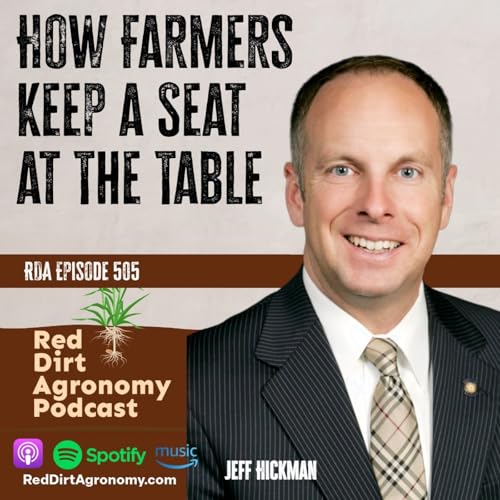
  • How Farmers Keep A Seat At The Table - RDA 505
    Feb 10 2026

    Recorded live from the Oklahoma Wheat Commission booth at the 2026 KNID AgriFest in Enid, the crew sits down with Jeff Hickman—farmer, longtime ag association leader, Oklahoma higher-education regent, and former Oklahoma House Speaker—for a grounded conversation on where agriculture is headed and why local involvement still matters.

    Jeff breaks down how ag organizations stay viable in an era of consolidation, why multiple commodity groups working together amplify agriculture’s voice, and how public policy and regulation increasingly shape day-to-day farm decisions. The discussion also hits consumer trust, social media misinformation (and how AI can muddy the waters), and why agriculture has to keep educating an audience that forgets fast.

    They close with what Jeff sees coming next—trade uncertainty, the need for a dependable farm policy, and the importance of building relationships with candidates before they’re elected. Practical, candid, and very Oklahoma.

    Ten Takeaways

    1. Ag organizations are stronger together—shared support can keep smaller groups viable and influential.
    2. Regulation is often the real battlefield, sometimes more than legislation.
    3. Fewer rural/ag lawmakers means ag has to work harder to be understood in policy rooms.
    4. Producer involvement doesn’t have to be huge—membership alone helps fund representation and benefits.
    5. Markets can disappear even after great yields, driving tough planting decisions (sorghum example).
    6. Wheat is in a strategy moment: “What’s our thing?” like corn has ethanol—new uses/value streams matter.
    7. Consumer curiosity is a double-edged sword—interest is good, misinformation is rampant.
    8. AI can accelerate fake “credible” ag narratives, raising the stakes for trusted education.
    9. Rural issues resonate when you connect the dots (health care access, metro revenue, statewide economy).
    10. Election years are relationship years—don’t wait until after someone wins to introduce agriculture.

    Detailed Timestamped Rundown

    00:00–01:44 — Episode open, setting: Oklahoma Wheat Commission booth at KNID AgriFest (Enid); introductions.
    01:45–03:35 — Jeff Hickman joins; “many hats” across OK ag organizations and higher ed.
    03:36–04:44 — Why shared management/back-office support keeps smaller ag groups viable and strengthens ag’s voice.
    04:45–06:53 — Policy reality: more dependence on public policy + regulations; increased focus on agencies/administration.
    07:03–08:52 — Jeff’s background: journalism/OU roles, media work, farm roots; “planting and harvest were my vacations.”
    09:12–12:44 — Political pendulum swings; how DC trends show up in statehouses; fewer rural/ag-connected legislators.
    12:45–15:54 — Consumer interest: good and hard; difficulty finding truth; misinformation and AI concerns; supply chain lessons.
    15:55–18:29 — Global factors hitting ag (tariffs, shipping routes, even piracy) through a real-world retail/cotton example.
    18:30–20:55 — Benefits/challenges of representing many groups; why having a strong government affairs team matters.
    21:14–23:59 — What growers are facing: crop choice risk, markets disappearing, wheat’s future “what’s our thing?”; value of membership (and CFAP example).
    24:00–27:33 — How to get more producers involved in leadership/politics; timing, family/team approach, candidate mentorship.
    28:13–32:50 — Translating rural needs for urban lawmakers (rural hospitals example); rural dollars fueling metro projects.33:26–36:31 — Next 6–9 months: trade unresolved, farm bill/farm policy stability, election-year urgency—build relationships now.
    36:32–38:11 — Wrap-up, thanks, and where to find resources.

    RedDirtAgronomy.com

    Mehr anzeigen Weniger anzeigen
    38 Min.
  • Nitrogen Know-How From A Teen Agronomist - RDA 504
    Feb 3 2026
    In this episode of the Red Dirt Agronomy Podcast, we’re joined by 16-year-old Brayden Arnall, who recently won the National FFA Agriscience Award. This episode isn’t just about a student project—it’s a story of curiosity turned passion, and a father-son bet that led to a national title. Brayden walks us through his award-winning research on nitrogen stabilizers, tillage practices, and ammonia volatilization, breaking down complex science in an engaging and relatable way. Co-hosts Dr. Brian Arnall and Dave Deken, along with guest host Dr. Paul Weckler, offer commentary on the broader impact of youth agricultural programs like FFA and 4-H in Oklahoma and beyond.Listeners will hear about Brayden's methodology, the surprising results from his controlled barn experiments, and how these findings could influence farming practices. Plus, he gives a sneak peek into his next project on winter wheat growth and irrigation. Whether you're a researcher, educator, student, or just someone who appreciates the next generation of ag leaders, this episode is packed with inspiration, science, and Oklahoma charm.Top 10 Key TakeawaysBraden Arnall won the National FFA Agriscience Fair with a project on nitrogen stabilizers and tillage.His experiment showed that no-till plots had more ammonia volatilization losses than tilled ones.Anvol was the most effective nitrogen stabilizer in reducing nitrogen loss.Braden began his agriscience journey in middle school, building on skills from 4-H.His project used controlled PVC-tube environments and ammonia detection tools.He’s now researching irrigation impacts on winter wheat and nitrogen use.Youth participation in agriscience is strong in Oklahoma, especially Stillwater.Braden’s early exposure to research is guiding his career toward agronomy.The family’s tradition of “5-minute science” helped Braden understand college-level concepts early.The episode emphasizes the value of mentorship and community in ag education.Major Discussion Timestamps00:00–00:02 – Episode setup: the “father-son bet,” Brayden’s national win, and where to find info.00:01–00:02 – Plug: upcoming recording at the Central Oklahoma Cattle Conference (Feb. 13).00:02–00:04 – On location at KNID AgriFest (Enid); Oklahoma Wheat Commission booth + the cinnamon roll/bread scene.00:04–00:07 – Brian explains the “promise” and Brayden’s path: early success, then winning nationals + spotlight presentation.00:07–00:10 – Dr. Paul Weckler joins; why Agriscience matters for STEM ag careers; what Agriscience competition is.00:10–00:11 – 4-H speaking background and why it gave Brayden confidence in FFA.00:11–00:16 – The research: nitrogen stabilizers, tilled vs no-till, ammonia volatilization + nitrate leachate; how the measurements were taken.00:16–00:18 – Age check (Brayden is 16) + “five-minute science” mentoring and learning the nitrogen cycle.00:18–00:21 – Agriscience momentum in Stillwater; youth research examples; workforce need in ag engineering/ag systems tech.00:21–00:25 – Brayden’s new project: rainfed vs irrigated winter wheat response with stabilizers; real-world Oklahoma weather challenges.00:25–00:27 – Undergrad research opportunities + how early research can feed future grad students.00:27–00:29 – Media moment: Brayden featured on “Is This a Great State or What?”00:28–00:31 – What’s next: chapter officer run, public speaking, possible land judging; speech topic See & Spray.00:30–00:32 – Dr. Weckler’s perspective: computer vision roots and how today’s tech builds on earlier work.00:30–00:32 – Staying active in both 4-H and FFA; what each teaches.00:32–00:33 – Wrap + thanks + where to connect. RedDirtAgronomy.com
    Mehr anzeigen Weniger anzeigen
    33 Min.
Noch keine Rezensionen vorhanden