Precision Medicine Made Simple Titelbild

Precision Medicine Made Simple

Precision Medicine Made Simple

Von: Taylor Cu
Jetzt kostenlos hören, ohne Abo

Über diesen Titel

Welcome to the “Precision Medicine Made Simple Podcast,” where we simplify the complex world of precision medicine. We're here to explore how personalized healthcare can empower you to understand and improve your health to live a longer and healthier life. Join us as we break down the latest in medical science into actionable insights. Let's make precision medicine accessible and actionable for everyone. Sponsored by: Biography Health, where healthcare meets personalization. With their DNAbled™ Blueprint, Biography Health empowers you with a health plan based on your unique DNA, aiming to prevent disease and extend your life. Take control of your health journey with a plan as unique as you. Visit BiographyHealth.com and start your personalized healthcare journey today.Copyright 2026 Taylor Cu Alternative & Komplementäre Medizin Hygiene & gesundes Leben
  • Surviving Cancer in a System That Wasn’t Built for You
    Feb 2 2026

    What happens when a highly motivated patient meets a healthcare system that’s… not built for patients? In this episode, Kathy Giusti joins Taylor Cu and Dr. William Stanford to break down why cancer care can feel impossible to navigate—and what patients can do to take control of decisions, timelines, and outcomes.

    Kathy shares how her diagnosis pushed her into “research mode,” how she identified the right myeloma centers before Google existed, and why personalization in cancer care is moving from “tumor type” to the underlying biology. She also gets real about trust: when patients can’t access their doctors or get answers beyond a 15-minute visit, trust erodes fast.

    Key mindset shift: being informed isn’t “being difficult”—it’s survival. As Kathy puts it, the goal is to learn how to get the best medical advice, not replace your doctor.


    Key Takeaways:

    1. How patients can build the right care team and choose specialists in a complex cancer system
    2. Why trust breaks down in healthcare and how limited access impacts patient outcomes
    3. The difference between personalized medicine and precision medicine in real-world care
    4. How genomics and epigenetics are reshaping cancer classification and treatment decisions
    5. How to use AI and digital tools to prepare for doctor visits and support shared decision-making
    6. The core ideas behind Kathy Giusti’s 12-step framework for patients and caregivers navigating cancer


    In This Episode:

    1. [00:00:00] Why patients lose trust in cancer care
    2. [00:02:12] Kathy Giusti’s diagnosis + why she turned to advocacy
    3. [00:05:54] The hardest early step: choosing the right team/center
    4. [00:07:48] Identical twin insight + transplant-era decision-making
    5. [00:09:48] Finding true specialists (and why it changes everything)
    6. [00:12:51] Epigenetics, family patterns, and future cancer classification
    7. [00:16:32] “Cure cancer” optimism vs the access reality
    8. [00:18:10] Prevention, screening, and why people still avoid action
    9. [00:21:15] Finding a great primary care doctor (and why it’s hard)
    10. [00:25:46] One system vs fragmented care: coordination wins
    11. [00:29:20] What precision medicine still gets wrong: clarity + language
    12. [00:31:20] Trust, influencers, and using your time with doctors wisely
    13. [00:36:00] Kathy’s book:...
    Mehr anzeigen Weniger anzeigen
    50 Min.
  • Sleep, HRV & Longevity: What Your Data Really Means with Dr. Mohammad Jarbou
    Dec 8 2025

    In this episode of Precision Medicine Made Simple, we continue our discussion with Dr. Mohammad Jarbou from Episode 33, where we first explored the significance of VO₂ Max testing and its role in personal health optimization. Now, we dive deeper into the importance of sleep health, heart rate variability (HRV), and the insights provided by sleep studies.

    Dr. Jarbou breaks down how HRV can be a valuable indicator of overall health and recovery, highlighting its connection to sleep quality and longevity. He also provides a closer look at mild sleep apnea, its effects on well-being, and how lifestyle interventions can help prevent the condition from progressing.

    With actionable advice on improving sleep hygiene and the science behind REM sleep rebound, this episode offers valuable insights for those looking to optimize their sleep and overall health through a precision medicine approach.

    Key Takeaways:

    • HRV reflects the balance between “fight or flight” and “rest and digest”—high HRV = good recovery.
    • High REM percentage can signal sleep deprivation, not “better sleep.”
    • Mild sleep apnea (AHI 5.6) is common and often doesn’t require CPAP in young, healthy patients.
    • Consistent sleep and wake times matter more than “making up sleep” with naps.
    • Sleep, fitness, and recovery exist in a cycle—fix one, improve the others.

    In This Episode:

    • [00:00:00] HRV explained: stress, recovery, and sleep’s role
    • [00:02:19] Taylor sets the stage: VO₂ max test and sleep study follow-up
    • [00:05:33] Home sleep study setup, devices, and first-night discomfort
    • [00:07:59] In-lab sleep studies vs home sleep tests
    • [00:10:35] 4–3–2–1 sleep hygiene rule and real-life challenges
    • [00:13:18] HRV, alcohol, and what readiness metrics can and can’t tell you
    • [00:16:44] Total sleep time: why 5–6 hours is Taylor’s “first problem”
    • [00:18:30] High REM percentage and REM rebound from sleep deprivation
    • [00:20:00] Deep sleep vs REM: what truly restores your body
    • [00:24:33] AHI, 3% vs 4% oxygen drop, and Taylor’s mild sleep apnea
    • [00:29:32] Snoring, sleeping on your back, and positional therapy
    • [00:35:42] Naps, “social jet lag,” and protecting your sleep drive
    • [00:40:28] When to repeat sleep studies and add body composition (DEXA)
    • [00:43:05] Taylor’s takeaways and next step: VO₂ max deep dive in a future episode

    Notable Quotes:

    • “REM sleep isn’t the restorative stage—deep non-REM sleep is where your body really recovers.” – Dr. Jarbou
    • “If your HRV is low in the morning, it’s often your body telling you it didn’t get the recovery it needed.” – Dr. Jarbou
    • “Most people don’t need fancy tests—they need better sleep structure and consistency.” – Dr. Jarbou
    • “Mild sleep apnea doesn’t mean treatment right away. Fix the basics first.” – Dr.
    Mehr anzeigen Weniger anzeigen
    44 Min.
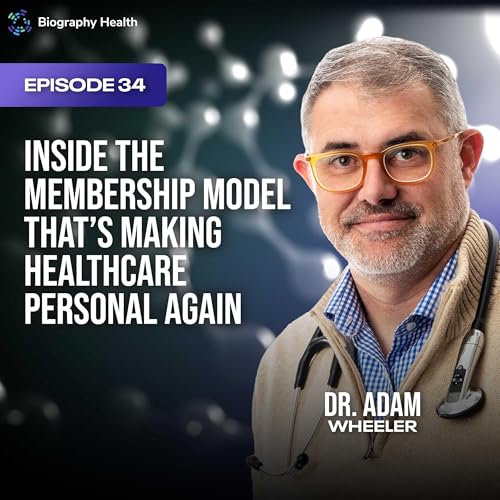
  • Inside the Membership Model That’s Making Healthcare Personal Again
    Nov 10 2025

    The traditional healthcare system is breaking under the weight of burnout, short appointments, and profit-driven incentives, and Dr. Adam Wheeler has lived it from the inside. After losing a patient and realizing that all his creative energy was going into improving metrics instead of improving lives, he decided to build something radically different.

    In this episode of Precision Medicine Made Simple, recorded live at Bigtree Medical in Columbia, Missouri, Dr. Wheeler joins host Taylor Cu and co-host Dr. William Stanford to share how he reimagined primary care from the ground up. His direct primary care network now serves more than 13,000 patients with a model built on unlimited time, transparent pricing, and authentic, patient-centered relationships.

    You’ll hear how Dr. Wheeler’s model leverages nurse practitioners to expand access, integrates genetic and metabolic testing to personalize care, and embraces patient-requested treatments such as testosterone therapy, compounded GLP-1s, IV infusions, and preventive protocols. He also discusses how AI and shared decision-making empower patients to take control of their health, creating a system that rewards outcomes instead of volume.

    This conversation explores what it truly takes to make healthcare personal again and why the future of medicine belongs to those willing to rebuild it from trust, data, and compassion.


    Key Takeaways

    • Why Dr. Wheeler walked away from the traditional insurance model
    • How the direct primary care (DPC) membership system works and why patients love it
    • The role of nurse practitioners in solving the physician shortage
    • How Bigtree trains new NPs to lead with empathy and precision
    • Why shared decision-making is critical to modern medicine
    • What peptides, testosterone therapy, and GLP-1 medications mean for personalized care
    • How AI tools are empowering, not replacing, doctors
    • Why genetic and metabolic testing helps patients “know the fight they’re fighting”
    • The real difference between health span and lifespan and how to extend both
    • What the future looks like when healthcare becomes proactive instead of reactive

    In This Episode

    • [00:00] Turning points in medicine
    • [01:17] Intro to Precision Medicine Made Simple
    • [02:39] Meet Dr. Adam Wheeler
    • [05:49] Membership model explained
    • [07:23] Bigtree care models
    • [08:19] Scaling intimacy in care
    • [08:48] Direct vs. concierge care
    • [09:51] Innovative patient care
    • [31:34] Genetics and cancer risk
    • [33:11] Personalized medicine
    • [34:06] Motivational interviewing
    • [35:11] Prostate cancer and genetics
    • [49:50] AI in healthcare
    • [53:01] AI’s role in medicine
    • [56:39] Bigtree Medical vision
    • [57:48] Final thoughts

    Notable Quotes

    • [05:43] “It’s really sad that all this creative energy is going to juicing the numbers, as opposed to taking care of people.” — Dr. Adam Wheeler
    • [05:24] “We allow our patients to leave our practice at any time. If we do a bad job, they’re supposed to leave, and if we do a good job, they stay.” — Dr. Adam Wheeler
    • [14:27] “The direct pay model absolutely changes your incentives as a doctor… it forces you to care about the things patients actually care about.” — Dr. Adam Wheeler
    • [38:21] “There’s nothing you can do about the Lp(a), but you need to really optimize all of your other numbers.”— Dr. Adam Wheeler
    • [55:19] "I think before we have AI replacing me, we're gonna have me enabled with AI." — Dr. Adam Wheeler


    Our Guest

    Dr. Adam Wheeler is a

    Mehr anzeigen Weniger anzeigen
    59 Min.
Noch keine Rezensionen vorhanden