Pages Podcast Titelbild

Pages Podcast

Pages Podcast

Von: Betty Jay
Jetzt kostenlos hören, ohne Abo

Über diesen Titel

The Pages Podcast explores the art of storytelling across every medium—books, anime, comics, TV series, and more. Our mission is to dissect the creative genius behind exceptional narratives and share insights that inspire your own creative journey. Whether you're a die-hard fiction enthusiast or a casual listener, join us as we discover new gems and translate fictional themes into powerful life lessons for everyday living. After all, "What’s the point of a story if we don’t learn anything from it?"Betty Jay Kunst
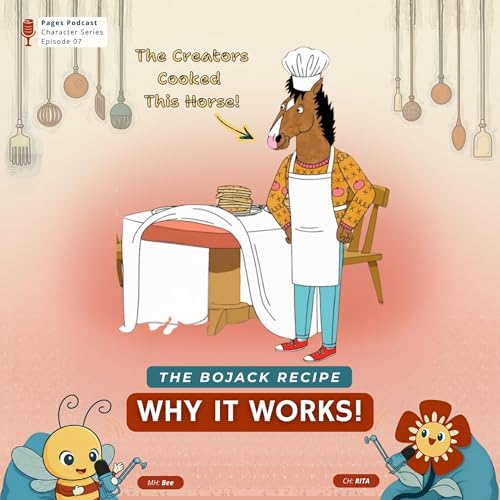
  • PART C: Character Design & Structuring | 3/3 — "The Development, Realism & Relatability Gourmet"
    Feb 25 2026

    Welcome to the finale of the Character Design saga! Betty and Rita cook up the ultimate recipe for creating characters that feel authentically human.


    RECAP

    BoJack Horseman scored a perfect 5 on the rounded character scale with 30 transformations across five major arcs. He's the quintessential dynamic character—constantly changing while staying tragically true to his broken core.


    INTRO

    Time to peel back the final layer: the eclectic secrets that make BoJack leap off the screen and into our lives. Today's menu features character development, realism, and relatability—served with the usual hilarious banter.


    PART A - Character Development: The Key Process

    Between debates about Nigerian stew recipes (Rita's simple method vs. Betty's elaborate "overcooking"), the hosts reveal a crucial insight: character development isn't an ingredient—it's the cooking process itself. Not every character needs development (SpongeBob, John Wick, Phineas and Ferb thrive without it), but rounded characters require this essential step. The literary definition: giving characters depth, personality, and motivation to feel like real, evolving individuals.


    PART B - The Character Development of BoJack Horseman

    Four development strategies revealed:

    1. Depth through complexity: living paradox, morally ambiguous, internally conflicted
    2. Motivations: wants vs needs: he wants fame and love; he neds self-acceptance and healing
    3. Evolution through arcs: vulnerable foal to defensive, cowardly stallion
    4. Emotional connection: through backstories, the iconic "free churro" monologue, and meaningful dialogue.


    PART C - Character Realism

    The big reveal: realism and relatability are results of rounded characters, not required ingredients. What makes characters feel real? Complexity, depth, transformation, consistency, meaningful arcs, and authentic backstory. Gina's tragic transformation from chill actress to anxious and inflexible feels earned after BoJack nearly strangled her. The show's love stories feel authentic—especially Princess Carolyn and Judah's coupling after her toxic relationships.


    PART D - Character Relatability

    Rita relates to Princess Carolyn's ambition and boundary-setting. Betty sees herself in Diane's judgmental honesty and tendency to push others while suffering. Key insight: relatability is subjective—you can't force it. Authors can target specific audiences, but different viewers connect with different characters based on personal experience.


    PART E - Character Relatability in BoJack Horseman

    Universal emotions make BoJack relatable: his grocery store cookie confrontation with Navy Seal Neal McBeal, bureaucratic frustrations at government offices, and politically charged statements that get him canceled. The show captures shared struggles (writer's block, creative depression) and presents flawed characters authentically. BoJack acts on intrusive thoughts we all suppress.


    CONCLUSION

    Creating relatable characters means focusing on humanity, emotional depth, growth, and leaving room for audience interpretation. As Diane tells BoJack in their final rooftop conversation: "Sometimes life's a bitch, and then you just keep living."

    The episode is rounded up with this quote from the host, Betty:

    "A great story is one that is always in progress, forever in a state of development, and to be continued, until the character is no more."


    Next: Character Categorization saga—hierarchies, roles, and archetypes await!

    Mehr anzeigen Weniger anzeigen
    52 Min.
  • PART C: Character Design & Structuring | 1/2 - "The Transformation Game, Are You Still You?"
    Feb 4 2026

    What if your life were a story? Hosts Betty and Rita turn the lens on YOU with an interactive game that reveals your transformation journey. Grab a pen and discover whether you're The Rock, The Reflector, or The Butterfly.


    RECAPBetty and Rita explored character complexity through flaws and consequences, examining BoJack's heartbreaking lie to protect someone he cherished—a moment foreshadowing his capacity for change. The true test of depth? Understanding a character's transformation.INTRO

    After analyzing BoJack's psyche, today's episode is different—it's dedicated to YOU. Play along with their character transformation game, a trip down memory lane exploring personal growth and the golden nuggets of fiction.

    PART A - What Type of Rounded Character Are You?

    Betty introduces her mathematical formula to calculate your character arc through four questions: location changes, growth spurts, uncontrolled experiences, and deliberate decisions.

    The Three Types:

    • Score 1-4: "The Rock"
    • Score 5: "The Reflector"
    • Score 6-10: "The Butterfly"


    Lesson: No one is a static character. We all change.

    PART B - Why Transformation Matters in Fiction - The Parallel with Reality

    Transformation makes complexity meaningful. At life's end, we face brutal questions: How much did we make a difference? What memory did we leave—rainbows or hurricanes?

    Change is the only constant. From humans living 1,000 years (Methuselah at 969!) to marriage at 15 being standard, to today's 30 being "the new 15"—timelines shift across generations.

    The Takeaway: We are judged by our actions. People mold, break, mend, and transform. This metamorphosis is real.

    Why Character Arc Matters:

    1. Audience engagement
    2. Emotional connection
    3. Narrative depth


    PART C - Types of Character Transformation

    1. Quality:

    • Internal: Beliefs, values (L from Death Note)
    • External: Physical, status (Cinderella)

    2. Phase:

    • Flat Arc: Transforms others (Luffy, Aang)
    • Dramatic Arc: Extreme personal change (Eren from Attack on Titan)

    3. Consequential:

    • Positive: Becomes better (Pain)
    • Negative: Degenerates (Light Yagami)
    • Neutral: Balances out (Itachi, Korra)

    PART D - What Drives Character Transformation?

    Five Catalysts:

    1. Conflict (that's why parents die in anime)
    2. Personal revelation (lion discovering it's not a sheep)
    3. Confronting the past (horror movie staple)
    4. Pivotal moments (discovering powers, finding 1 million euros)
    5. Environmental change (isekai worlds)

    The Funny Debate

    Would you pick up a bag containing a million euros? Betty and Rita explore the moral, spiritual, and practical implications—with hilarious tangents about Nigerian superstitions, squid games, and whether that money might turn you into a yam! (LOL)


    CONCLUSION

    Next episode: BoJack Horseman's complex, neutral transformational journey. This was an introspective mirror reminding you how far you've come.


    OUTRO

    Share your score in the comments. Subscribe on YouTube, Spotify, Amazon, Apple Podcasts. Visit www.pagespodcasthq.com for more.

    Remember: The best things are often hidden in plain sight.


    Mehr anzeigen Weniger anzeigen
    1 Std. und 1 Min.
  • Part B: Character Design & Structuring | 2/2 — “The Rule of Depth” (The gold in Bojack’s character)
    Jan 28 2026

    If complexity is the hook, depth is the soul. In this episode, we dig beneath the wreckage of BoJack Horseman to uncover what transforms a character from interesting to unforgettable —from cartoon to cultural icon.


    RECAP

    A quick refresher on our journey so far: BoJack Horseman asthe living paradox—a horse who's also human, rejecting his identity while embodying it. We revisit the "Nay way, Jose" joke that reveals his rare moments of pride, and how physical contradictions create the foundation for complex, rounded characters that feel devastatingly real.


    INTRO

    While complexity makes characters interesting, depth makesthem real. The creators of BoJack Horseman didn't just follow this storytelling commandment—they mastered it, creating an industry standard for adult animation. Today we continue our anatomy of a legend, mining for the gold hidden beneath the dirt of character construction.


    PART A - What really is "depth" in Characters? and What it's not!

    We dissect the critical difference between complexity and depth. Why do some characters feel hollow despite massive screen time? We expose shallow stereotypes—the gay best friend, the angry Black woman, the fiery Latina—as examples of complexity without depth. Then we flip the script:simple characters like Lorelai Gilmore, Luffy, and Sheldon Cooper prove depth doesn't require complexity. Through witty dialogue, flashbacks, and transparent motivations, these characters reveal rich inner lives. The verdict: depth is about the "why" and "how" behind the "what"—the richness of a character's inner world and backstory.


    PART B - Utilising Depth in Character Design - The MajorPoints

    The technical masterclass: six essential tools for craftingdepth.

    • Understanding motivations—you can't explain "how" without knowing "why."
    • Exploring inner life through thoughts and perspectives, not just conflict.
    • Building backstories that shape personality and drive.
    • Adding relatable flaws and vulnerabilities tied to plot—no random honey allergies unless they serve the story.
    • Showing agency through action over inaction—even Studio Ghibli's ordinary protagonists actively shape their destinies.
    • Grounding characters in realistic relationships andbehavioral quirks that reveal rather than tell. Every detail must earn itsplace.


    PART C - How was Depth Added to Bojack's Character?

    The case study crystallizes. BoJack's childhood trauma doesn't just explain his behavior—it becomes the interpretive key. His pattern of running from shame (abandoning Herb, hiding from Kelsey) traces back to Secretariat's advice: "keep running forward, never look back." We witness the conscious effort to tie complexity to development, showing not justwhat BoJack does, but why and how his past shapes everycowardly decision. Then comes the transformative moment: BoJack lies to Hollyhock, telling her the dark voices will go away—a selfless act that foreshadows his capacity for change. This is depth in action: the audience understanding not just the character's actions, but the profound "whys" behind them.


    CONCLUSION

    Character depth isn't mandatory for every story, but forrounded characters, it's non-negotiable. The more time spent with a character of depth, the more we know and understand them—not through exposition, but through the intricate weaving of motivation, backstory, relationships, and behavioral truth.

    Mehr anzeigen Weniger anzeigen
    42 Min.
Noch keine Rezensionen vorhanden