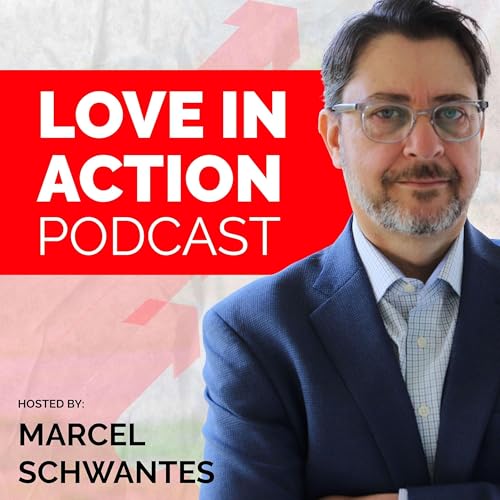
Love in Action Titelbild

Love in Action

Love in Action

Von: Marcel Schwantes
Jetzt kostenlos hören, ohne Abo

Über diesen Titel

The Love in Action Podcast—ranked #33 among the 100 Best Leadership Podcasts and in the top 2% of shows worldwide—is where leadership meets humanity. Hosted by global influencer, author, and executive coach Marcel Schwantes, the show features candid conversations with bestselling authors, visionary executives, and thought leaders who are redefining what it means to lead. Whether you want to sharpen your leadership skills, create a culture people love to work in, or grow your business by putting people first, you’ll find practical wisdom and inspiring stories to help you get there.© 2025 Love in Action Management & Leadership Ökonomie
  • How Hope Is the Key to the Future of Work, with Jen Fisher and Dr. Alex Lovell
    Feb 20 2026
    Episode recap This episode focused on hope in the workplace, starting with a discussion with Dr. Alex Lovell, head researcher and vice president at the O.C. Tanner Institute, and covering a recent O.C. Tanner study that revealed a decline in employee hopefulness. Marcel transitioned to a lively conversation with Jen Fisher, author of Hope Is the Strategy, and one of the world's first chief well-being officers. They explored how leaders can cultivate hope by using language that builds rather than kills hope, emphasizing curiosity, empathy, and transparency. Jen explained that hope requires clear goals, acknowledgment of current reality, and identifying multiple pathways to achieve those goals. They also discussed the limitations of wellness programs alone in improving employee well-being and the need to address cultural and behavioral factors in the workplace. The conversation concluded with Jen encouraging listeners to become "hope dealers" by helping others identify possibilities and support their potential. Bio: Jen Fisher is a global authority on workplace well-being, the founder and CEO of The Wellbeing Team and the author of Hope Is the Strategy: The Underrated Skill That Transforms Work, Leadership, and Wellbeing. Dr. Alex Lovell is the Vice President of the O.C. Tanner Institute and a political psychologist focused on the human side of work—specifically, how organizations can better foster appreciation, identity, belonging, and fulfillment to unlock human potential. Quotes: Alex Lovell Employees are seven times more likely to be engaged when they feel hopeful When people don’t see a path forward and don’t believe they can follow that path, there is no way they can get there Recognition and belonging are one of the strongest antidotes to hopelessness When teams aren’t inclusive, employees are 513 percent more likely to feel burned out Our younger workers don’t see a future anywhere, not personally and not professionally Jen Fisher Hope is not an emotion; it is a cognitive and behavioral process Do you want to lead a hopeful organization or a hopeless one? People need to believe that your strategy will leave them better off tomorrow than they are today Never in the history of telling someone not to worry have they not worried Be a hope dealer and help people see possibilities Takeaways: Hope is a measurable leadership skill that requires clear goals, multiple pathways, and agency Employees who feel hopeful are significantly more engaged and resilient Gen Z workers are struggling to see a personal and professional future, making belonging and recognition essential The language leaders use can either build hope or quietly destroy it Transparency and telling the whole truth reduce anxiety and strengthen trust Wellness programs alone cannot fix broken work design or culture Rebuilding hope starts with identifying and taking the next small step The future of work must intentionally preserve humanity alongside advancing technology. Timestamps: Alex Lovell — Timestamps 0:02 — Opening Banter and Formal Introduction to Dr. Alex Lovell 0:33 — Inside the OC Tanner Global Culture Report: Why This Research Matters Now 2:32 — The Alarming State of the Workplace: Hope, Depression, and Retention Risks 5:10 — Why Gen Z Feels Especially Hopeless About the Future of Work 7:00 — Belonging, Recognition, and the Antidote to Workplace Hopelessness 9:52 — Inclusion Gaps, Anxiety Spikes, and the Burnout Multiplier Effect 11:25 — The Seven-Times Engagement Effect When Employees Feel Hopeful 11:53 — Practical Drivers of Hope: Preventing Connection Decay and Building Momentum 15:18 — Where to Access the Global Culture Report and Continued Research 15:57 — Transition to Featured Guest Jen Fisher Jen Fisher — Combined Timestamps 0:05 — Welcome Back: Introducing Jen Fisher and the Book Hope Is the Strategy 2:26 — Jen’s Personal Journey Through Burnout, Cancer, and Caregiving 7:37 — Why Hope Is Not a Feeling but a Cognitive and Behavioral Strategy 11:34 — Addressing Leadership Skepticism: The Business Case for Hope 12:25 — What Hope Looks Like in Practice for Managers and Executives 16:16 — The Language of Hope: Replacing Hope Killers with Hope Builders 20:39 — Becoming a “Hope Dealer”: Leading Through Possibility Thinking 22:29 — Developing Hope as a Learnable and Measurable Leadership Skill 24:05 — Leading with the Whole Truth: Transparency, Uncertainty, and Trust 29:56 — Why Wellness Programs Alone Don’t Fix Broken Work Design 33:22 — Rebuilding Personal Hope One Small Action Step at a Time 34:45 — The Future of Work: Valuing Humanity in the Age of AI 30:13 — Leading with Love: Human Leadership in a Transactional World 31:09 — Final Charge: Be a Hope Dealer 31:52 — Where to Connect and Continue the Conversation 33:06 — Full Episode ...
    Mehr anzeigen Weniger anzeigen
    1 Std. und 2 Min.
  • A Bold, Human-Centered Guide to Leading Change, with Frank Danna and Chris Pitre
    Feb 13 2026
    Episode recap Don’t forget to subscribe to my Substack for exclusive access to tools, action plans, long-form articles, book content, and coaching resources to level up your leadership! Subscribe here. In this episode, Marcel interviewed Frank Danna and Chris Pitre, co-authors of "Love as a Change Strategy," discussing their book's themes and their experience at Softway, a technology company that transformed from a toxic culture to a human-centered organization. The conversation explored how embracing discomfort, prioritizing relationships, and practicing empathetic curiosity can lead to successful organizational change. Frank and Chris shared personal stories about their own transformation journeys and how they apply these principles at Softway. They discussed the importance of leaders modeling change behavior and the role of AI in enhancing human connection at work. The authors emphasized that change should be led, not managed, and highlighted the need for leaders to be intentional with their words and actions. Guest Bio Chris Pitre is Vice President at both Culture+ and Softway. Chris has spent his career helping companies reimagine how they work, focusing on how they treat their people and communicate. Frank Danna serves as the Marketing Director at Softway and is the Co-Founder of Culture+, where he helps leaders transform their leadership through love, empathy, and behavior-based change. Quotes: Chris Pitre: “Without a positive or strong culture, it's actually harder to bounce back. Adversity becomes that much scarier and that much more formidable.” Chris Pitre: “If you are a leader who is about to implement change and you're not uncomfortable, that should be a scary thing.” Frank Danna: “If you want to change, discomfort is the solution.” Chris Pitre: “I truly believe that comfort is a privilege and change, and so if you are comfortable, that means that everybody else is paying for your comfort, and likely you are someone who is probably oppressing the team.” Chris Pitre: “You get to decide at a certain point in your career who you will become: are you the boss that leaves a mark or a scar?” Takeaways: Real, sustainable change fails when it’s treated as a technical process instead of a deeply human, emotional experience. The six principles of change—embracing discomfort, prioritizing relationships, practicing empathetic curiosity, wielding your influence, experimenting, and being effective—act as a flexible “middle layer” between rigid processes and long-term behavior change. Leaders themselves are often the biggest blockers of transformation when they cling to titles, certainty, and comfort while expecting others to do the hard changing. Resistance to change is frequently a signal that people feel unheard, and genuine empathetic curiosity can turn resistors into powerful champions. AI, when introduced from a humane, people-first lens, can remove transactional work and actually create more room for empathy, collaboration, and truly human leadership. Timestamps: 00:00:02 Introduction and Softway’s turnaround story 00:03:30 Welcoming guests Frank Danna and Christopher Pitre 00:03:55 Frank’s story: from imposter syndrome to belonging 00:05:26 Chris’s story: corporate “robot,” stroke, and the power of workplace community 00:11:36 What Softway does and its evolution to AI-focused transformation 00:15:02 What people get wrong about love as a change strategy and why change fails 00:21:53 The six principles of change 00:24:00 Embracing discomfort and why leaders must feel uneasy 00:27:12 How leaders become the blockers of change 00:31:06 Personal transformation, accountability, and resistance as unheard voices 00:36:21 Rabbit hole: traditional male leadership, narcissism, and the cost to culture 00:40:13 Can AI actually increase humanity and love in the workplace? 00:43:35 Have we missed any essential questions? 00:44:55 Practical ways to lead with love day in and day out 00:47:39 Final takeaways: be like the buffalo and don’t manage change—lead it 00:50:15 Teasing the third book in the series 00:51:08 Where to learn more about Softway, the books, and the podcast Conclusion: Love isn’t a soft extra in business—it’s the toughest, most practical strategy for real change. This episode shows how embracing discomfort, listening with empathy, and leading like a “buffalo” through the storm can turn a toxic culture into a place of belonging and growth. Frank and Chris prove that when leaders go first, drop their ego, and put people at the center, both performance and humanity rise. AI, handled with a humane-first mindset, becomes a catalyst—not a threat—for more meaningful, human work. Take what you’ve heard today and decide: will you manage change from a distance, or step in and lead it with love? Links/Resources: Softway: https://...
    Mehr anzeigen Weniger anzeigen
    53 Min.
  • How Your Core Values Are the Key to Fulfillment at Work with Robert Glazer
    Feb 6 2026
    Episode recap In this episode, Marcel talks with Robert Glazer, author of The Compass Within, about why core values are essential for effective leadership and meaningful work. Robert explains the difference between aspirational values and actionable core values—non-negotiable principles that guide real decisions and behavior. They explore how values alignment boosts employee engagement, strengthens trust in leaders, and reveals whether an organization’s stated values actually match what it rewards in practice. The conversation also dives into authenticity, emotional honesty, and how early life experiences shape our values and sense of purpose. Robert shares a practical framework and reflective questions to help people clarify their true core values, arguing that clarity leads to better decisions, healthier leadership, and deeper personal fulfillment. The episode closes with Robert’s mission to help more people discover their “true north” and live with greater integrity and intention. Bio: Robert Glazer is a globally recognized entrepreneur, speaker, and author. He is the founder and former CEO of a $50M marketing agency with an award-winning, values-driven culture, and the author of multiple bestsellers, including Elevate and Elevate Your Team. His inspirational newsletter, Friday Forward, reaches over 200,000 readers weekly. Quotes: I define core values as the non-negotiable principles that decide your actions and behaviors, reflecting who you are, not who you wish you were. Most of our purpose is tied to pain, but people are afraid to go there and look, even though those formative experiences are where their real values live. If you can help people figure out their personal core values, you help them become better leaders, because they are going to lead from those values, whether they realize it or not. Everyone wants the shortcut, but if you really want to figure out your core values, you have to be willing to do the work and spend time with the questions. When you understand your core values, you gain a dramatic clarity that changes how you live and how you lead. Takeaways: Core values are intrinsic, non-negotiable decision rules that show up across all areas of life, not vague one-word aspirations like “integrity” or “family.” Much of our purpose and many of our values are rooted in formative childhood experiences, especially painful or ignored parts of our story. Alignment is impossible until you first clarify what you are actually aligning to, which is why defining values must come before trying to “live in alignment.” Research shows that when people’s work aligns with their values, engagement, trust, life satisfaction, and retention all increase significantly. Doing the structured inner work, like Robert’s six-question process and core values course, provides a practical pathway to make better long-term decisions about career, relationships, and leadership. Timestamps: 00:00:00 – 00:02:30 Opening, sponsor message, and Marcel’s setup about authenticity and alignment 00:02:30 – 00:05:56 Introducing Robert Glazer and the story behind The Compass Within 00:05:56 – 00:07:12 Robert’s personal story and how purpose is tied to pain 00:07:12 – 00:14:46 Why this book now, tribalism, and what people get wrong about values 00:14:46 – 00:17:25 Core values, culture, and how companies really reward behavior 00:17:25 – 00:21:17 Data, research, and why values alignment matters at work and in life 00:21:17 – 00:31:43 The six core values questions and live exercise revealing Marcel’s value of authenticity 00:31:43 – 00:36:25 Robert’s own core values and how they play out in his life and leadership 00:36:25 – 00:36:58 The hardest parts of doing core values work and why there is no shortcut 00:36:58 – 00:39:13 Speed round: what makes Robert smile, who inspires him, and bold life choices 00:39:13 – 00:41:00 How to lead with love, Robert’s final takeaway, and where to find his work Conclusion: This episode makes one thing crystal clear: if you do not define your values, the world will do it for you. Robert Glazer shows that core values are not fluffy slogans, but the invisible rails that quietly direct every major choice you make. Once you illuminate those rails, you can stop bouncing off the walls of the tunnel and start driving your life and leadership with intention. The stories, data, and live coaching moment with Marcel prove that this inner work is both emotional and incredibly practical. Listen in, then dare yourself to turn on your own “compass within” and see what needs to change. Links/Resources: Website: https://robertglazer.com/ Book: https://robertglazer.com/compass/ Core Values Course: www.corevaluescourse.com Get the Six Questions: https://robertglazer.com/six/ LinkedIn: https://www.linkedin.com/in/glazer
    Mehr anzeigen Weniger anzeigen
    41 Min.
Noch keine Rezensionen vorhanden