

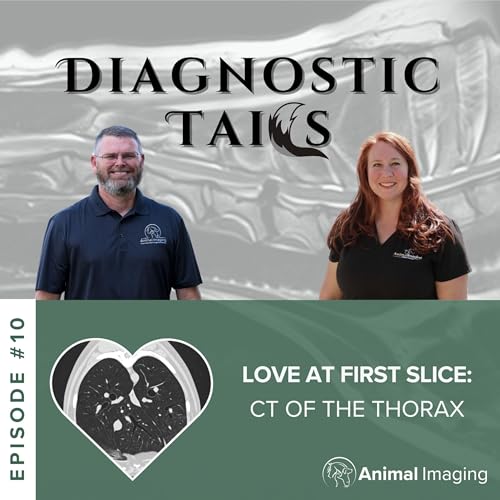
Love At First Slice: CT of the Thorax
Artikel konnten nicht hinzugefügt werden
Der Titel konnte nicht zum Warenkorb hinzugefügt werden.
Der Titel konnte nicht zum Merkzettel hinzugefügt werden.
„Von Wunschzettel entfernen“ fehlgeschlagen.
„Podcast folgen“ fehlgeschlagen
„Podcast nicht mehr folgen“ fehlgeschlagen

Love At First Slice: CT of the Thorax
-
Gesprochen von:
-
Von:
Über diesen Titel
In this episode of Diagnostic Tails, Dr. Amy Armentrout and Dr. Lon Hays break down the power of CT in small-animal medicine, spotlighting why CT consistently outperforms radiographs - especially for detecting pulmonary nodules, planning oncology cases, and guiding complex procedures. They explore when sedation is enough, when anesthesia is required, and how contrast, breath-holds, and modern fan-beam technology elevate diagnostic accuracy.
The conversation moves through real cases including Sancho’s hidden metastatic disease, a CT-guided lung mass aspirate, a young dog with a vascular anomaly, and an inventive urethral stricture study - illustrating how CT changes outcomes, improves surgical planning, and saves patients from unnecessary procedures. They wrap with a practical comparison of CT vs. MRI and clear guidance on choosing the right modality for the right case.
EPISODE HIGHLIGHTS:
00:00–01:00 — Intro to thoracic CT & why it’s a go-to modality.
01:00–02:30 — CT advantages: speed, clarity, and value over radiographs.
03:30–05:15 — Sedation vs. anesthesia, contrast use, and why breath-holds matter.
05:15–06:30 — Fan-beam vs. cone-beam CT: what’s the difference?
07:00–09:15 — Case 1: Sancho - clean X-rays, but CT reveals multiple pulmonary nodules.
10:12–11:25 — Case 2: Snickers - CT-guided lung mass aspirate and why ultrasound can’t reach it.
11:58–12:35 — Case 3: Persistent Right Aortic Arch - diagnosing a congenital vascular anomaly.
15:00–15:57 — Case 4: Urethral stricture - creative retrograde contrast CT for surgical planning.
16:15–17:40 — Why thoracic CT should accompany most soft-tissue studies.
18:00–18:45 — Big-dog abdomen workups: when CT beats ultrasound.
19:20–22:10 — CT vs. MRI: which modality to choose and when.
23:26–24:30 — Final takeaways + call for clinicians to consult the imaging team.
KEY TAKEAWAYS:
- CT provides far greater detail than radiographs, especially for pulmonary, abdominal, and oncologic cases.
- Small nodules and subtle abnormalities are frequently invisible on X-ray but obvious on CT.
- Cone-beam CT has its place (dentistry/skull) but cannot replace fan-beam CT for thorax or abdomen.
- CT-guided aspirates offer precise, safe sampling for challenging masses surrounded by air.
- 3D reconstructions and vascular studies improve surgical planning and owner decision-making.
- For elbows, carpi, and below-stifle issues → CT excels; for shoulders, hips, and neuro → MRI is preferred.
- Adding a thoracic CT when evaluating masses is cost-effective and often case-changing.
Animal Imaging Veterinary Radiology Specialists: https://animalimaging.net/
(972) 869-2180 info@animalimaging.net
Facebook: https://www.facebook.com/AnimalImaging/
Linked In: https://www.linkedin.com/company/animalimaging
Instagram:
