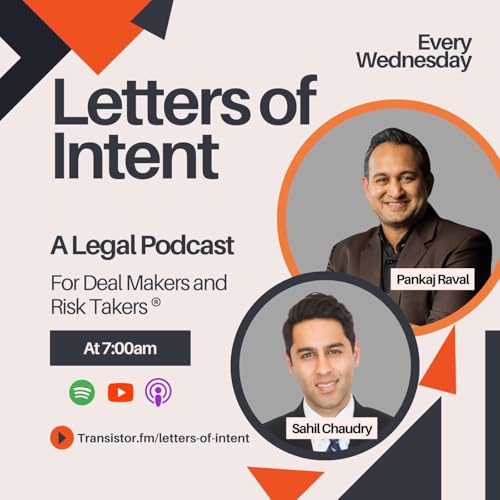
Letters of Intent Titelbild

Letters of Intent

Letters of Intent

Von: Pankaj Raval
Jetzt kostenlos hören, ohne Abo

Saisonale Sparangebote | 0,99 € pro Monat für die ersten 3 Monate

Danach 6,99 €/Monat. Bedingungen gelten. Monatlich kündbar.
Conversations with business leaders and changemakers on how they built their business and what keeps them going.© 2025 Carbon Law Group Management & Leadership Ökonomie
  • Sahil's Trip to India and GIFT City
    Oct 28 2026

    In this episode breakdown, Pankaj Raval and Sahil Chaudry unpack GIFT City, India’s new international financial center, as Sahil prepares for two months of meetings with family offices and cross-border advisors in Mumbai and Gujarat. Working from GIFT City’s regulatory framework and its Family Investment Fund regime, they explain why the city is drawing US-based capital and where US tax rules follow that capital into India.

    Through this practical analysis, Pankaj and Sahil extract critical structuring, tax, and coordination lessons, that apply directly to founders and leaders of growing private enterprises moving capital between the US and India.

    This podcast is for informational purposes only and does not constitute legal advice.

    Takeaways

    • The Onshore Dollar Platform: GIFT City (the Gujarat International Finance Tech City) is India’s international financial services center. It is a special economic zone with its own regulator, the IFSCA, where transactions can run in US dollars while capital stays in India. Sahil explains that families once routed money through Singapore or Mauritius, which added upkeep costs, substance requirements (rules that demand real local operations), and friction claiming US foreign tax credits, and that GIFT City removes that middleman country.
    • The Family Investment Fund: A Family Investment Fund (FIF) is a single regulated vehicle a family can use to consolidate holdings, set governance, and plan succession across generations, instead of managing fragmented trusts in different legal systems. Sahil also describes GIFT City structures as a way for non-resident Indians (NRIs) to repatriate capital in foreign currency, outside the lock-in periods and annual caps of standard Non-Resident Ordinary (NRO) accounts.
    • Navigating the US Tax Trap: Indian tax incentives do not switch off US tax rules. Without US planning, a US citizen or green card holder investing through a GIFT City vehicle can end up holding a passive foreign investment company (PFIC, a foreign entity built mostly on passive investment income) or a controlled foreign corporation (CFC, a foreign company controlled by US owners). Sahil explains that timely qualified electing fund (QEF) or mark-to-market elections, backed by accounting statements from the fund itself, are the standard way to avoid the punitive default treatment.
    • Coordinating Two Legal Systems: The structural risk is separate US and Indian legal teams that never talk to each other. Carbon Law Group’s model is to act as US lead counsel, drafting intercompany master service agreements, family charters, and US governance documents, while partner firms in India handle registrations, Registrar of Companies filings, and fund accounting.

    Soundbites

    • “...local tax incentives in one country can easily trigger severe tax liabilities in another if not structured correctly.” — Pankaj Raval
    • “Historically, family offices used offshore jurisdictions like Singapore or Mauritius to route capital into India... GIFT City eliminates all that, it eliminates the middleman country entirely.” — Sahil Chaudry
    • “That has been a tough part about investing in India is how do you get the money out.” — Sahil Chaudry
    • “Domestic Indian setup alone does not protect you from the IRS.” — Sahil Chaudry

    Keywords

    GIFT City, Family Investment Fund, Cross-Border Investment, India Family Offices, NRI Capital Repatriation, Passive Foreign Investment Company, Controlled Foreign Corporation, US-India Tax Planning, International Financial Services Center, US Lead Counsel


    🔗 Learn More

    Website: carbonlg.com

    Connect with Pankaj: https://www.linkedin.com/in/pankaj-raval/

    Connect with Sahil: https://www.linkedin.com/in/sahil-chaudry-6047305/
    Carbon Law Group's links: https://linktr.ee/carbonlawgroup


    Click Here To Schedule A Call With Us

    Mehr anzeigen Weniger anzeigen
    11 Min.
  • Go East, Young Man: Why Carbon Law Group Is Going to India
    Oct 22 2026

    In this special episode, Pankaj Raval and Sahil Chaudry announce Carbon Law Group’s move into the India-US corridor. Instead of breaking down a document, they explain why Sahil will spend October 26 through the end of December in Juhu, Mumbai, meeting with venture capital firms, family offices, and founders who want to access the US market.

    Through this practical conversation, Pankaj and Sahil extract critical shifts in where growth is happening, the compliance layers of US market entry, and the patterns behind Indian capital flowing west, that apply directly to founders and leaders of growing private enterprises navigating cross-border expansion.

    This podcast is for informational purposes only and does not constitute legal advice.

    Takeaways

    • The Eastward Shift in Growth: Pankaj argues that the old advice to “go west” is dated, because much of the last twenty years of growth has happened in Asia. For leaders deciding where to expand or raise capital, the East is a source of opportunity that can’t be overlooked.
    • The Layered Complexity of US Market Entry: Sahil uses California as the example of what US entry involves. That means securities compliance (the rules on raising money from investors), labor compliance (employment rules), and intellectual property protection, including copyright and trademark. Each is a separate track, and none of it is the business itself.
    • Indian Capital’s Appetite for US Businesses: The interest the hosts describe is industry agnostic. It ranges from hedge funds investing in publicly traded securities, to buyers looking at US hotels, to companies selling medical devices. The common thread is demand for the US middle market, the tier of established private companies between small businesses and large corporations.
    • Building the Gateway to the US: Sahil will be in Juhu, Mumbai from October 26 through the end of December, meeting with venture capital firms, family offices, and founders. Meeting requests go to sahil@carbonlg.com.


    Soundbites

    • “We’ve got the Gateway of India that’s made of stone in Mumbai that I know you and I have both visited. But we are building the gateway to the US, which is going to be built of carbon for Carbon Law Group.”
    • “Accessing the US market is complex. And you don’t want to be focused on the administrative, the compliance, the legal. You want to focus on your business and making money.”
    • “I think that saying, the statement that, go west, young man, I think is absolutely dated, right?”
    • “The most important thing that I notice is that it seems that there’s an appetite from Indian capital for US businesses and we are here to service that capital.”


    Keywords

    Cross-Border Transactions, India-US Business, US Market Entry, Family Offices, Venture Capital, Securities Compliance, Labor Compliance, Intellectual Property, Trademark, Middle Market

    🔗 Learn More

    Website: carbonlg.com

    Connect with Pankaj: https://www.linkedin.com/in/pankaj-raval/

    Connect with Sahil: https://www.linkedin.com/in/sahil-chaudry-6047305/
    Carbon Law Group's links: https://linktr.ee/carbonlawgroup


    Click Here To Schedule A Call With Us


    Mehr anzeigen Weniger anzeigen
    5 Min.
  • $4M vs. $300M: The Private Equity Roll-Up Playbook
    Oct 22 2026

    In this episode breakdown, Pankaj Raval and Sahil Chaudry dissect the private equity roll-up, the buy-and-build strategy consolidating fragmented industries from HVAC to dental practices. Working from a hypothetical regional HVAC sale and Blackstone’s reported $2.5 billion agreement to acquire home services platform Champions Group, they show how the same earnings can be valued at a fraction or a multiple depending on who owns them.

    Through this practical analysis, Pankaj and Sahil extract critical lessons on valuation multiples, rollover equity, and integration risk, that apply directly to founders and leaders of growing private enterprises weighing a sale or planning to grow through acquisition.

    This podcast is for informational purposes only and does not constitute legal advice.

    Takeaways

    • The Mechanics of Multiple Arbitrage: Businesses are often priced as a multiple of EBITDA (earnings before interest, taxes, depreciation, and amortization, a common measure of operating profit). Pankaj explains that small companies trade lower, roughly 3X to 5X, because buyers price in key-person risk and customer concentration, while large platforms can trade at 10X to 15X. Combining many small companies into one platform can lift the value of the same earnings before any organic growth.
    • The Four-Step Buy-and-Build Playbook: Sahil lays out the sequence: buy a platform company with $2 million to $5 million in EBITDA and a strong leadership team, then acquire smaller “add-on” or “tuck-in” competitors at lower multiples. Next comes integration, cutting duplicate overhead and using scale for better supplier terms. The final step is selling the combined company to a larger fund or strategic buyer at a premium.
    • The Second Bite of the Apple: A founder selling to a platform buyer is commonly asked to roll 10% to 20% of the payout into equity in the new parent company. That stake is revalued when the sponsor sells the whole platform, which Sahil puts at three to five years later, and he notes the second payout is frequently larger than the original cash check. How the rolled portion is taxed generally depends on how the deal is structured.
    • The People Behind the EBITDA: Pankaj and Sahil identify integration as the main failure point. Forcing new systems and cutting local bonus structures overnight can push out the technicians and managers who made the business valuable, and heavy acquisition debt can crush cash flow if revenue dips.

    Soundbites

    • “And suddenly the exact same twenty million dollars in aggregate earnings isn’t worth eighty million dollars anymore. It’s worth two hundred and forty million dollars to three hundred million dollars.”
    • “And in service businesses, the enterprise value is the people. If the technicians or lead managers leave, you didn’t buy EBITDA you bought an expensive lease and some used trucks.”
    • “Financial engineering alone doesn’t create real value. You have to drive actual operational efficiencies.”
    • “At the end of the day, a roll-up is simple, but it’s not easy. It’s a vehicle for turning fragmented local effort into scalable institutional wealth.”

    Keywords

    Private Equity Roll-Up, Buy-and-Build Strategy, Multiple Arbitrage, EBITDA Multiples, Rollover Equity, Second Bite of the Apple, Add-On Acquisitions, Platform Acquisition, Fragmented Industries, M&A Exit Planning

    🔗 Learn More

    Website: carbonlg.com

    Connect with Pankaj: https://www.linkedin.com/in/pankaj-raval/

    Connect with Sahil: https://www.linkedin.com/in/sahil-chaudry-6047305/
    Carbon Law Group's links: https://linktr.ee/carbonlawgroup


    Click Here To Schedule A Call With Us

    Mehr anzeigen Weniger anzeigen
    9 Min.
adbl_web_anon_alc_button_suppression_t1
Noch keine Rezensionen vorhanden