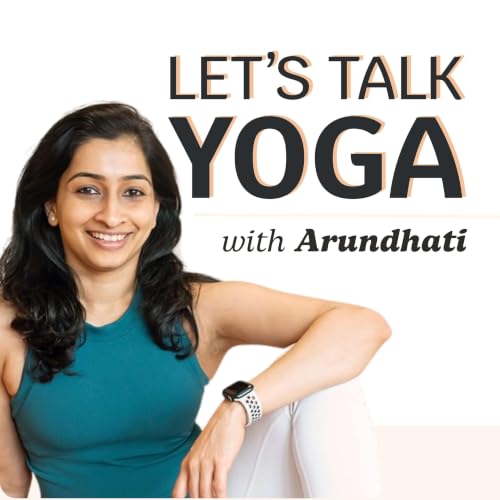
Let's Talk Yoga Titelbild

Let's Talk Yoga

Let's Talk Yoga

Von: Arundhati Baitmangalkar
Jetzt kostenlos hören, ohne Abo

Über diesen Titel

Welcome to the Let's Talk Yoga podcast—your ultimate online destination for everything yoga. Think of it as your virtual yoga school, offering something for everyone—whether you’re a seasoned yoga teacher, a dedicated student, or simply curious about the deeper layers of yoga.

Join host Arundhati Baitmangalkar, an immigrant yoga teacher, studio owner, global mentor, and creator of some of the most sought-after yoga teacher training programs in the world. Each week, we bring you valuable insights, in-depth conversations with renowned yoga teachers, and an abundance of yoga resources designed to inspire, educate, and transform.

From mastering the art of teaching to navigating the complexities of yoga philosophy and business, this niche podcast is your go-to resource for all things yoga. Ready to deepen your practice and expand your understanding? Hit subscribe now and never miss an episode of Let's Talk Yoga!

© 2026 Let's Talk Yoga
Alternative & Komplementäre Medizin Hygiene & gesundes Leben Management & Leadership Ökonomie
  • "You Don’t Know How to Study Yoga” The Traditional Framework We’ve Ignored
    Feb 22 2026

    Are we actually studying yoga, or just consuming it? In this episode, I explore the traditional frameworks that shaped authentic yogic learning and why modern education often skips the foundations. If you’re serious about deepening your practice beyond certifications, this conversation will shift your perspective.

    Episode Highlights:

    • The difference between modern yoga education and traditional teacher-student learning
    • Why student qualification (Adhikari Bheda) mattered before receiving teachings
    • The method of progressive revelation (Arundhati Darshana Nyaya)
    • Traditional classifications of yoga students in Hatha Yoga
    • The threefold process of learning: listening, reflection, and deep assimilation
    • The three valid means of knowledge outlined in the Yoga Sutras
    • The four foundational qualifications for serious spiritual study
    • The structure and progression of the four chapters of the Yoga Sutras
    • Kriya Yoga as a practical framework for disciplined study
    • Why slowing down and refining your approach changes everything

    Join our mailing list
    Find all the resources mentioned in this episode
    Connect with us on Instagram
    Subscribe to Aham Yoga on YouTube
    Let’s Talk Yoga Podcast on YouTube
    Leave us a review and share this podcast with your friends!


    Mehr anzeigen Weniger anzeigen
    27 Min.
  • The Hormonal Body - What Yoga Teachers Need to Understand with Dr. Manasa Rao
    Feb 8 2026

    Hormones influence how we move, rest, recover, and show up on the mat, yet they’re rarely discussed clearly in yoga spaces. In this episode, I sit down with Dr. Manasa Rao to explore what yoga teachers need to understand about the hormonal body through both modern science and yogic wisdom. We talk about stress, rhythm, pranayama, women’s hormonal cycles, and how yoga can support balance through listening and alignment without overstepping into medical advice.

    Episode Highlights:

    • Are hormones a modern concept, or something yoga has always addressed through a different language?
    • Hormones as internal messengers and their connection to yogic ideas of prana, ojas, tejas, and balance.
    • How yoga works across the physical and subtle bodies to regulate internal harmony.
    • The relationship between chakras, glands, and pranic flow, and where confusion often arises.
    • Why hormonal balance is the body’s natural state and how modern lifestyle disrupts rhythm.
    • Cortisol, stress, and the importance of restoring rhythm rather than suppressing hormones.
    • Pranayama as a key regulator of the hormonal and nervous systems.
    • How to think about different pranayama practices, including ujjayi, with more discernment.
    • Pratyahara as a lifestyle-based practice rooted in routine, rhythm, and sensory regulation.
    • Understanding women’s hormonal transitions, including menstruation, perimenopause, and menopause.
    • Menopause reframed as a phase of reorganization and inward movement, not decline.
    • How yogic practices can support different phases of the menstrual cycle.
    • The importance of personalization and sensitivity when teaching hormonally affected students.
    • Body-to-mind versus mind-to-body, and why dissolving that duality matters.
    • The central takeaway: hormonal health comes from listening, alignment, and rhythm rather than fixing.

    Join our mailing list
    Find all the resources mentioned in this episode
    Connect with us on Instagram
    Subscribe to Aham Yoga on YouTube
    Let’s Talk Yoga Podcast on YouTube
    Leave us a review and share this podcast with your friends!


    Mehr anzeigen Weniger anzeigen
    49 Min.
  • Pose Literacy - Your Gateway Into Smart Sequencing
    Jan 30 2026

    Sequencing doesn’t start with themes or peak poses, it starts with understanding the pose itself. In this episode, I introduce pose literacy and explain why it’s the missing link behind clearer, safer, and more intelligent sequencing. Using Downward-Facing Dog as a real example, I break down how learning to read a pose beyond alignment can completely change how you teach, sequence, and support your students.

    Episode Highlights:

    • Why modern sequencing often skips the most essential step
    • What pose literacy is, and why alignment alone isn’t enough
    • How low pose literacy leads to guesswork, overload, and unsafe sequencing
    • A pose-literacy breakdown of Downward-Facing Dog
    • How a pose-first approach transforms sequencing and teaching confidence

    Join our mailing list
    Find all the resources mentioned in this episode
    Connect with us on Instagram
    Subscribe to Aham Yoga on YouTube
    Let’s Talk Yoga Podcast on YouTube
    Leave us a review and share this podcast with your friends!


    Mehr anzeigen Weniger anzeigen
    28 Min.
Noch keine Rezensionen vorhanden