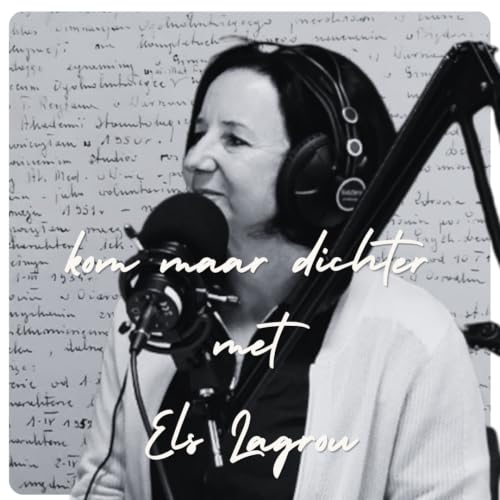
Kom Maar Dichter Titelbild

Kom Maar Dichter

Kom Maar Dichter

Von: Artemis Kubala
Jetzt kostenlos hören, ohne Abo

Kom Maar Dichter is een podcast met schrijvers en denkers over schrijven, leven en alles wat daartussen schuurt. Over twijfel, verbeelding en wat mensen drijft om woorden te blijven zoeken.

Copyright 2026 All rights reserved.
Kunst
  • Delphine Van Belleghem – De Sh*tstorm Survival Guide | Schrijf je giftigste antwoord — en publiceer het niet
    Sep 12 2026
    Als je online communiceert voor een organisatie, weet je dat sociale media een fantastische manier zijn om mensen te bereiken — maar soms komen er stevige uitdagingen bij kijken. Comments die ontsporen, een stortvloed aan negativiteit, of die ene reactie waar je maar op blijft kauwen. In De Sh*tstorm Survival Guide. Een praktische gids bij lastige reacties op sociale media biedt Delphine Van Belleghem praktische tips, expertinzichten en herkenbare voorbeelden — over trollen en online polarisatie, maar ook over empathisch reageren, humor inzetten en grenzen stellen. Delphine is communicatieconsultant en trainer voor ngo's, vzw's en overheden, en oprichter van hier niet, een campagne tegen online haat die meer dan 800 organisaties achter zich verzamelde. In deze negende aflevering van Kom Maar Dichter gaan we voorbij de flaptekst — naar het proces, de twijfels en de inzichten die blijven hangen. Delphines pad verliep toevallig: van sociologie en ontwikkelingssamenwerking naar digitale communicatie, in de begintijd van Facebook, toen iedereen zich nog afvroeg of dat wel professioneel inzetbaar was. Het boek groeide uit hier niet, dat begon met een oproep van een community manager die de stroom racistische reacties beu was: "kunnen we hier samen iets aan doen?" Toen uitgeverij Kortom Delphine vroeg voor een boekenreeks, lag haar idee al klaar — al bracht dat momentum ook imposter syndroom mee. We praten over hoe ze de praktische gids opbouwde met veel stemmen (interviews, AI-transcripties, een "ugly first draft" die ze nadien boetseerde), en over tips om harde comments je niet persoonlijk te laten raken. Over de vraag wie verantwoordelijk is — een "sandwich" van platformen, overheden, burgers en het middenveld — en over hoe de grote platformen een businessmodel op polarisatie bouwden. Over hoe online en offline polarisatie elkaar versterken, over bruggenbouwers en "toetsenbordfeeën", en over regulering, trusted flaggers en de dunne grens met censuur. We hebben het ook over AI als versterker én hulpmiddel, over het herkennen van intentie (de "hartluchter" die vooral gehoord wil worden), en over Delphines credo "begint eer ge bezint". Tot slot leest ze een passage voor uit het hoofdstuk over zelfzorg — over hoe het groepje achter hier niet voor haar een vangnet werd, misschien wel de belangrijkste vorm van zelfzorg die ze kan aanraden. De Sh*tstorm Survival Guide van Delphine Van Belleghem was de aanleiding voor dit gesprek. Wil je geen enkele aflevering missen? Abonneer je op Kom Maar Dichter via je favoriete podcastkanaal, en schrijf je in op The Conversation Layer — dan belanden de gesprekken, transcripties en extra reflecties meteen in je inbox. Kom maar dichter. We luisteren samen verder. --- If you communicate online for an organisation, you know social media are a fantastic way to reach people — but stiff challenges sometimes come with it. Comments that spiral out of control, a flood of negativity, or that one reaction you keep chewing on. In De Sh*tstorm Survival Guide. Een praktische gids bij lastige reacties op sociale media ("The Sh*tstorm Survival Guide: A Practical Guide to Difficult Reactions on Social Media"), Delphine Van Belleghem offers practical tips, expert insights and recognisable examples — on trolls and online polarisation, but also on responding with empathy, using humour and setting boundaries. Delphine is a communications consultant and trainer for NGOs, non-profits and governments, and founder of hier niet ("not here"), a campaign against online hate that rallied more than 800 organisations behind it. In this ninth episode of Kom Maar Dichter, we move past the back-cover blurb — toward the process, the doubts, and the insights that linger. Delphine's path unfolded by chance: from sociology and development cooperation to digital communication, in the early days of Facebook, when everyone still wondered whether it could be used professionally. The book grew out of hier niet, which began with a call from a community manager fed up with the stream of racist reactions: "can we do something about this together?" When a publisher asked Delphine for a book series, her idea was already waiting — though that momentum also brought imposter syndrome. We talk about how she built the practical guide with many voices (interviews, AI transcripts, an "ugly first draft" she then sculpted), and about tips for not letting harsh comments affect you personally. About who is responsible — a "sandwich" of platforms, governments, citizens and civil society — and how the big platforms built a business model on polarisation. About how online and offline polarisation reinforce each other, about bridge-builders and "keyboard fairies", and about regulation, trusted flaggers and the thin line with censorship. We also discuss AI as both amplifier and tool, recognising intent (the "heart-venter" who mainly wants to be heard), and Delphine's credo "act before you reflect". To close,...
    Mehr anzeigen Weniger anzeigen
    45 Min.
  • Tuly Salumu – Bintje | We erven niet alleen een huidskleur, maar ook de zonde van onze vaders
    Aug 29 2026
    Bintje groeit op in de jaren 90, in de rijzige appartementsblokken van een provinciestad — voor haar een leven lang verbonden met de geur van pilipili, het ritme van rumba en het geluid van de typmachine van haar vader. Een man die zich verliest in God en drank, die zacht en gewelddadig is, voortdurend aan- en afwezig. In Bintje schrijft Tuly Salumu een snoeihard romandebuut over identiteit, over de alledaagsheid van racisme, en over het besef dat we niet enkel een huidskleur erven, maar ook de zonde van onze vaders. In deze achtste aflevering van Kom Maar Dichter gaan we voorbij de flaptekst — naar het proces, de twijfels en de inzichten die blijven hangen. Bintje ligt heel dicht bij Tuly — "een beetje mijn spiegel", een op scherp gestelde versie van zichzelf. Het boek is een roman met veel fictie, maar evenveel autobiografische elementen; aanvankelijk wilde Tuly memoires schrijven, maar koos voor fictie om haar familie te beschermen. Als journalist had ze de neiging het rauwste verhaal te zoeken, en het was vooral de Schrijversacademie die haar leerde dat niet elke scène heftig hoeft te zijn — een roman heeft ook lucht nodig. Het schrijven viel samen met een werkgerelateerde depressie: in die periode lukte bijna niets nog, maar schrijven wél, en het legde een "gouden randje" over een moeilijke tijd. We praten over hoe Bintje zich als kind bewust wordt van haar lichaam en huidskleur (mensen zeggen dat kinderen geen kleur zien, maar Tuly toont het tegendeel), en over de weg van "half" naar "dubbel" — van geloven dat je maar half bent naar beseffen dat je dubbele origine een rijkdom is, een weg die ze nog niet volledig heeft afgelegd. Over taal als kwetsuur, en over een vader die buiten vernederd wordt en thuis macht zoekt. Over de loyaliteit van kinderen naar ouders, en over het geloof dat trauma over generaties heen kan helen. We hebben het ook over het stigmatiserende taalgebruik in het boek en waarom het erin moest, over Bob Dylan en de pijn die als een kurkentrekker door het hart gaat, en over schrijven als verbinding: "ik zal altijd een gekwetst kind blijven dat op zoek is naar verhalen van andere gekwetste kinderen." Tot slot leest Tuly een passage voor waarin haar vader haar te vroeg van school komt ophalen — twee werelden die ze het liefst uit elkaar hield. Bintje van Tuly Salumu was de aanleiding voor dit gesprek. Wil je geen enkele aflevering missen? Abonneer je op Kom Maar Dichter via je favoriete podcastkanaal, en schrijf je in op The Conversation Layer — dan belanden de gesprekken, transcripties en extra reflecties meteen in je inbox. Kom maar dichter. We luisteren samen verder. Dit gesprek raakt aan gevoelige thema's, waaronder racisme, huishoudelijk geweld en mentale gezondheid. --- Bintje grows up in the 1990s, in the towering apartment blocks of a provincial town — for her bound for a lifetime to the smell of pilipili, the rhythm of rumba and the sound of her father's typewriter. A man who loses himself in God and drink, who is gentle and violent, forever present and absent. In Bintje, Tuly Salumu writes a searing debut novel about identity, about the everydayness of racism, and about the realisation that we inherit not only a skin colour, but also the sins of our fathers. In this eighth episode of Kom Maar Dichter, we move past the back-cover blurb — toward the process, the doubts, and the insights that linger. Bintje lies very close to Tuly — "a bit of a mirror," a sharpened version of herself. The book is a novel with much fiction, but just as many autobiographical elements; initially Tuly wanted to write a memoir, but chose fiction to protect her family. As a journalist she tended to seek out the rawest story, and it was above all the Writers' Academy that taught her not every scene has to be intense — a novel needs air too. The writing coincided with a work-related depression: in that period almost nothing worked anymore, but writing did, laying a "golden lining" over a difficult time. We talk about how Bintje becomes aware of her body and skin colour as a child (people say children don't see colour, but Tuly shows the opposite), and about the road from "half" to "double" — from believing you're only half to realising your dual origin is a richness, a road she hasn't fully travelled. About language as a wound, and about a father humiliated outside who seeks power at home. About the loyalty of children toward parents, and the belief that trauma can heal across generations. We also discuss the stigmatising language in the book and why it had to be there, Bob Dylan and the pain that goes through the heart like a corkscrew, and writing as connection: "I'll always remain a wounded child searching for the stories of other wounded children." To close, Tuly reads a passage in which her father comes to collect her from school too early — two worlds she would rather have kept apart. Bintje by Tuly Salumu was the starting point for this conversation. Don't want ...
    Mehr anzeigen Weniger anzeigen
    1 Std. und 3 Min.
  • Els Lagrou – Waarom we meer over geld moeten praten | Financieel onderuitgaan kan iedereen overkomen
    Aug 15 2026
    Geld is overal en beïnvloedt ons welzijn, onze productiviteit en de werksfeer — en toch blijft het vaak onbesproken. In Waarom we meer over geld moeten praten. Financiële educatie als bouwsteen voor geluk en weerbaarheid van werknemers laat Els Lagrou zien hoe financiële geletterdheid, educatie en inclusie bijdragen aan welzijn, en hoe je dat kunt integreren in een wellbeing- of ESG-beleid. Els is econoom en oprichter van het initiatief Dagelijks Geld; ze werkte jarenlang in de financiële sector en bij de Belgische toezichthouder, en coördineerde internationale projecten rond financiële geletterdheid bij de OESO. In deze zevende aflevering van Kom Maar Dichter gaan we voorbij de flaptekst — naar het proces, de twijfels en de inzichten die blijven hangen. Het gevoel dat dit boek er moest komen, ontstond uit Els' eigen verlangen om haar boodschap te delen én uit de vele mensen die na haar verhaal zeiden: "daar hebben we nooit aan gedacht, schrijf daar een boek over." Tien jaar eerder, zegt ze, had niemand het bekeken — praten over geld was toen nog veel minder bespreekbaar. En zelfs nu is het nog geen vlot gespreksonderwerp, want we hebben een rare, dubbele relatie met geld: het geeft vrijheid, maar draagt ook een zwaar oordeel. We praten over de mythe dat wie kapitaalkrachtig is, automatisch financieel geletterd zou zijn, en over het verschil tussen geletterdheid en financieel welzijn: niet enkel een crisis kunnen opvangen, maar een plan hebben rond wat je gelukkig maakt. Over eigenaarschap en de juiste vragen durven stellen, over "hand-naar-mondgezinnen" en lifestyle creep, en over de grootste mythe die we moeten doorprikken: denken dat het jóú niet kan overkomen. We hebben het ook over de werkvloer als hefboom — een inclusieve plek waar je mensen bereikt die anders nooit de kans krijgen — en over geldstress als reële bedrijfskost. Over de aanname dat financiële verantwoordelijkheid puur individueel is, over de risico's van digitalisering (waarbij net jongeren vaak kwetsbaar zijn), en over het genderaspect: hoe jongens en meisjes anders gesocialiseerd worden rond geld en risico. Els sluit af met één inzicht, en het is meteen haar titel: praat over geld. Want praten is de eerste stap — en omdat we, zeker als Vlamingen, dat niet doen, blijft dat de stap die ze moet blijven pushen. Waarom we meer over geld moeten praten van Els Lagrou was de aanleiding voor dit gesprek. Wil je geen enkele aflevering missen? Abonneer je op Kom Maar Dichter via je favoriete podcastkanaal, en schrijf je in op The Conversation Layer — dan belanden de gesprekken, transcripties en extra reflecties meteen in je inbox. Kom maar dichter. We luisteren samen verder. --- Money is everywhere and shapes our well-being, our productivity and the atmosphere at work — and yet it often goes unspoken. In Waarom we meer over geld moeten praten ("Why We Need to Talk More About Money: Financial Education as a Building Block for Employee Happiness and Resilience"), Els Lagrou shows how financial literacy, education and inclusion contribute to well-being, and how to integrate this into a well-being or ESG policy. Els is an economist and founder of the initiative Dagelijks Geld; she worked for years in the financial sector and at the Belgian regulator, and coordinated international projects on financial literacy at the OECD. In this seventh episode of Kom Maar Dichter, we move past the back-cover blurb — toward the process, the doubts, and the insights that linger. The feeling that this book had to exist grew from Els's own desire to share her message and from the many people who, after hearing her story, said: "we never thought about that, you should write a book about it." Ten years earlier, she says, no one would have looked at it — talking about money was far less discussable then. And even now it's still not an easy topic, because we have a strange, double relationship with money: it gives freedom, but also carries a heavy judgement. We talk about the myth that whoever is wealthy is automatically financially literate, and about the difference between literacy and financial well-being: not just being able to absorb a crisis, but having a plan around what makes you happy. About ownership and daring to ask the right questions, about "hand-to-mouth households" and lifestyle creep, and about the biggest myth we need to puncture: thinking it can't happen to you. We also discuss the workplace as a lever — an inclusive place where you reach people who would otherwise never get the chance — and money stress as a real business cost. About the assumption that financial responsibility is purely individual, the risks of digitalisation (with young people often surprisingly vulnerable), and the gender aspect: how boys and girls are socialised differently around money and risk. Els closes with one insight, and it's her title itself: talk about money. Because talking is the first step — and because we, certainly as ...
    Mehr anzeigen Weniger anzeigen
    45 Min.
adbl_web_anon_alc_button_suppression_t1
Noch keine Rezensionen vorhanden