Incredible India Travel | Social Impact & Culture Tours Titelbild

Incredible India Travel | Social Impact & Culture Tours

Incredible India Travel | Social Impact & Culture Tours

Von: 5 Senses Tours | Cultural Experiences & Social Impact Guides
Jetzt kostenlos hören, ohne Abo

India travel podcast exploring responsible tourism, deep cultural experiences, and experiential travel across incredible India. Your India travel guide for authentic, meaningful journeys. Join hosts Debbie & Tim of 5 Senses Tours — an inbound tour operator specialising in cultural and sustainable travel in India — as they take you beyond the monuments to the real heart of the country. Each episode covers places to visit in India, hidden heritage sites, ethical community tourism, and off-the-beaten-path adventures that celebrate Indian culture and support local communities. From the ancient forts of Rajasthan and the backwaters of Kerala to tribal Odisha and the Himalayan ashrams, this is responsible tourism India done right — immersive, purposeful, and unforgettable. Whether you are a first-time visitor or a seasoned India traveller, we help you explore with purpose and respect. 🎧 Subscribe now and start your journey. 🌏 Plan your India tour: 5sensestours.com2025 Five Senses Tours Privted Limited Reiseliteratur & Erläuterungen Sozialwissenschaften
  • Wheat vs Rice: How Two Grains Quietly Shaped Two Indias
    Jun 24 2026

    Why does Punjab celebrate its new year in April with bonfires and a festival built around cut wheat, while Tamil Nadu celebrates its harvest festival in January, watching a pot of rice boil over with milk and jaggery.

    Why do the temples of the south rise in towering gopurams visible from a distance, while many temples of the north sit smaller and more intimately set into a riverbank or hillside.

    Why does the north's classical music tradition favour a single performer exploring a raga alone, while the south's classical tradition favours an ensemble in constant, audible dialogue with itself.

    One honest, well documented answer, among several that matter, turns out to be sitting on a plate in front of you at almost every meal.

    It is the grain.

    This episode traces how two different staple crops, wheat in the north and rice in the south, quietly shaped two different calendars, cuisines and artistic traditions across India over thousands of years, while being equally honest about where this theory holds up and where it does not.

    What You Will Discover in This Episode

    How the Indus Valley Civilisation grew wheat and barley as winter staples and rice as a summer crop over four thousand years ago, and how archaeologists at Rakhigarhi found evidence of sophisticated seasonal multi-cropping that predates comparable evidence from Mesopotamia or Egypt

    Why wheat ripens all at once in spring across the entire northern wheat belt, while rice, dependent on monsoon timing that varies by region, staggers its harvest across a much wider stretch of the calendar

    Why Punjab's Baisakhi falls every April, marking the wheat harvest and the Punjabi new year, while Tamil Nadu's Pongal falls every January, named for the moment rice cooked with milk and jaggery boils over an earthen pot, and how Onam, Bihu and Nabanna each follow this same underlying logic across other regions

    How North Indian cuisine centres on wheat breads and dairy based gravies while South Indian cuisine centres on rice, fermented batters and coconut based dishes, and why neither tradition should be read as more or less communal than the other

    Why North Indian Nagara temples are built around a curved shikhara tower echoing a mountain peak with a small, dim sanctum at their centre, while South Indian Dravida temples rise in towering gopurams visible for miles, built around vast courtyards for grain storage, education and annual festivals, and why this difference likely reflects geography and centuries of stable patronage rather than any difference in devotion

    The genuinely surprising case of Indian classical music, where the northern Hindustani tradition, born in royal courts, favours a single performer's unhurried solo exploration of a raga, while the southern Carnatic tradition, born in temples, favours a tightly coordinated ensemble in constant real time dialogue, a pattern that runs in the opposite direction from what the wheat and rice theory would predict

    The honest limits of this entire theory, including why rice growing Bengal produced one of India's most distinguished intellectual traditions and why wheat growing Punjab is home to the deeply communal langar tradition, both of which complicate any simple version of this story

    How 5 Senses Tours brings the complete wheat belt and rice belt heritage circuit to life for international travellers

    Experience the Two Indias With 5 Senses Tours

    Our Delhi tours take you through the heart of India's wheat belt, the Indo-Gangetic plain that has grown wheat for over four thousand years, at https://5sensestours.com/home-delhi-tours/

    Our Kerala tours take you into the rice belt, where the August festival of Onam and centuries of paddy cultivation define the landscape, at https://5sensestours.com/tour/kerala-5-days/

    Our Kolkata tours and Kolkata city tour take you into rice growing Bengal, where the Nabanna festival celebrates the new rice harvest each winter, at https://5sensestours.com/home-kolkata-tours/ and https://5sensestours.com/tour/kolkata-city-tour/

    5 Senses Tours is recognised by India's Ministry of Tourism, winner of the Tripadvisor Travellers Choice Award and the Outlook Responsible Tourism Award. Every tour is private, expert guided and completely customised for your group.

    Mehr anzeigen Weniger anzeigen
    20 Min.
  • Chanakya's 40 Ways to Steal: How Ancient India's Most Dangerous Book Catalogued Every Way to Rob a Government, and How a Librarian Found It Again Eight Hundred Years After It Vanished
    Jun 24 2026

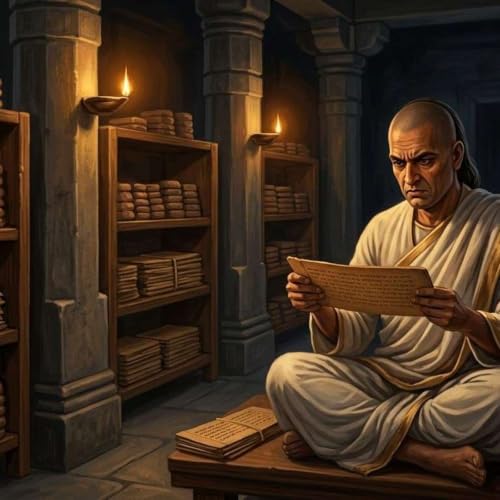
    In 1905, a young Sanskrit scholar named Rudrapatna Shamasastry was working through a heap of palm leaf manuscripts in the Mysore Oriental Library, doing the kind of routine cataloguing work a librarian does every day.

    Then he opened one written in the Grantha script, and the words stopped being routine.

    He was holding the Arthashastra. Chanakya's lost political treatise, written for the Mauryan Empire roughly twenty four centuries earlier. A book European scholars believed might never have survived, because it had vanished from circulation sometime around the 12th century and had not been seen by a single scholar anywhere on earth for nearly eight hundred years.

    Buried inside its second book is a chapter Chanakya titled, with characteristic bluntness, Detection of Embezzlement by Government Officials. In it, the man who helped build one of the largest empires in the ancient world catalogued, in exhaustive detail, exactly forty distinct ways a government treasury official could steal from the state.

    This episode tells the story of that chapter, the empire it was written to protect, and the librarian who rescued it from eight centuries of silence.

    What You Will Discover in This Episode

    The complete story of Chanakya, also known as Kautilya, who helped a young Chandragupta Maurya build the first great political unification of the Indian subcontinent around 321 BCE, and his likely connection to the ancient university of Takshashila

    The forty distinct embezzlement techniques catalogued in Book Two, Chapter Eight of the Arthashastra, including mismatched gift records, phantom recipients and unrecorded raw materials, described with a precision that reads like a modern forensic accounting textbook

    Chanakya's investigative method of separately interrogating every official connected to a suspicious transaction, the treasurer, the authoriser, the receiver, the payer, to prevent coordinated false testimony, a principle still used in fraud investigations today

    The honest limitation Chanakya built into his own system, comparing the near impossibility of catching a dishonest official to determining whether a fish swimming underwater has swallowed any of the water around it

    How the Arthashastra, an influential and widely cited text for centuries, simply disappeared from circulation around the 12th century, vanishing so completely that an entire tradition of European scholarship grew up believing ancient India had learned its principles of statecraft from the Greeks

    The story of Rudrapatna Shamasastry, born in 1868 on the banks of the Kaveri river, who mastered Sanskrit, Vedic literature, Prakrit, English, German and French before becoming the Mysore Oriental Library cataloguer who discovered the lost manuscript in 1905, published the Sanskrit edition in 1909, and completed the first English translation in 1915

    Why Shamasastry's discovery has been called an epoch making event in the history of the study of ancient Indian polity, and how it overturned a settled European assumption about where ancient India's statecraft came from

    Where the original palm leaf manuscript is preserved today, at the Oriental Research Institute in Mysore, alongside nearly sixty thousand other classical Indian manuscripts

    How 5 Senses Tours brings the complete story of Chanakya, Takshashila and the Mysore manuscript discovery to life for international travellers

    Experience Chanakya's Mysore With 5 Senses Tours

    The palm leaf manuscript Shamasastry discovered in 1905 is still preserved at the Oriental Research Institute in Mysore, alongside the Mysore Palace and the city's deep Sanskrit scholarly tradition.

    Our Royal Mysore tour explores this heritage in full at https://5sensestours.com/tour/tour-of-mysore/

    Our Mysore day tour from Bangalore covers the same heritage as a convenient day trip at https://5sensestours.com/tour/mysore-tour/

    For a customised journey connecting Chanakya, Panini and the ancient university of Takshashila, contact us at https://5sensestours.com/

    5 Senses Tours is recognised by India's Ministry of Tourism, winner of the Tripadvisor Travellers Choice Award and the Outlook Responsible Tourism Award. Every tour is private, expert guided and completely customised for your group.

    Mehr anzeigen Weniger anzeigen
    19 Min.
  • Panini: The World's First Programmer Wrote Code in Sanskrit, Twenty Five Centuries Before Computers Existed
    Jun 21 2026
    In 1959 a computer scientist named John Backus invented a notation for describing the grammar of programming languages.It is called Backus Naur Form, and it is one of the foundational tools of modern computer science. Every programming language you have ever used was at some point defined using a descendant of this notation.In 1967 a researcher reading an old Sanskrit grammar wrote a letter to the Communications of the ACM, the most respected computer science journal in the world, to point out something extraordinary.Someone had already invented Backus Naur Form. Twenty five hundred years earlier. In Sanskrit.Panini was a scholar who flourished between 400 and 200 BC, and in order to describe the rules of Sanskrit grammar he invented a notation equivalent in its power to that of Backus.The researchers proposed a new name for the notation computer scientists had been using for nine years.The Panini Backus Form.This episode tells the story of Panini, the Sanskrit grammarian born near the Indus river in what is now Pakistan, who wrote a grammar so rigorous, so mechanical and so completely rule based that twenty five centuries later, computer scientists building the first programming languages discovered he had already solved their problem.What You Will Discover in This EpisodeThe complete story of Panini, born in Shalatula near Attock on the Indus river sometime between the 4th and 7th century BC, and his likely connection to the ancient university of Taxila, which also produced Chanakya, the strategist behind the Mauryan Empire, and Charaka, the father of Ayurvedic medicineThe structure of the Ashtadhyayi, Panini's eight chapter grammar of Sanskrit containing approximately 4000 sutras, generative rules that completely define the language mechanically rather than through memorised examples, in a structure modern linguists compare directly to a formal computer programming languageHow Panini classified 1700 basic linguistic elements into systematic categories using single letter symbolic markers called anubandhas, a technique functionally identical to how modern programmers define variable classes and apply functions across entire categories of dataThe 1967 letter to the Communications of the ACM in which researcher P Z Ingerman demonstrated that Panini's notation was structurally equivalent in power to Backus Naur Form, leading to the proposed term Panini Backus Form, and why this discovery mattered so much precisely because Backus had developed his notation independently, with no knowledge of Panini's workHow Panini's rule based grammar uses recursion, transformations and metarules, rules about rules, in an architecture that mirrors exactly how a modern compiler operates, where certain rules transform raw input and higher order rules determine which transformations apply and in which orderWhy Sanskrit, structured according to Panini's deterministic grammar, has become a subject of active research in modern artificial intelligence and large language models, with researchers finding that Panini's generative rules offer measurable computational efficiency advantages over languages that rely on memorised patternsThe honest and important distinction between what Panini actually achieved, a complete formal system describing an existing human language, and what Backus and Naur achieved, an artificial language built for a machine, and why the structural toolkit required to solve both problems with total precision turned out to be, almost exactly, the same toolkitHow Panini connects to India's broader ancient scientific tradition, including Kanada's atomic theory in Gujarat, the calculus described by Karnataka's mathematicians five centuries before Newton, and the modern physics achievements of Kolkata's Bengali scientists, forming an unbroken line of rigorous Indian thought spanning more than two thousand yearsHow 5 Senses Tours brings the complete ancient Indian science and intellectual heritage trail to life for international travellers through expert guided experiences connecting Delhi, Gujarat, Karnataka and KolkataExperience Panini's World With 5 Senses ToursPanini's birthplace near the Indus river sits within reach of one of the most historically layered regions accessible from northern India, and the broader story he belongs to stretches across the entire subcontinent.Our Delhi tours connect international travellers to the closest major gateway for exploring this ancient intellectual landscape at https://5sensestours.com/home-delhi-tours/Travellers who want to walk the same ground that shaped Kanada's atomic theory can extend their journey to our Ahmedabad tours in Gujarat at https://5sensestours.com/home-ahmedabad-tours/The calculus described by Karnataka's mathematicians five centuries before Newton comes alive through our Karnataka tours at https://5sensestours.com/home-karnataka-tours/The quantum physics breakthroughs of Kolkata's Bengali scientists are covered in full through our Kolkata tours at ...
    Mehr anzeigen Weniger anzeigen
    19 Min.
adbl_web_anon_alc_button_suppression_t1
Noch keine Rezensionen vorhanden