• Marcescence (and a blanket of snow)
    Jan 8 2026

    There are few things on this planet as peaceful as walking in a New England forest after a snowstorm. The sound deadening blanket covering the earth creates a blissful silence and is the perfect tonic for an overly noisy world. The welcomed hush is broken only by the gentle rustle of leaves stubbornly clinging to a few outlying trees.

    Most deciduous trees drop their leaves as soon as the color fades in Autumn. But a few, like white oak and beech trees, are “marcescent” and hold on to their dead leaves through the winter. Researchers have yet to agree on why these trees do this. Some theorize that marcescent leaves provide a fresh layer of mulch in the spring when the trees need it most. Some think the retained leaves offer shelter for birds, which in turn fertilize the ground below them. Some think the unappetizingly dead leaves help protect the tasty new buds from being eaten by browsing herbivores. I’ve often thought that the leaves were just left there for me to enjoy, like muted wind chimes on a wintry day.

    Curiously though, and perhaps revealingly so, is that the majority of marcescent leaves are within twenty feet of the ground. A white oak tree which might be eighty feet tall, will only retain the leaves on its lower branches. If the purpose of marcescence is to provide a layer of mulch, or shelter for the birds, surely retaining the upper leaves would be useful as well.

    The fact that the only leaves retained are ones within reach of passing herbivores lends credence to the theory that it’s a form of protection from grazing. To discourage our contemporary white-tailed deer, the twenty-foot cut off point is definitely overkill, but oak and beech trees evolved for millions of years in the company of giant sloths and mastodons. In fact, back when beavers were the size of bears (about 10,000 years ago), your average run of the mill herbivore could easily have grazed from the gutters of a two-story home.

    The only things that kept those super-sized grazers from consuming the entire planet were the equally impressive hypercarnivores that hunted them. Despite today’s allure, I seriously doubt I’d find my meandering wintertime stroll so relaxing if I had to share the forest with saber tooth tigers, American cheetahs, and dire wolves. Perhaps the true purpose of the marcescent leaves is to serve as a reminder that though the modern world might seem loud and at times stressful, at least I can aspire to be something more than just an appetizer in the food chain of life.


    This is a public episode. If you would like to discuss this with other subscribers or get access to bonus episodes, visit clatterridgefarm.substack.com
    Mehr anzeigen Weniger anzeigen
    3 Min.
  • Counting Peas
    Jan 1 2026

    Our friends with culinary ties to the South made their annual pilgrimage to buy smoked pork jowl from our farm last week. The jowl is traditionally cooked with collard greens, black-eyed-peas and served with cornbread. All of which are believed to bring good luck and prosperity in the New Year. The meal served either at midnight, or on New Year’s Day, has many iterations across the South and very specific ingredients and traditions surrounding each variation. I can’t keep track of them all but the gist of it is that the black-eyed-peas are considered a “lowly food” and eating them shows humility - which in turn will be recognized and rewarded by God.

    The color of the collard greens symbolizes money, and the color of the cornbread symbolizes gold.

    Hogs represent prosperity, because historically, if you owned a hog, your family would have plenty of food for the winter. Also, because pigs can’t turn their heads to look over their shoulder, they symbolize a “forward looking” nature which is perfect for the start of a new year, and of progress towards one’s goals.

    Out of curiosity I ask everyone who purchases our jowl how they cook it and how they celebrate the New Year. Everyone seems very happily committed and amused by their family’s interpretation of the tradition.

    Some make “Hoppin Johns” with black-eyed-peas, greens, rice, and pork.

    Some use kale, or cabbage instead of collard greens.

    Some use smoked ham hocks instead of jowl bacon.

    Some put pennies in the dish - some put a penny under the dish.

    Some swear the coin must be silver and placed inside the pot – or not.

    Most use black-eyed-peas, but some substitute red peas, lentils, or cow peas.

    Some are very committed to the exact number of peas that must be eaten. Too many or too few can bring bad luck – or good luck, depending on who you ask.

    Anne’s and my own New Year’s Day tradition is much less complicated. We drive to Hammonasset Beach and watch as the sun rises over the ocean. This year standing at the edge of our world, we watched the tide come in and the sun come up. Surrounded by magic, filled with awe, and overwhelmed with gratitude, I tried to count all my blessings. If happiness has a monetary value, I’m as prosperous as anyone I’ve ever known. In this coming year, there isn’t a lot more I would wish for myself but if I thought it would result in a kinder,saner planet, I’d happily eat my body weight in black-eyed-peas.


    This is a public episode. If you would like to discuss this with other subscribers or get access to bonus episodes, visit clatterridgefarm.substack.com
    Mehr anzeigen Weniger anzeigen
    3 Min.
  • In Praise of the Christmas Orange
    Dec 26 2025

    I always thought my mom’s tradition of putting an orange in the bottom of everyone’s stocking was a waste of perfectly usable stocking space, and I told her so every Christmas. She explained that growing up oranges were a special treat, and as a child, one of the magical joys of Christmas. As a kid I found that hard to believe, but it makes sense to me now. In an era before refrigeration and mass transportation, everyone ate locally. You knew your farmer, and you ate what was in season, and I can certainly imagine how exciting something as exotic as an orange, grown in a faraway place by total strangers would be to a small child. I’ll likely never know the thrill of such “exotic” food, as now everything is shipped everywhere and available any time of year. Probably the closest I could come to that kind of culinary thrill is tasting something that is just absurdly expensive.

    On one of the first Christmases that I spent away from home, my mom sent me a small package, labeled very clearly “not to be opened until Christmas morning”. I should have known what it was, but it was small enough, and light enough, that I didn’t think about it, I just stuck it in the bottom of my backpack as a friend and I headed out to hike the Kalalau Trail on the Na Pali coast of Kauai.

    The hike was strenuous but the views and the beach at the end of that hike were absolutely stunning. A mile of pristine sandy beach nestled between the ocean and the cliffs of the Kalalau Valley. The place was completely deserted except for a couple we could see setting up their tent at the far end of the beach.

    It was a surreal spot for a New Englander to spend Christmas eve. I fell asleep on the beach, under the stars, to the sound of a 300-foot waterfall thundering into the ocean below.

    I awoke, just before dawn on Christmas morning, when the unnerving sound of waves coming in way too close and way too fast, pierced my consciousness. We quickly moved to the elevated safety of the dunes and waited for sunrise.

    As the sun came up, we could see that the couple down the beach had not been so lucky. They lost everything to that rogue wave. It had swept them away while they were zipped up and sound asleep inside their tent. They managed to get out of their tent and swim to shore but lost everything they had brought with them. They were completely traumatized, but very happy to be alive.

    The four of us walked the beach trying to retrieve anything we could find in the roiling surf. We recovered a tent pole, a hiking boot, and a couple random things, but there was actually very little the ocean was willing to give up. At some point we stopped looking, sat down, and with a deep sense of gratitude for just being alive, we wished each other a Merry Christmas...

    We eventually left the couple there on the beach - shoe-less, and still wearing their wet pajamas- promising to contact the park ranger as soon as we got back to our car, so that a helicopter would be sent in to air lift them out. Before we left, though, I opened the package from my mom. My “Christmas Orange” looked pathetic, alone in that box, with no stocking, wrapping paper, or gifts to keep it company - but split four ways, that orange tasted every bit as exotic, as my mom had always claimed them to be

    .


    This is a public episode. If you would like to discuss this with other subscribers or get access to bonus episodes, visit clatterridgefarm.substack.com
    Mehr anzeigen Weniger anzeigen
    3 Min.
  • The Scruffiest Tree
    Dec 19 2025

    When we were kids, we were fortunate enough to be able to cut our own Christmas trees, and of all our holiday traditions, getting the tree was definitely my favorite.

    We’d head out the back door and climb up the quarter mile path through the ravine to a grove of spruce trees that my grandmother had tasked my uncles with planting years before.

    Our Christmas tree lot was deeply magical. The trees, by then, were magnificently tall, perfectly formed, and densely packed. We’d wander about and look at each one in search of the perfect tree. The snow laden branches would glisten in the sun, and every tree seemed prettier than the last.

    There was always much debate about which tree was the most perfect one of all, but in the end my dad would insist that whatever tree we cut, had to be a tree that by its removal, left the forest better off.

    That was my dad. To own land was a privilege and an honor - it was not a commodity to sell or harvest lightly. It was our responsibility to care for, and to protect our land. It was all about “stewardship” not just about getting the perfect tree.

    So, from this quintessential New England Christmas vision, we would haul home the scruffiest tree in the forest and lovingly give it the place of pride inside our home.


    This is a public episode. If you would like to discuss this with other subscribers or get access to bonus episodes, visit clatterridgefarm.substack.com
    Mehr anzeigen Weniger anzeigen
    1 Min.
  • A Fox, a Crow, and Me
    Dec 13 2025

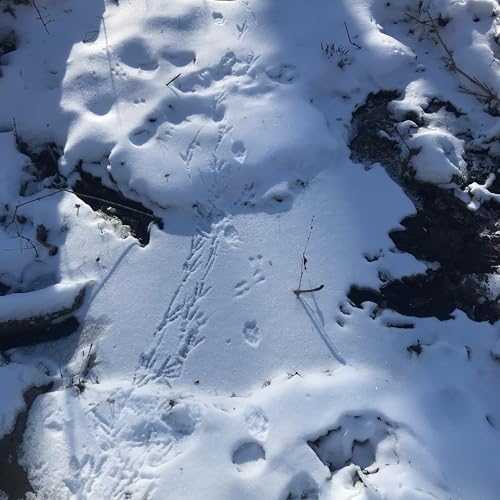
    Just as the sun came up, the snow stopped, and the wind moved on. It was so bitterly cold, though, the only hope of staying warm was to just keep moving. I wanted to check the fence line for any trees that might have come down in the storm, and I was indeed making great time. When I crossed the stream, though, a series of tracks caught my eye. Pleased to see that I wasn’t the only one out doing chores in the freezing cold, I paused for a while to look at the storyboard recorded in the snow.

    A mouse, taking advantage of the lull in the storm, had emerged from its burrow under a fallen tree and traveled to the edge of the stream to get a drink.

    Soon afterwards, a crow landed, its wings leaving a distinctive impression in the snow, and brushing away some of the tracks the mouse had left behind.

    A fox, clearly on its way to somewhere important (or hoping, at least, to avoid running into me) also trotted purposefully through.

    My own journey left a trail as well. My footsteps could be tracked moving quickly along the fence line and crossing the stream, pausing just long enough to read the story in the snow.

    Soon enough, the winds picked up again and erased every trace of us all. A mouse, a fox, a crow – and me.


    This is a public episode. If you would like to discuss this with other subscribers or get access to bonus episodes, visit clatterridgefarm.substack.com
    Mehr anzeigen Weniger anzeigen
    1 Min.
  • The Prettiest Pigs in Town
    Dec 4 2025

    On this cold December morning, the witch hazel in our wooded pig pasture seems quite pleased with itself. Long after all our autumn leaves have fallen and every other plant has completely faded, Connecticut’s native witch hazel comes into bloom. The timing seems self-defeating as there are very few cold tolerant insects this time of year that are available to pollinate it. It is, however, the only blossoming game in town, so despite how few pollinators there are, there is no competition for their services. The thermoregulating moths are attracted to witch hazel’s showy yellow flowers and fragrance - and songbirds are attracted to the protein rich moths.

    Despite that lack of competition, witch hazel seeds have an abysmally low viability rate. Though pollinated in late fall, fertilization is delayed until spring when the seeds begin to form inside a pod. As summer progresses, the pods dry out and just about the time the new blossoms appear in November, the pod explodes and ejects the seeds 10-40 feet away. Once on the ground, it takes another year, or two, for the seeds to germinate – allowing an exceptionally long window of opportunity for hungry critters to discover them. The fact that the evolutionarily challenged shrub ever successfully reproduces at all is amazing.

    Witch hazel has been revered by humans (and moth eating songbirds) for centuries. Its branches were commonly used for dowsing as a means of locating underground water sources. The “y” shaped branches were known as “divining” or “witching” wands and that’s likely how the shrub got its name.

    Though dowsing for water has fallen out of favor by farmers and well drillers, distilled witch hazel is still a multi-million dollar industry. Connecticut is, in fact, the witch hazel capital of the world, as the majority of distilled witch hazel used worldwide is grown and produced here. Millions of gallons are distilled each year from CT grown witch hazel bark and twigs. Elizabeth Arden, Este Lauder, Avon and Revlon all use Connecticut witch hazel in their products.

    Watching our pigs bathe in the mud beneath this world-famous beauty product, I think to myself “is it any wonder our pigs are so darn pretty.”


    This is a public episode. If you would like to discuss this with other subscribers or get access to bonus episodes, visit clatterridgefarm.substack.com
    Mehr anzeigen Weniger anzeigen
    2 Min.
  • And a Whole Lot of Time
    Nov 28 2025

    15,000 years ago, our farm (and the rest of New England) was covered with a sheet of ice a mile thick. As the glacier receded, it left behind barren rock, glacial till and valleys filled with lakes. The surface of New England had been scrubbed clean of whatever topsoil, earthworms, and megafauna that had lived here before. We had to completely start over from scratch.

    Lichen recolonized the rock – while shrubs and moss grew along the shores of the glacial lakes that were left behind. Grasses filled in quickly (glacially speaking) creating a treeless tundra populated by ancient horses, dire wolves, giant beaver, camels, and migrating herds of mastodons, and wooly mammoths. The grass followed the melting ice and rain, and the grazing animals followed the grass. Small bands of nomadic humans followed them both, across the Bering Strait and into the Americas.

    Within a few thousand years, Paleo-Americans were encamped on the Farmington River. The river provided an abundance of water and an assortment of fish, and the Metacomet Ridge (upon which Anne and I built our home) was the perfect elevated vantage point from which to spot the dust clouds that alerted hunters to the arrival of migrating herds. Around10,000 years ago, those ice age animals became extinct and were replaced by the more familiar caribou, white tailed deer, moose, bear and elk.

    While we were building our barn on the ridge, I found a spear point which the State Archaeologist said was 4,000-6,000 years old. It’s in perfect shape, and I often wonder how it came to be left behind. Unlike Anne’s spate of missing sunglasses, I doubt it was simply misplaced or left on the hood of a car. It was most likely lost during a hunt or buried, with ceremony, alongside its rightful owner.

    Heading out to feed the animals this morning, there was a dense fog blanketing the valley below. The fog followed the course and the bend of the Farmington River, from north to south and back up north again. As I watched from the ridge, the fog dissipated as the sun rose, and I was reminded of the glacier in retreat, and of how much has come and gone since then. From barren rock to fertile soils, from dire wolves to the paleo point I held in my hand. There’s an odd sense of serenity in knowing that we humans are but a tiny blip on this planet’s timeline, and that ultimately, she’ll be just fine without us. She has, in fact, moved on and started over, plenty of times before. All she needs is a little bit of lichen - and a whole lot of time.


    This is a public episode. If you would like to discuss this with other subscribers or get access to bonus episodes, visit clatterridgefarm.substack.com
    Mehr anzeigen Weniger anzeigen
    3 Min.
  • The Luckiest Squirrel
    Nov 21 2025

    Halfway up the path through our ravine is a shagbark hickory tree that never seems to grow. It appears happy enough, but it’s been the same size since I was a kid. I’m sure that the limited nutrients from the rocky talus slope and the struggle of living in the shade of larger oaks has stunted its growth. But it’s not just the tree itself which never seems to age but the hole in its trunk never seems to change either. It’s neither healed, nor deteriorated, in all the years that I’ve known it. Waist high and facing the path, the hole isn’t very large – perhaps big enough for a child’s hand to fit inside, if ever there was a child brave enough to try.

    My mom always dropped a nut in the hole as she walked by. “One nut for each safe passage” she’d say. She was never very clear about what would happen if you didn’t pay – but I got the feeling it was a bit of a moral failing, something you tried to avoid as best you could. My older sister insists it’s way more consequential, with talk of vengeful trolls and such. I have doubts about this though, because for all the times I’ve been distracted and just hurried past, nothing bad ever happened to me, other than immediately hearing my mother’s voice once again, chiding me “where were you brought up child?”

    Being that the tree is hickory, finding nuts this time of year is easy, but by Spring finding any kind of nut can be a challenge. Sometimes the best that can be found is a leftover cap from an acorn, so I’ll drop that in and hurry along – hoping that the slight goes unnoticed. When nuts are abundant, though, I’ll deposit a handful and hope that it evens up the score.

    My sisters and I instilled this tree feeding ethic to our children, our grandchildren and to our friends as well. In fact, when friends from Manhattan were walking in Central Park, they reported that their 3-year-old insisted on feeding a tree with every nut he found. He wandered about, nut in hand looking for trees with a suitable hole.

    I said, “how absolutely wonderful!” I felt very proud to have had such an outsized influence on a child. His parents agreed that it was very sweet - but allowed as how it was also a terribly inefficient way to actually get anywhere.

    Even though the number of nut-bearing travelers has grown exponentially over the years, the hollowed-out trunk never gets full. It seems multiple generations of self-contented squirrels have been born to this tree, where all the children who pass by happily collect a winter’s supply of nuts for them. What an incredibly lucky family of squirrels! I’m certain, though, that the multiple generations of children who have also been born to this tree, have been even luckier still.


    This is a public episode. If you would like to discuss this with other subscribers or get access to bonus episodes, visit clatterridgefarm.substack.com
    Mehr anzeigen Weniger anzeigen
    3 Min.