How I Grew This Titelbild

How I Grew This

How I Grew This

Von: Branch
Jetzt kostenlos hören, ohne Abo

Über diesen Titel

Dive into the dynamic world of digital marketing with Amanda Vandiver and Adam Landis in “How I Grew This,” where we invite leaders in the space to explore how they overcome industry challenges to achieve growth. Expect insightful conversations that uncover the secrets of our guest’s success in the ever-evolving landscape of digital marketing.2025 Branch Metrics Management & Leadership Marketing & Vertrieb Persönliche Entwicklung Persönlicher Erfolg Ökonomie
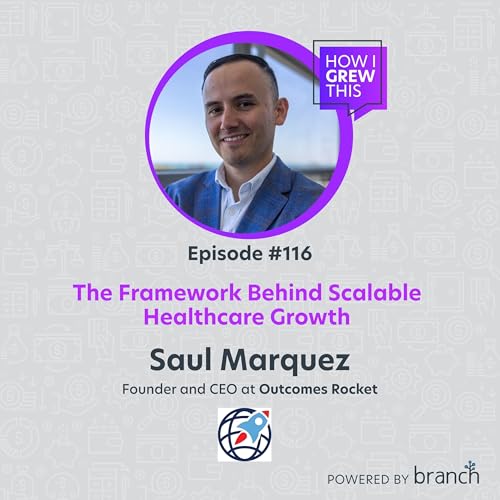
  • Personalization vs. Privacy: How Healthcare Marketers Can Win Both with Saul Marquez
    Feb 19 2026
    What if your health tech marketing strategy is actually holding you back from growth? In this episode, Amanda and Adam sit down with Saul Marquez, founder and CEO of Outcomes Rocket, to explore why most health care companies are missing critical strategy before tactics, how to navigate HIPAA without fear while personalizing your marketing, and the key opportunities in influencer marketing and AI integration that your competitors are sleeping on. Whether you're a health tech founder, marketer, or growth leader, this conversation is packed with actionable frameworks—from the three D's of marketing (discover, define, deliver) to leveraging custom GPTs for team alignment—to help you cut through the noise and focus on execution in 2026. Tune in to uncover why strategy comes first, always, and how the convergence of health tech and medical device playbooks is creating unprecedented opportunities.What You’ll Learn:The "Three D Framework" (Discover, Define, Deliver)How to leverage micro-influencers (10K–50K followers) in B2B health careWhy "tactics are the noise you hear before the war is lost"How to implement a custom GPT as your team's "source of truth"The convergence of health tech and medical device marketing playbooksWhy HIPAA compliance fears are overblownThe 2026 execution imperativeAbout the Guest(s):Saul Marquez is the Founder and CEO of Outcomes Rocket, a healthcare-exclusive marketing, media, and advisory firm specializing in helping health tech and medical device companies accelerate growth. With over 20 years of experience in the medical device industry—including a tenure as Vice President at Medtronic and field experience as a medical device representative—Marquez brings deep operational and market insights to healthcare marketing strategy. A prolific podcast host with over 2,000 episodes across multiple shows, he has interviewed hundreds of healthcare leaders and identified critical market trends at the intersection of health tech and medical device innovation. In this episode, Marquez shares his proprietary three-D framework (Discover, Define, Deliver) for healthcare marketing success, explores the convergence of health tech and medtech, and provides actionable guidance on leveraging AI as a strategic tool rather than a distraction. His insights on regulatory compliance, personalization within HIPAA constraints, and the future of healthcare marketing make this conversation essential listening for health tech professionals, CMOs, and entrepreneurs looking to execute with precision in an increasingly complex market.If you enjoyed this episode, make sure to subscribe, rate, and review it on Apple Podcasts, Spotify, and YouTube Podcasts. Instructions on how to do this are here.Episode Highlights:[00:16:14] Apply the Three D Framework: Discover, Define, Deliver - Saul's proprietary Three D Framework provides a simple yet comprehensive structure for building effective health care marketing programs that eliminate decision paralysis. The **Discover phase** involves asking hard questions about your goals, target audiences, key metrics, and overall go-to-market strategy, ensuring alignment on what success looks like. In the **Define phase**, you crystallize your go-to-market strategy, establish frameworks and roadmaps, and set KPIs that will measure success or failure throughout your campaign. The **Deliver phase** encompasses executing tactics across three buckets—owned, earned, and paid media—with the advantage that your earlier discovery and definition work eliminates wasteful noise and focuses spending. Once you've delivered and gathered data, you iterate continuously based on KPI performance, doubling down on what works and adjusting what doesn't. For health care companies struggling with fragmented marketing efforts, this framework provides the clarity needed to move from scattered activity to coordinated, measurable growth.[00:19:35] Micro-Influencers (10K–50K Followers) Represent an Underutilized B2B Health Care Opportunity - Saul identifies that B2B health care marketing is "asleep at the wheel" on influencer marketing, particularly leveraging micro-influencers in the 10,000 to 50,000 follower range across platforms like LinkedIn. These niche creators show higher willingness to collaborate with brands, deliver more targeted audiences, and produce measurable impact that often exceeds traditional email or paid advertising methods. Health care marketers can identify relevant micro-influencers by using ChatGPT to search for niche voices in their specialty—whether that's cardiology, orthopedics, or health tech innovation—and approaching them directly with collaboration proposals. Measurement of influencer campaigns can focus on brand awareness (site visits, click-through rates) or mid-to-bottom funnel metrics (conversions from qualified personas), depending on your campaign goals. Since most health care companies haven't yet systematized influencer outreach, first movers in ...
    Mehr anzeigen Weniger anzeigen
    36 Min.
  • Why Your Mobile App Strategy Is Backwards — and What to Do Instead (with Matt Hudson)
    Feb 5 2026
    What if your mobile app strategy was holding back your entire company's growth? In this episode, Amanda and Adam welcome back Matt Hudson, founder of BILDIT, to discuss why mobile-first thinking isn't just about technology—it's an organizational imperative. From breaking down the real ROI of app investment and the myth of channel cannibalization, to preparing your ecommerce business for AI discovery optimization, Matt shares hard-won lessons on aligning teams, personalizing customer experiences, and staying ahead of LLM-driven search trends. Whether you're scaling retail, launching a mobile strategy, or wrestling with how to compete in an AI-first world, this conversation cuts through the noise to deliver actionable insights that will reshape how you think about customer engagement across all channels.What You’ll Learn:How to determine if your ecommerce business actually needs a mobile appWhy organizational alignment across teams matters more than technologyThe critical difference between SEO and AI discovery optimizationHow to immediately implement AI-ready data on your site todayWhy React Native and cross-functional web-and-mobile teams accelerate app growthHow AI personalization works at scale using embeddings and vectorsEpisode Highlights:[00:05:35] The Five-Point Framework for Determining If Your Business Needs a Mobile App - Matt Hudson shares a strategic framework to help ecommerce businesses evaluate whether a mobile app investment makes sense for their company. The framework addresses a critical question many retailers face: with limited resources, is building an app worth the effort and cost? Rather than assuming all businesses need apps, Hudson identifies five specific criteria: having 50,000+ SKUs, operating physical stores, running loyalty programs, generating $100M+ in revenue, and understanding that app users are your most loyal customers—not necessarily younger demographics. For example, a retailer with nearby physical locations sees 50% higher app usage within a 25-mile radius, proving that apps convert loyal, high-value customers who trust the brand. This framework helps ecommerce leaders make data-driven decisions about mobile strategy instead of following industry trends blindly.[00:11:36] Organizational Alignment Over Technology: Why Mobile App Growth Requires Company-Wide Buy-In - Matt Hudson reveals that mobile app success depends far less on technical excellence and far more on getting every department—from stores to marketing to IT—genuinely invested in the app's growth. The challenge most retailers face is that mobile and web teams operate in silos, compete for attribution credit, and prioritize their own channel's metrics over total revenue. Hudson explains that when the marketing team sees improved ROAS (return on ad spend) from app traffic, and when stores actively promote downloads, the app grows exponentially; without this organizational alignment, even a perfect user experience fails. A key tactic is seating app and marketing teams physically next to each other and tying bonuses to overall company revenue rather than channel-specific metrics. This organizational shift removes the false notion of "cannibalization" and ensures every team pushes customers to their best experience—whether web or app.[00:21:19] Optimize for AI Discovery (AIO) Now or Lose 90% of Your Search Traffic - Matt Hudson warns that traffic from AI-powered discovery is already replacing traditional Google search, with click-through rates dropping from 15% to as low as 8% (or lower), and the trend will only accelerate. Unlike Google's SEO, which indexes everything and rewards backlinks, AI discovery prioritizes authoritative sources—Reddit, Quora, FAQs, podcasts, and trusted voices—and cares about giving correct answers, not just showing available links. Retailers must shift strategy immediately: stop relying on keyword rankings and start building authority through FAQ-formatted content, detailed product descriptions, JSON-LD schema markup, and getting mentioned in trusted communities where real people validate your answers. The good news is that unlike SEO, this content doesn't need to be visible to users—you can hide FAQs below product pages specifically for AI consumption. For any retailer serious about discoverability in the next 2–3 years, implementing AIO optimization today is non-negotiable for maintaining visibility.[00:32:38] Layer Personalized Customer Data into Product Pages Today So LLMs Reference It Now - Matt Hudson advises ecommerce companies to immediately begin adding customer-specific, personalized data to product pages—not just generic descriptions—so that large language models start consuming and referencing this information in recommendations today, rather than waiting for "perfect" AI features. LLMs use three-dimensional embeddings and vectors to predict which tokens (words) come next based on a user's entire conversation history; if you provide ...
    Mehr anzeigen Weniger anzeigen
    43 Min.
  • Clarity Wins: The Fundamentals That Still Matter (Best of 2025)
    Jan 23 2026
    In 2025, growth didn’t stall because teams lacked tools—it stalled because they lacked clarity. AI accelerated everything, dashboards multiplied, and activity increased, yet decision-making quietly got worse.In this Best of 2025 compilation, Amanda and Adam revisit standout conversations with growth, product, and leadership operators to uncover a shared truth: the teams that won weren’t moving faster—they were seeing more clearly. From subscription app fundamentals and AI attribution to leadership focus, creative guardrails, and defensibility in an agent-led future, this episode connects the patterns that actually held up.You’ll learn why understanding your funnel matters more than scaling it, why server logs reveal what analytics dashboards miss, where “vibe coding” breaks down, and why saying no is often the most strategic decision a leader can make.If you’re building, leading, or navigating an AI-first world, this episode is a reminder that the fundamentals never stopped mattering. Episode Highlights:[00:01:01] Build Subscription Apps on Clear Metrics, Not Blind ScalingTakeaway: If you can’t see your funnel end-to-end, you’re guessing—and scaling guesswork is how apps die.Shumel explains that early-stage subscription app founders often rush into growth before setting up the analytics that actually matter. Many compare themselves to mature competitors with completely different economics, timelines, and data maturity. The real work starts by tagging the right events early so you can see how users move from app open to registration to engagement—and how different subscription tiers (weekly vs. annual) change behavior. Once that visibility exists, founders can model realistic unit economics like CAC, LTV, and payback period instead of chasing premature ROI. Clarity here prevents expensive scaling mistakes and gives teams a foundation they can trust.[00:04:34] Use Server Logs as Your Most Reliable AI Attribution SignalTakeaway: Your analytics dashboard is lying to you—server logs are the source of truth.Jason breaks down why standard tools like GA4 fail to show how AI models interact with your content. AI systems like ChatGPT use multiple bots for training, retrieval, and other functions, and their activity never appears cleanly in traditional dashboards. Server logs, however, capture every request. By analyzing them, teams can see which content AI models actually reference, how often training bots consume data, and what traffic flows from AI tools like Perplexity. This uncomfortable clarity lets brands make smarter content decisions in an AI-driven distribution landscape where polished dashboards obscure reality.[00:07:59] Know Where AI Accelerates Your Team—and Where It Creates RiskTakeaway: AI should speed up judgment, not replace it.Robert explains that “vibe coding” works well for proofs of concept and simple applications but breaks down in regulated environments and complex legacy systems. In fintech and healthcare, security, compliance, and maintainability still demand human oversight. His team uses AI tools like Microsoft Copilot to eliminate repetitive cognitive work—research, scaffolding, and suggestions—so engineers can focus on architecture and risk. The advantage isn’t letting AI build the product for you; it’s freeing your best people to make the decisions that keep the business safe and defensible.[00:10:06] Lead Through Mission Clarity and Ruthless Focus, Not Heroic EffortTakeaway: Too many priorities feel urgent—clarity tells teams what to ignore.Patrick shares a leadership framework centered on repeatedly resetting the mission: who you’re building for and why. When teams juggle too many “important” initiatives, progress stalls and morale drops. His antidote is ruthless prioritization—actively unfocusing from false emergencies—and creating structured space for creativity through hackathons and design challenges. He also challenges the idea that technical PMs must code, arguing that curiosity and supported learning matter more. In fast-moving environments, clarity isn’t motivational fluff—it’s how teams survive sustained pressure.[00:13:14] Use Principles as an Operating System, Not DecorationTakeaway: Saying no isn’t a luxury—it’s how durable businesses are built.Mick shows how principled constraints create long-term advantage. By declining gambling and gaming clients and focusing tightly on mobile, his agency protected quality, talent, and culture—even when cash flow was tight. Early-stage companies don’t lack ambition; they lack focus. Prioritizing payroll, vendors, and sustainable growth over personal draw builds trust internally and externally. Over time, this creates a compounding effect: trained leaders pass down standards and judgment that outside hires can’t replicate. Principles stop being slogans and become infrastructure.[00:17:36] Use Guardrails to Unlock Creativity Instead of Stifling ItTakeaway: ...
    Mehr anzeigen Weniger anzeigen
    29 Min.
Noch keine Rezensionen vorhanden