Fungos & Fastballs: Baseball History & Trivia Titelbild

Fungos & Fastballs: Baseball History & Trivia

Fungos & Fastballs: Baseball History & Trivia

Von: Jerry Dynes
Jetzt kostenlos hören, ohne Abo

Über diesen Titel

Join us on this podcast exploring baseball's history and lore, plus enjoy some fastball trivia all in under 30 minutes. Topics will be all over the place - players, traditions, baseball lingo, stadiums, baseball movies/books. Like you, we just want to talk baseball!

© 2026 Fungos & Fastballs: Baseball History & Trivia
Baseball & Softball Welt
  • 7th Inning Stretch: Baseball's Midgame Pause Becomes a Beloved Ritual & NOBLETIGER Explained
    Feb 20 2026

    Send a text

    We start today with the meaning of the baseball acronym NobleTiger. No spoilers here - you'll just have to listen.

    Then we're on to the Seventh Inning Stretch. It feels timeless, but the story behind that stand-up-and-sing moment is far messier, funnier, and more revealing than the folklore suggests. We follow the ritual from scattered 19th-century notes and the “lucky seventh” label to the polished spectacle that fills ballparks today, testing the famous tale of President Taft against earlier sources and a surprising college origin that credits Brother Jasper with getting restless fans on their feet.

    Once the standing started, music turned the pause into a chorus. We revisit how Take Me Out to the Ball Game went from a 1908 tune to the soundtrack of togetherness, and how Harry Caray’s off-key charm made singing a stadium-wide tradition. From there, the stretch becomes a map of local identity: the Yankees’ God Bless America after 9/11, Milwaukee’s Beer Barrel Polka, Houston’s Deep in the Heart of Texas, Seattle’s tug-of-war over Louis Louie, the Orioles’ Thank God I’m a Country Boy, and the Mets’ Lazy Mary. Even Boston’s Sweet Caroline, famously a bottom-of-the-eighth anthem, shows how teams bend time with sound to make a place feel like theirs.

    We zoom out to global variations, including Japan’s Lucky Seven with skybound balloons and dueling fight songs, and Toronto’s literal stretching routine before the singalong. Not every experiment lands—sorry, Marlins—but the attempts reveal how clubs chase connection without losing the thread of tradition. Through it all, the stretch does what baseball does best: it invites everyone to slow down, breathe, and belong for a minute before the late-inning drama. Pull up the song in your head, grab your Cracker Jack, and consider the century of habit packed into that brief, joyful pause.

    Enjoyed this deep dive? Follow, share with a fellow fan, and leave a quick review to help others find the show. What’s your ballpark’s go-to stretch song—and do you sing, snack, or just soak it in?

    Mehr anzeigen Weniger anzeigen
    17 Min.
  • Chipper Jones, Forever Clutch And Forever Brave
    Feb 17 2026

    Send a text

    (Listener...this was our first recording...one mic, two people, one every inexperienced "producer"...sorry. We are getting better, so stick with us!)

    A single swing can rewrite a night, but a philosophy can define a franchise. We dive into the legend of Chipper Jones—why his switch-hitting precision, calm under pressure, and team-first choices still shape how Braves fans watch the game. From the TBS era that turned living rooms into nightly bleachers to the 1995 title run that cemented Atlanta’s modern identity, we connect the moments that made No. 10 more than a stat line.

    You’ll hear how a young shortstop became the Braves’ anchor at third, why more walks than strikeouts signals a rarer kind of greatness, and how hitting .300 from both sides placed him among the elite. We revisit the walk-up pulse of Crazy Train, the last hit at Atlanta–Fulton County Stadium and the first at Turner Field, and the infamous infield fly wildcard that tested a city’s patience. Along the way, we unpack undervalued defense at the hot corner, the injuries that complicated perception, and the unselfish move to left field to keep the roster strong.

    Stories carry this legacy forward: the AAA brawl punctuated by Jim Thome’s “Are you done?”, the snowbound night Chipper rescued Freddie Freeman by ATV, and the 2012 three-run walk-off that felt like a signature stamped in late ink. We trace how his approach—take what you’re given, hit it where it’s pitched—mentored a new core and kept influencing at-bats long after retirement. If you care about plate discipline, clutch DNA, Braves history, and how players become anchors for an entire fan base, you’ll find plenty to savor.

    Enjoy the ride, then stick around with us. Subscribe, share with a Braves fan, and leave a quick review telling us your most unforgettable Chipper moment.

    Mehr anzeigen Weniger anzeigen
    17 Min.
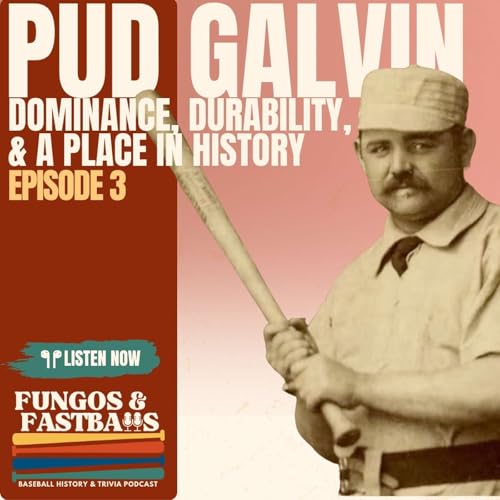
  • Pud Galvin, Forgotten Ace & Rush's Geddy Lee's Book 72 Stories
    Feb 11 2026

    Send a text

    Listen to Jerry, along with producer Brooke, to hear about a forgotten record holder Pud Galvin. Our first pitch is on Geddy Lee's baseball book.

    A coffee table book opened a door: from Geddy Lee’s unlikely baseball shrine and a donation to the Negro Leagues Baseball Museum to a web of autographs that includes Ruth, Eisenhower, Sinatra, Fidel Castro, and all four Beatles. That curiosity trail led us to a bigger fixation—how stories survive—and straight into the life of Pud Galvin, the nineteenth-century workhorse who helped build the record book but slipped out of memory. See Dan Rather interview at 22:30 for Geddy talking baseball. https://www.youtube.com/watch?v=GP_JvHFiNpo

    We trace Galvin’s path from St. Louis to Buffalo to Pittsburgh, unpacking a résumé that still startles: two no-hitters, 646 complete games, the first to 300 wins, and 20-plus victories in ten seasons without a pennant. The backdrop matters. Walks shrank from eight balls to four in a single decade, rotations ran two deep, and ERA didn’t even exist until historians backfilled it in the twentieth century. Through it all, Galvin thrived on control, guile, and a pickoff move so sharp SABR chronicles him loading the bases only to erase every runner and taunting Cap Anson by walking a batter just to nab him at first.

    We also reckon with a headline that feels modern: performance enhancement. Before an 1889 game, Galvin tried Brown-Séquard’s animal-extract “elixir,” tossed a two-hit shutout, and drew praise rather than outrage. Science later dismissed the tonic, but the episode exposes an old truth—athletes probe edges, and culture decides where the lines are. Finally, we follow the long road to recognition, where Buffalo historian Joseph M. Overfield’s advocacy helped pry open the Hall of Fame door in 1965, decades after Galvin died poor and largely forgotten. Join us for a brisk, story-rich tour that reframes early baseball, honors the researchers who rescue lost legends, and asks how we choose which heroes to remember.

    If this kind of baseball time travel hits your sweet spot, follow the show, share it with a fellow fan, and drop a review so more listeners can discover these stories.

    Mehr anzeigen Weniger anzeigen
    16 Min.
Noch keine Rezensionen vorhanden