Divergent Files Podcast Titelbild

Divergent Files Podcast

Divergent Files Podcast

Von: Divergent Files Podcast
Jetzt kostenlos hören, ohne Abo

Über diesen Titel

Divergent Files is not a conspiracy podcast. It’s a forensic investigation into the stories we’re told not to question.

We don’t follow prepackaged narratives from governments, academia, or corporate media. We don’t accept consensus because it’s convenient. We dissect the noise, challenge the assumptions, and surface what remains — using real documents, declassified material, and evidence most outlets won’t touch.

Hosted by Ralph, Divergent Files blends grounded skepticism with cinematic storytelling, where mythology collides with physics and curiosity is treated as a tool — not a threat. Every episode follows the evidence with an open mind, skeptical of cookie-cutter explanations and anchored in receipts, context, and uncomfortable contradictions.

From suppressed history and lost science to black-budget programs, intelligence operations, and reality-bending anomalies, the truth comes first — not institutions, not ideology, not optics.

This isn’t content.
It’s a challenge to the narrative.

Prefer visuals?

Many episodes have a companion video version featuring documents, footage, and visual evidence. You can watch those episodes on YouTube at:
www.YouTube.com/@DivergentFiles

Copyright 2024 All rights reserved.
Sozialwissenschaften Welt Wissenschaft
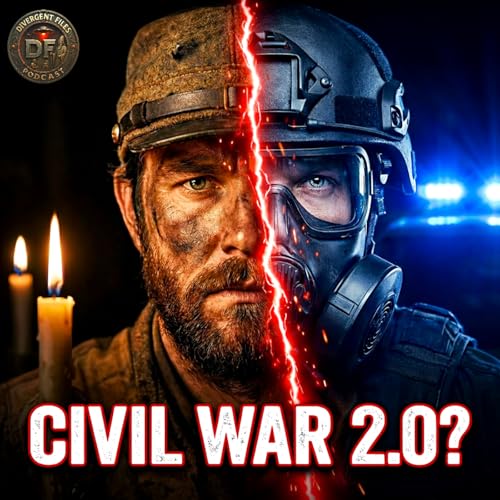
  • Second Civil War? The Last Time Americans Felt This Split, 1861 Followed
    Feb 18 2026

    In 1860, most Americans didn’t think a civil war was coming.
    They argued. They polarized. They distrusted each other. They believed the system would hold.

    It didn’t.

    In this episode of Divergent Files, we step past headlines and outrage cycles and ask a harder question: are we repeating the structural conditions that precede internal conflict?

    Not the surface-level noise. The deeper architecture.
    Civil wars don’t begin with a single spark. They form when pressure builds across systems — economic, cultural, informational, institutional — until the state can no longer mediate reality between competing groups.

    We examine what the United States actually looked like before 1861, economically and structurally. We explore the concept of “dual societies” existing inside one nation, and how modern political science identifies early-stage civil conflict. We break down economic divergence, elite fragmentation, and the collapse of shared information ecosystems. We analyze erosion of institutional trust, jurisdictional tension between state and federal power, and why modern internal conflict would not resemble 1861 — and why that difference matters.

    This isn’t fear-mongering.
    It’s pattern recognition.

    History shows that collapse rarely announces itself. It feels gradual. Rational. Manageable. Until it isn’t.

    The question isn’t whether Americans are angry. The question is whether the structural guardrails that prevent fracture are strengthening — or weakening.

    We don’t predict. We examine.
    Because once institutional trust erodes past a certain threshold, recovery becomes exponentially harder. And by the time a nation realizes it crossed the line, it’s already on the other side of it.

    Divergent Files investigates history, power, and systemic pressure points with receipts — not rhetoric.

    If you want outrage, there are plenty of places to find it.
    If you want to understand how societies actually break — and how they sometimes pull back from the edge — sit with this one.

    Mehr anzeigen Weniger anzeigen
    44 Min.
  • Philip K. Dick Predicted the Future — Then the Pattern Kept Repeating
    Feb 14 2026

    Philip K. Dick’s visions.
    VALIS.
    The Exegesis.

    Science fiction… or something closer to reality?

    In this episode of Divergent Files, we take a grounded, evidence-first look at one of the most enigmatic writers of the 20th century.

    Best known for inspiring Blade Runner, Minority Report, Total Recall, and A Scanner Darkly, Philip K. Dick didn’t just imagine dystopian futures. In 1974, after a series of unusual experiences he struggled to explain, he began writing obsessively—filling thousands of pages with philosophical reflections, metaphysical theories, and attempts to decode what he believed was a hidden layer of reality.

    He called it The Exegesis.

    Part journal.
    Part theology.
    Part cognitive self-interrogation.

    Inside those pages, Dick explored ideas that would later dominate modern culture:
    Artificial intelligence.
    Simulation theory.
    Surveillance states.
    Memory manipulation.
    False realities layered over consensus worlds.

    So what was happening?
    A psychological break?
    A neurological event?
    Creative intuition decades ahead of its time?
    Or something stranger that refuses easy labels?

    This investigation follows documented sources, biographical records, archived manuscripts, interviews, and historical context to separate what is verifiable from what remains speculative.

    We examine:
    • Philip K. Dick’s life and the timeline of the 1974 events
    • The structure and content of The Exegesis manuscripts
    • VALIS and its connection to Gnostic philosophy
    • Early conceptual parallels to simulation theory and artificial intelligence
    • The cultural and political environment of the 1970s
    • Government records and the paranoia era that shaped his worldview
    • The psychology of visionary and revelatory experiences

    No mythology.
    No mysticism added.
    No dismissive shortcuts either.

    Just the documented material and the questions that continue to echo decades later.

    Because the unsettling part isn’t that Philip K. Dick believed reality was unstable.

    It’s that many of the ideas he wrestled with are now central to modern technological culture.

    If you’re interested in science fiction history, philosophy of reality, consciousness research, or the intellectual roots of today’s AI-driven world, this case goes deeper than most people realize.

    Divergent Files is a long-form investigative podcast examining history, science, and unresolved questions through documented sources and careful analysis.

    Grounded.
    Receipts-first.
    No hype.

    Mehr anzeigen Weniger anzeigen
    45 Min.
  • The Chemtrails Debate: Weather Control, Aviation Science, and the Records Nobody Reads
    Feb 11 2026

    Why do some airplane trails vanish instantly…
    while others stretch across the sky for hours?

    For decades, this question has fueled one of the most persistent and polarizing debates on the internet: chemtrails. Some believe they point to covert spraying programs. Others insist it’s simple atmospheric physics. Most conversations collapse into ridicule or certainty.

    This episode doesn’t do either.

    In this Divergent Files investigation, we slow the conversation down and examine the actual record—the physics of contrails, the chemistry of jet exhaust, and the documented history of weather modification and climate intervention research that often gets flattened into online mythology.

    No hype.
    No fear.
    Just receipts.

    We examine:

    • What chemtrails are claimed to be—and why the idea persists
    • How contrails actually form at high altitude
    • Why temperature, humidity, and pressure determine whether trails spread or disappear
    • The real, documented history of cloud seeding and weather modification
    • Project Popeye and Cold War–era environmental warfare programs
    • Modern solar radiation management and geoengineering proposals
    • Aviation fuel chemistry and particulate emissions
    • Why large-scale “spraying” theories collapse under logistics, physics, and airspace regulation
    • And why distrust—not trails—keeps this debate alive

    This is not an episode telling you what to believe.
    It’s an investigation into why the chemtrails question refuses to go away—and what remains when speculation, ridicule, and algorithm-driven extremes are stripped out.

    Some claims don’t hold up.
    Some programs were very real.
    And some questions persist not because of evidence—but because institutional trust has eroded.

    If you’ve ever looked up at the sky and wondered what you were actually seeing overhead, this episode gives you the framework to evaluate it for yourself.

    Divergent Files is a long-form investigative podcast focused on evidence, historical context, and uncomfortable questions—especially when the conversation has been reduced to shouting matches.

    Listen carefully.
    Think slowly.
    And decide for yourself.

    Mehr anzeigen Weniger anzeigen
    40 Min.
Noch keine Rezensionen vorhanden