Folgen

  • Episode 31 - Book of Tobit (For Michael)
    Feb 6 2026

    What happens when you mix ancient Jewish history, a string of mysterious wedding-night murders, and a very unfortunate encounter with a sparrow? You get the Book of Tobit. In this episode, Daniel takes us on an ancient road trip through the 8th-century BCE Assyrian exile to explore one of the most cinematic stories in the Deuterocanonical tradition.

    We follow the righteous but blind Tobit, the cursed Sarah, and the young Tobias as they navigate a world of demons, angelic disguises, and medicinal fish guts. But it’s not just a tall tale—we’re diving deep into the academic and historical bones of the text. From the influence of Persian Zoroastrianism to the groundbreaking textual discoveries in the Dead Sea Scrolls, we’ll look at how the "Short" and "Long" versions of this story changed the way we understand divine providence. Whether you’re here for the Archangel Raphael or the critical analysis of Second Temple literature, this episode has something for every thinker.

    Mehr anzeigen Weniger anzeigen
    13 Min.
  • Episode 30 - The Celtic Church
    Jan 23 2026

    In this episode, Daniel navigates the "thin places" of the North Atlantic to uncover the gritty reality of Celtic Christianity. We move past the romantic myths to explore a radical world of monastic cities, oar-less voyages, and a philosophy that saw the entire natural world as a visible manifestation of the divine.

    From the high-level metaphysics of John Scotus Eriugena to the psychological depth of the Anmchara (Soul Friend), we examine how the "interlace" of the Celtic mind connected the human, the animal, and the sacred. Discover why this ancient, nature-centric expression of faith still haunts our modern imagination.

    In this episode:

    • Fact vs. Myth: Debunking the Victorian invention of the "Celtic Church."

    • Metaphysics: Eriugena’s fourfold division of Nature.

    • The Three Martyrdoms: Radical trust in the "Desert of the Sea."

    • The Interlace: Visualising the interconnectedness of all things through the Book of Kells.

    Mehr anzeigen Weniger anzeigen
    12 Min.
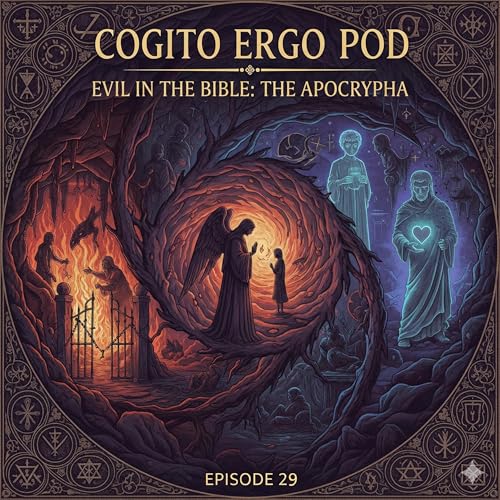
  • Episode 29 - Evil in the Bible: The Apocrypha
    Jan 15 2026

    In this episode of Cogito Ergo Pod, your host Daniel explores the shadows of the early Christian and Jewish imagination. While the canonical Bible provides the foundation for Western views on morality, many of our most vivid images of the Devil, the architecture of Hell, and the nature of betrayal actually stem from the "Expanded Universe"—texts written between the 1st and 4th centuries CE that didn't make the final cut of the New Testament.

    We often think of the Bible as a complete manual, but for early believers, there were massive narrative gaps. How did Satan fall? What exactly happens to sinners in the afterlife? What was Jesus like as a child? In this deep dive, we dissect the non-canonical answers to these questions.

    Mehr anzeigen Weniger anzeigen
    21 Min.
  • Episode 28 - Evil in the Bible: The Book of Revelation
    Jan 2 2026

    In this episode of Cogito Ergo Pod, Daniel dives into the most complex and controversial text in the Western canon: The Book of Revelation.

    Far more than a roadmap for the end of the world, Revelation serves as a profound "unveiling" of the systemic and cosmic forces that govern our reality. As the penultimate chapter in our series on Evil in the Bible, we move beyond simple archetypes to dissect the "Unholy Trinity"—the Dragon, the Beasts, and the False Prophet—and explore how this ancient text creates a scathing critique of political tyranny, economic coercion, and the deification of the state.

    In this episode, we explore:

    • The Symptoms: Why the Four Horsemen are the harvest of human ambition rather than just divine punishment.

    • The Source: The cosmic "Accuser" and the "wounded animal" theory of the Great Red Dragon.

    • The Power & The Propaganda: Dissecting the Beast from the Sea (Tyranny) and the Beast from the Earth (Ideology).

    • The Riddle of 666: Moving past modern myths to uncover the 1st-century reality of the Mark of the Beast and the Imperial Cult.

    • The Fall of Babylon: How Revelation defines evil as the commodification of "human lives and souls."

    • The Endgame: The trajectory of the Dragon and the philosophical implications of the "Second Death" in the Lake of Fire.

    Whether you approach this text through the lens of theology, history, or philosophy, join us as we do justice to John of Patmos’s visionary masterpiece. It is a story of resistance, a theatre of the mind, and ultimately, a defiant message of hope that evil—no matter how systemic—has an expiration date.

    Follow the Journey:

    • Listen: Available now on Apple Podcasts, Spotify, and all major providers.

    • Connect: Join the conversation and view our episode bibliography on Instagram @cogito_ergo_pod.


    Mehr anzeigen Weniger anzeigen
    12 Min.
  • Episode 27 - Evil in the Bible: The Personal & Catholic Epistles
    Dec 18 2025

    In this episode of Cogito Ergo Pod, we continue to dive deep into a multi-faceted and often misunderstood subject: the anatomy of evil in the Bible. While many look to the dramatic imagery of the Gospels or Job, this episode shifts the lens toward the practical, "boots-on-the-ground" letters found at the end of the New Testament—the Pastoral and Catholic Epistles.

    Drawing from texts like James, 1 & 2 Peter, 1, 2, & 3 John, Jude, Hebrews, and the letters to Timothy and Titus, Daniel dissects how these second and third-generation communities defined the forces threatening to undo their mission. We explore evil not as a single, abstract monster, but as a three-dimensional threat:

    • The Evil Within: How disordered internal desires—pride, lust, and the "love of money"—serve as the "source code" for human destruction (James 1:14-15; 1 Timothy 6:10).

    • The Evil Between Us: The social collapse caused by favouritism, the "poison" of the tongue, and the absence of love within a community (James 2-3; 1 John 4:20).

    • The Evil From Outside: The terrifying rise of the "False Teacher," the ideological spirit of the "Antichrist," and the prowling "roaring lion" that seeks to devour the faithful (2 Peter 2; 1 John 2:18; 1 Peter 5:8).

    Whether you view these texts as sacred scripture or fascinating historical artefacts, this episode offers an accessible, scholarly, and engaging look at how ancient writers mapped the struggle for human goodness.

    Cogito Ergo Pod is available on most major podcast platforms, including Apple Podcasts and Spotify.

    Don't forget to subscribe and follow us on Instagram at @Cogito_Ergo_Pod for episode updates, and further explorations into theology, philosophy, and the esoteric.


    Mehr anzeigen Weniger anzeigen
    15 Min.
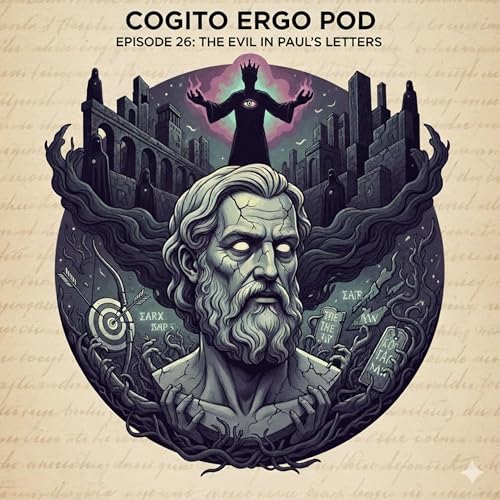
  • Episode 26 - Evil in the Bible: The Pauline Letters
    Nov 26 2025

    As we continue to explore the representation of evil in the Bible, we now move on to explore the Pauline Epistles. For the Apostle Paul, it wasn't just about pitchforks and demons. It was a complex interplay of psychology, paradox, and cosmic oppression.

    In this episode of Cogito Ergo Pod, Daniel dissects the "flavours" of evil in the Pauline tradition, moving from the personal to the apocalyptic. We explore:

    • Hamartia & Sarx: Evil as "missing the mark" and the internal struggle of the ego.

    • The Law: How rules can inadvertently provoke transgression.

    • Principalities & Powers: The esoteric vision of systemic, spiritual injustice.

    We also navigate the scholarly distinction between Paul's Undisputed and Disputed letters to see how these ideas shaped the Western mind.

    (Note: This episode also builds on the biography of Paul discussed in Episode 19.)

    Mehr anzeigen Weniger anzeigen
    14 Min.
  • Episode 25 - Evil in the Bible: The New Testament Gospels
    Nov 15 2025

    In this episode, host Daniel dissects the concept of evil as it's presented in the New Testament Gospels. From a secular, literary, and historical perspective, Daniel first explores why these texts frame evil in a world of cosmic warfare, Roman occupation, and intense sectarianism. The episode then breaks down the three primary categories of evil in the narratives: Personified Evil (Satan, demons like "Legion," and the Beelzebub accusation), Systemic Evil (the political paranoia of King Herod and the cynical indifference of Pontius Pilate), and Internal Evil (the religious hypocrisy of the Pharisees, the betrayal of Judas, and the frightening psychology of the mob).

    Mehr anzeigen Weniger anzeigen
    13 Min.
  • Episode 24 - Evil in the Bible: Job, the Old Testament, and Satan
    Feb 14 2025

    In the third episode in our series of looking at evil in the Bible, we find ourselves jumping around the Bible. Starting with the first couple of chapters of the Book of Job, and exploring a number of other writings in the Old Testament, we are going to explore the figure of Satan within the Hebrew canon. We are going to consider the questions:

    Who or what is the Satan which is found in chapters 1 and 2 of the book of Job?

    How does Job's Satan compare to the Satan found within other Old Testament/ Tanakh writing?

    How does Satan differ in these difference contexts?

    What is a theodicy, and how does it relate to the Book of Job and Satan?

    Why is the use of the definite article important to all of this?


    References:

    • Barton, John. & Muddiman, John. (2001) The Oxford Bible Commentary

    • Pagels, Elaine. (1995) The Origin of Evil

    • Plantinga, Alvin. (1976) God, Freedom, and Evil.

    • Russell, Jeffrey Burton. (1977) The Devil

      • Swinburne, Richard (1998). Providence and the Problem of Evil.
      • Wright, N. T. (2006). Evil and the Justice of God.

    • Find this podcast on most major podcast platforms, and give us a follow on:

      Facebook - 'Cogito Ergo Pod'

      Instagram - cogito_ergo_pod

      Threads - Cogito Ergo Pod

      Bluesky - Cogito Ergo Pod

      Youtube - https://www.youtube.com/channel/UCKbkJyOskelSoJWr7hqDl6A (Cogito Ergo Pod)

    Mehr anzeigen Weniger anzeigen
    29 Min.