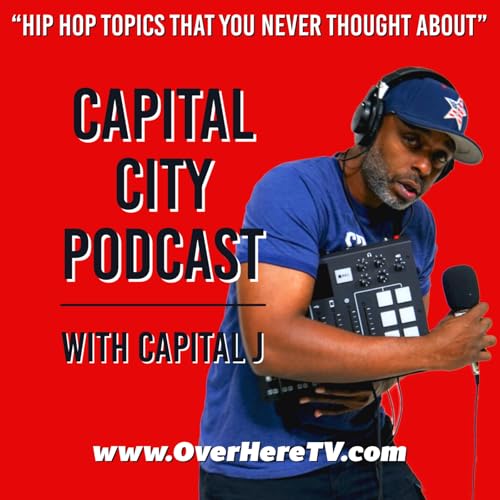
Capital City PodCast Titelbild

Capital City PodCast

Capital City PodCast

Von: Capital J and DL Glass
Jetzt kostenlos hören, ohne Abo

Über diesen Titel

With over 30 years in the music industry, Hip-Hop historian Jerome "Capital J" Dickens and DL Glass talk lyrics, beats, and music. In-depth conversations that discuss the music business and the business of music. To be apart of the conversation email us at info@overheretv.com.

First Time Films LLC 2020
Musik
  • Capital City Podcast #137 “The Old Welcomes The New"
    Feb 16 2026

    Capital City Podcast #137 “The Old Welcomes The New"

    Mehr anzeigen Weniger anzeigen
    27 Min.
  • Capital City Podcast #136 "Hip-Hop’s Slippery Slope: Raunchy Rap, Gang Culture, Mumble Era… Who Opened the Door?"
    Feb 9 2026

    Hip-hop didn’t jump to “extreme” overnight—it evolved. In this episode, Capital J and D.L. Glass break down the progression pattern that keeps repeating in the culture: something small shows up, nobody checks it, then years later it explodes into the new normal.

    From raunchy rap shifting from “you had to be at the show” to on wax to full-on image + brand, to gang culture going from references… to real affiliations… to “every crew is a gang,” to violence becoming content, to raunchy male rap hitting a ceiling, to the mumble/SoundCloud era where “unpolished” stopped being a dealbreaker—this conversation connects the dots in a way that’s going to have you pausing, rewinding, and arguing in the comments.

    And yes… y’all heard it right: they put KRS-One, N.W.A., Master P, Lil’ Kim, and today’s artists on the same timeline and ask the question everybody avoids:

    Did the culture choose this… or did it get conditioned into it?

    0:00 – Cold open / behind-the-scenes

    J talks remixing the podcast theme and how the show has evolved (audio + occasional YouTube video).

    0:56 – The episode thesis: “the progression”

    D.L. lays out the core idea: “bad/tough stuff” in hip-hop often starts small, gets ignored, then balloons into its most extreme form.

    1:35 – Topic 1: Raunchy female rap’s timeline

    Early era: raunchy mostly a live-show thing (not always on record). First “shock on wax” moments (example mentioned: BWP). Lil’ Kim as a turning point: lyrics + image + photoshoot era. The “normalized” moment: what used to be scandal becomes everyday.

    6:00 – The culture’s desensitization effect

    “Went from ‘Oh my God’ to ‘Who cares?’” The bigger point: once the shock wears off, the next extreme has to be louder to get attention.

    7:30 – Topic 2: “Gay rapper” progression

    Argument: this trend hasn’t “floodgated” yet the way others did, but the pathway looks familiar. Discussion of artists pushing boundaries and the idea that time determines what becomes normalized.

    10:00 – Topic 3: Gang culture 1.0 → 2.0 → 3.0

    West Coast storytelling era → real affiliations becoming visible → “everything is a gang” era. Conversation shifts to how mass appeal + branding can make dangerous identities feel “cool.”

    13:45 – Topic 4: Violence in hip-hop

    Violent imagery existed early (movies, covers, stage presence). Debate around “who introduced it” vs “who trivialized it.” Timeline logic: early shocks → pauses → later explosions → today’s extreme outcomes.

    18:00 – “Mentorship vs outcome” moment

    A big “what if” discussion: how different paths and guidance could have changed outcomes.

    19:00 – Topic 5: Raunchy male rap reaching the ceiling

    From novelty raunch to mainstream—then into on-stage extremes. They argue it’s hit the “pinnacle” where there’s nowhere else to go.

    23:30 – Topic 6: Mumble rap / “unacceptable becoming acceptable”

    Debate around Master P opening the door for unpolished sound to reach the masses. Connection to the SoundCloud era: polish stopped being required to “finish the race.”

    29:00 – Topic 7: R&B following rap’s raunchy curve

    R&B examples across eras and the argument that it’s on the same path, just not fully “exploded” yet.

    31:30 – The “negative trends spread faster than positive” takeaway

    Why positivity doesn’t create a wave the same way controversy does.

    33:00 – Topic 8: Street code → oversharing era

    From silence about real life to broadcasting everything (social media, diss cycles, public beefs). Monetization + attention economy as the accelerant.

    38:00 – “Trivializing violence” discussion

    The difference between “meaningful” violence vs “casual” violence in lyrics and skits, and how that shapes listeners.

    40:00 – Closing thoughts + final punchline

    They call for a progression of positive and end with the “2026” reality check.

    Mehr anzeigen Weniger anzeigen
    41 Min.
  • Capital CIty Podcast #135 "From Crates to Waveforms: How DJ Culture Really Changed” (w/ Deron Juan)
    Feb 2 2026

    The club looks the same… but everything about DJ’ing—and the crowd—has changed.

    Capital J and D.L. Glass sit down with Deron Juan (102 Jamz / Heavy Hitters) to break down the real shift from the vinyl era to today’s waveform era: why DJs run through songs faster, how attention spans (and social media) changed the whole party, why dance floors are basically extinct, and what DJs used to have to do (scratching, bringing it back, “save-me” records) just to survive a night.

    They also get into the truth about multi-DJ lineups, promoters chasing flyer hype over execution, and how Deron Juan still breaks records—using radio + social media—like the new-school version of what DJs used to do with pure influence.

    If you ever wondered why parties don’t feel like “back in the day,” this one explains it from the people who lived both eras.

    Tap in, share it with a DJ, and tell us: are today’s parties better… or just different?

    Mehr anzeigen Weniger anzeigen
    53 Min.
Noch keine Rezensionen vorhanden