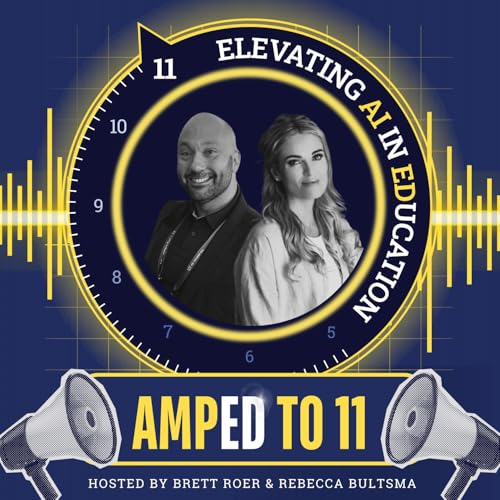
AmpED to 11 Titelbild

AmpED to 11

AmpED to 11

Von: Amplify and Elevate Innovation
Jetzt kostenlos hören, ohne Abo

Das größte Angebot der Saison | 0,99 € pro Monat für die ersten 3 Monate + 15 € Audible-Guthaben

Danach 6,99 €/Monat. Bedingungen gelten. Monatlich kündbar.
Über diesen Titel
Elevating AI in Education Welcome to AmpED to 11, the podcast where AI, education, and technology collide to reshape the future of learning. Hosted by EdTech experts Brett Roer and Rebecca Bultsma, AmpED to 11 brings you the latest insights, trends, and strategies in AI-powered education. We believe that education should never settle for "good enough." Each episode is packed with cutting-edge news, expert interviews, and actionable insights that will keep you ahead of the curve in the rapidly evolving world of EdTech. Whether you're an educator, administrator, or EdTech professional, AmpED to 11 equips you with the tools to integrate AI into education and drive innovation. What You Can Expect: AI in Education: Stay up-to-date with the latest AI tools and trends that are transforming classrooms and educational technology. Expert Interviews: Brett leads in-depth conversations with top educators, innovators, and policymakers to explore how AI is shaping the future of learning. Tech Updates: Rebecca delivers the latest news and updates in AI and education, providing insights into new developments and practical applications for educators. Actionable Tips: Get real-world strategies and tools that you can immediately apply in your classroom or EdTech business to enhance learning outcomes. Why Listen? In each episode of AmpED to 11, you’ll: Learn how AI is revolutionizing education and how you can stay ahead. Gain practical insights from leaders in education and technology. Discover AI-powered tools and strategies to implement in your classroom or EdTech business. Meet the Hosts: Brett Roer is an EdTech visionary who excels at uncovering powerful stories in education and building connections with innovators. He’s committed to bridging the gap between technology and educators to enhance learning. Rebecca Bultsma is an educator and tech strategist with a talent for breaking down complex ideas into actionable insights. She helps educators integrate the latest technology and AI into their teaching, improving engagement and outcomes. Who Should Listen? AmpED to 11 is perfect for: Educators and administrators looking to integrate AI into their teaching. EdTech professionals seeking the latest industry trends and tools. Tech enthusiasts interested in the role of AI in the future of education. Join Brett and Rebecca as they turn the dial on education and AI, bringing you inspiring conversations and actionable advice to drive innovation in the classroom. Stay informed, stay inspired, and stay ahead of the curve with AmpED to 11.©2024-2025 Amplify and Elevate Innovation Politik & Regierungen
  • The Process Is the Product with Dr. Miguel Cardona
    Nov 23 2026

    What if the most important question about AI in schools isn’t what the technology can do, but whether we’re ready to protect the children using it?

    Former U.S. Secretary of Education Dr. Miguel Cardona joins Brett Roer and Rebecca Bultsma to make the case for embracing AI without repeating the mistakes made with the internet and social media. He calls AI “chapter three” and offers a clear warning: “Don’t go faster than you can protect our kids.”

    But safety isn’t one person’s job. From technology companies and policymakers to school leaders, teachers and families, everyone has a role in deciding how AI enters education. Cardona shares why those decisions need meaningful professional learning, community voices and a clear understanding of what schools value most.

    There’s a hopeful question at the heart of the conversation, too: if AI could give teachers more time, how would they spend it? The answer may have less to do with technology and more to do with relationships, creativity and the people in our schools.

    Find Dr. Cardona at cardonasolutions.com. Subscribe to AmpED to 11 for more conversations about human-centered AI in education.

    Mehr anzeigen Weniger anzeigen
    44 Min.
  • Relational intelligence and the "very little friction" of AI interaction with Isabelle Hau
    Nov 9 2026

    What happens when we get used to AI that never argues, gets impatient, or needs an apology?

    Human relationships are messier than that, and Isabelle Hau thinks that's exactly why they matter. The Executive Director of the Stanford Accelerator for Learning joins Brett Roer and Rebecca Bultsma to explore relational intelligence: our capacity to connect, navigate differences, and make meaning with other people.

    Isabelle shares why friction can help us grow, and why the easy interactions offered by AI raise questions about how we practice being human. She points to Stanford research with adults suggesting that human relationships can feel more effortful and less satisfying after interacting with AI; whether the same holds for children is a question she believes deserves attention.

    The conversation moves from a ninth grader learning to apologize in the Relational Intelligence Lab to a surprisingly simple family ritual: Sunday disco night. Because making space for connection doesn't always require a grand plan. Sometimes it starts with play, a little music, and putting the devices down.

    What you'll learn:

    Relational intelligence, how Isabelle defines it and where AI fits.

    Friction, why Isabelle says perseverance is at risk when AI interaction has very little friction.

    The Relational Intelligence Lab, what ninth graders are teaching Isabelle.

    What fills your cup, Brett's question for teachers.

    Tune in, subscribe, and share if you're ready to turn up the volume on what's possible in education.

    Mehr anzeigen Weniger anzeigen
    1 Std. und 8 Min.
  • Teaching student teachers to extend their thinking with AI feedback with John Schembari
    Oct 12 2026

    Brett Roer came in ready to talk about what an AI moratorium breaks. Rebecca Bultsma wanted to talk about what the rush toward AI already broke.

    He had just left a New York City middle school, two weeks into the year, trying to live inside a pause that showed up after the summer work was done. The curriculum is on screens. The approved tools are off. Students can still open an unvetted tool at home. Brett wants a way to teach this without getting students in trouble for the assignment.

    Rebecca will not let that scramble settle the question. Schools have stacked vendors, screens, and spending, and she thinks a pause might be how you find out which of it was ever for students. A moratorium, she argues, is only as useful as the year a school spends inside it. Brett wants the answer. She holds the question open on purpose.

    John Schembari, a school improvement consultant who advises student teachers at Brooklyn College, steps into that argument. Fire is his comparison for AI. He does not want teachers to become the AI police. He does think they have to teach the difference between AI that extends a student's thinking and AI that replaces it. Brett says that line pushed him in a way he was not hoping to be pushed.

    Do not stop there. Brett still has the Briarcliff story: students who once called AI rules a rollercoaster, and who now say there isn't one. A few of them add the line a policy memo never includes. They are not sure they need the AI their teachers just allowed. Then the guest takes the host chair, and the questions belong to Brett and Rebecca.

    In this episode, you'll hear:

    • A pause, as it felt in one school two weeks into the year
    • Where Brett and Rebecca refuse to land
    • An equity question that is not about access
    • Students who got clear rules and still hesitated
    • The stretch where the hosts have to answer

    Subscribe to AmpED to 11, and stay through the chair switch. That is the part worth the rest of the episode.

    Mehr anzeigen Weniger anzeigen
    1 Std. und 2 Min.
adbl_web_anon_alc_button_suppression_t1
Noch keine Rezensionen vorhanden