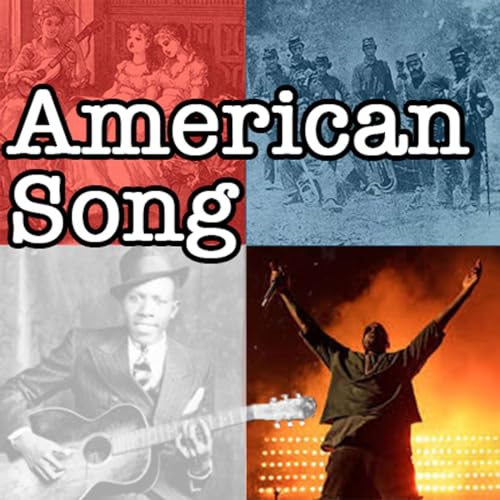
American Song Titelbild

American Song

American Song

Von: Joe Hines
Jetzt kostenlos hören, ohne Abo

Saisonale Sparangebote | 0,99 € pro Monat für die ersten 3 Monate

Danach 6,99 €/Monat. Bedingungen gelten. Monatlich kündbar.

America was meant to be a light on the hill — a place others looked to when they needed to find their own way forward.


If America has ever truly been that light, it came from its music. From the people who suffered the most and somehow still found something worth singing about.

From colonial taverns to protest marches in the Eastern Bloc, from gospel churches to a ghetto in Soweto, American rhythms helped people band together, speak truth, and refuse to quit. Our songs became the world's songs — not because we exported them, but because people who needed hope reached out and claimed them as their own.


American Song tells the stories of the artists who made the music and the people who were moved by it. One era at a time. One genre, one band, one song at a time. Music that started by campfires, in cotton fields, in churches and juke joints — and moved out into the world to become something larger than any one nation could contain.


This is American Song.

© 2026 American Song
Musik Sozialwissenschaften Welt
  • Signal: Static
    Sep 28 2026

    Get in touch!

    At the start, radio was like the Wild West. Anyone could get on the air, and it was all fair game: preachers, farmers, a quack broadcasting from Mexico. But that was before the networks moved in, before the payola hearings took the records out of the DJs' hands, and ultimately before a single law in 1996 sold the dial to a few corporations. Signalis the story of American radio's hundred-year fight between the people who wanted to say something and the people who wanted to sell something. Because the good guys win in the end, free voices keep getting through anyway.

    Last time: Signal Episode One, “Hello, World,” covered radio’s first three decades. We listened in as a man on a Pittsburgh rooftop in 1920, read election returns into a microphone without a clue as to whether anyone was listening. In just three short years from that random starting place, there were 556 stations. In the beginning, Boy Scouts built crystal sets. Families gave the radio the best spot in the living room. Farm wives in the Depression found company in it, and FDR comforted a nation in it. For a brief, chaotic window, anyone could get on the air: preachers, poultry farmers, Pedro González speaking Spanish to Los Angeles, and a goat-gland doctor blasting half a million watts from across the Mexican border, where a six-year-old Johnny Cash heard the Carter Family for the first time. Then NBC and CBS moved in and turned all that noise into a business.

    Radio was built on the fact that people would crave a voice they trust.

    Then television showed up and took the business away.

    Now: This is Episode Two and its about what happened in the empty room TV left behind. The big stars packed their bags and left: Jack Benny, Bob Hope, the Lone Ranger all headed for that little box with the fishbowl screen. Meantime, a transmitter, a microphone, and a stack of records were left to hold down the fort. That turned out to be enough. It actually birthed the DJ.

    Episode two is also the tragic story of Edwin Armstrong, who invented FM radio and was destroyed by the company that should have made him famous. So much for gratitude and fair dealing. And this is also the story of WDIA in Memphis, where Nat D. Williams reached one in ten Black Americans and B.B. King sang jingles. This was also the open range prowled by wildman Wolfman Jack, howling across the border at 250,000 watts. Look again and its also the story of payola hearings: Alan Freed lost everything, Dick Clark lost nothing, and anyone paying attention could see why.

    My episode two guest is Bruce Warren, who has spent more than 35 years at WXPN Philadelphia, most recently as Assistant General Manager for Programming and Executive Producer of NPR's World Cafe. He’s living proof that some vestiges of the 1950s still remain. The listener-supported model that a pacifist invented in Berkeley, CA in 1949 is the same one that pays NPR station bills. The promotion game that brought down Alan Freed still happens to a lesser extent; these days its concert tickets now instead of cash. And the formatted, playlist-driven radio the payola hearings created leads straight to today, where one voice-tracked DJ can "host" six cities at once.

    Turn it up. The static’s the good part.


    Did you miss the first episode - Signal: Hello World? No problem! It's available here on your favorite streaming platform or on the American Song website. Check it out - you won't want to miss it!


    Get in touch: I'd love to hear from you! Find American Song on Substack.

    Mehr anzeigen Weniger anzeigen
    1 Std. und 33 Min.
  • Signal: Hello World
    Sep 16 2026

    Get in touch!

    In 1920, a radio signal was a rumor with electricity behind it — a handful of amateurs in garages and attics, broadcasting into a void nobody had proven was listening. There were no networks, no formats, no rules, because nobody in power had figured out yet that there was anything here worth controlling. That's the world this episode opens in: the accidental birth of American radio, before it belonged to anyone.

    "Hello, World" traces how a scattered hobby became a national voice — and sets up the argument this whole series is built on: American freedom tends to live in the places nobody's bothered to claim yet. Episode one of Signal, a new American Song series on the rise, fall, and strange afterlife of American radio, is live now.

    In this episode:

    • Robert Baden Powell (founder of the Boy Scouts and Girl Scouts) talks to parents
    • KDKA Pittsburgh. 11/2/1920. First Commercial Radio Broadcast
    • W.K. (Old Man) Henderson - Hello World (1930)
    • KPBS Classics - Ballad of an Unsung Hero
    • Father Couglin - 12/11/1938
    • The Amos 'n Andy Show - Courtroom Catastrophe
    • Orson Welles - War of the Worlds Radio Broadcast (1938)
    • FDR Fireside Chat on Banking
    • Edward R. Murrow - The London Blitz

    And here's what comes next:

    Radio didn’t stay innocent for long. Neither did anyone, really.

    A man invents FM radio, and the company profiting from it steals it out from under him and leaves him with nothing. For thirty years after that, nobody wants what he built. Turns out neglect was the best thing that could’ve happened to it — because ignored is free, and free is where a DJ can play whatever he wants, for as long as it deserves to be heard, with nobody telling him otherwise. That part is genuinely glorious. It’s also, like most glorious things, temporary.

    Because eventually somebody in Washington signs a piece of paper almost nobody reads, and in a few short years radio stops belonging to the people who loved it and starts belonging to a balance sheet. Local voices get replaced with automation. One January morning, a chemical disaster hits a small town, and the station legally required to warn people doesn’t answer the phone — because there’s nobody left inside to answer it. That’s not a metaphor. That’s what corporate greed actually costs.

    The people radio pushed out never stopped loving it. They rebuilt it somewhere else — podcasts, Substack, stations run by people who remember what this was supposed to sound like. Something America loved got taken away by greed, and then, quietly and stubbornly, brought back from the ashes by the people who never let go of it.

    That’s also an American pattern. It happened to jazz. It happened to punk. Over the next six episodes, we watch it happen to radio.

    Mehr anzeigen Weniger anzeigen
    1 Std. und 5 Min.
  • Meet Southern California Singer-Songwriter, Anson Corsair
    Sep 8 2026

    Get in touch!

    Today’s episode is an interview with the Southern California based singer-songwriter, Anson Corsair. His remarkably open interview reveals some of the highs and the lows he’s lived through and how he’s processed these events into a growing group of beautiful songs. While American Song generally covers some of the most well-known musicians throughout the canon of popular music, these artists are just the tip of the iceberg. Interviews with people like Anson help us appreciate just how rich the music world is. Writers like myself have an opportunity to shine a light on the immensity of what’s found below the waterline!

    With a sound that is reminiscent of Jack Johnson, John Mayer, and Ed Sheeran, Anson’s songwriting craft is elegant, and poetic. In this interview, he goes deep on the many life experiences that have shaped who he is and how he understands his world.

    I hope you’ll enjoy today’s show!


    Learn more about Anson Corsair:

    Website: https://www.ansoncorsair.com/

    Instagram: AnsonCorsairMusic

    Soundcloud: https://soundcloud.com/ansoncorsairmusic

    Spotify


    Follow American Song on Buzzsprout or your favorite streaming platform and connect with me on Substack!

    Mehr anzeigen Weniger anzeigen
    1 Std. und 13 Min.
adbl_web_anon_alc_button_suppression_t1
Noch keine Rezensionen vorhanden