Folgen

  • The Friday Download: When Your AI Gets a Security Clearance (And You Don't) (May 15, 2026)
    May 15 2026

    Welcome to The Friday Download for May 15, 2026!

    This week JR DeLaney covers five stories reshaping how AI intersects with security, finance, and neuroscience.

    First: OpenAI launched GPT-5.5 Cyber through the Trusted Access for Cyber (TAC) program—a model built for pen testing and red teaming that requires vetting before access. Anthropic’s rival cybersecurity model, nicknamed Mythos, prompted a banking warning from India’s finance ministry. The UK AI Safety Institute notes frontier cyber AI capability is doubling every four months.

    Second: the Chicago Mercantile Exchange is launching a futures market for AI compute—you can now trade GPU capacity like corn or crude oil, as Anthropic commits $200B to Google Cloud and Meta acquires robotics startup ARI.

    In our Wait… That’s Actually Cool segment: Meta’s Tribe V2 brain model predicts neural activity with 70x better resolution using 1,115 hours of fMRI data from 700+ volunteers—zero-shot, open-sourced, and genuinely revolutionary for neuroscience. Plus: a Stanford undergrad achieved a 5x training speed-up with a new optimizer, embarrassing every billion-dollar AI lab in the process. Tiny Tech Snacks cover agentic AI (Google Remy), compute futures, and zero-shot generalization. #AIInnovationsUnleashed

    Send us Fan Mail

    Support the show

    Mehr anzeigen Weniger anzeigen
    10 Min.
  • AI in 5: How Your New AI Study Buddy Actually Thinks (May 11, 2026)
    May 12 2026

    Your student’s AI study buddy is already in the room—are you ready to talk about how it actually works? In this episode of AI in 5, we pull back the curtain on the large language models powering today’s most popular study tools, from ChatGPT to flashcard generators. Host JR explains what it really means that these tools are “pattern machines”—not truth machines—and why that distinction matters for every teacher, parent, and student. Learn why AI hallucinations happen, how to spot over-reliance, and three simple human-in-the-loop rules your classroom or family can start using today.

    Show Notes Links:

    • Sal Khan on AI tutoring: https://www.khanacademy.org/about

    • Dr. Ethan Mollick, Co-intelligence: ethanmollick.com

    • Join The Unleashed community: aiinnovationsunleashed.com

    • Subscribe & review on Apple Podcasts: https://podcasts.apple.com/us/podcast/ai-innovations-unleashed/id1776672844

    APA Citations
    Khan, S. (2023). Harnessing AI for education. Khan Academy. https://www.khanacademy.org/about

    Mollick, E. (2024). Co-intelligence: Living and working with AI. Portfolio/Penguin.

    Mollick, E., & Mollick, L. (2023). Assigning AI: Seven approaches for students, with prompts. The Wharton School, University of Pennsylvania. https://papers.ssrn.com/sol3/papers.cfm?abstract_id=4475995

    Send us Fan Mail

    Support the show

    Mehr anzeigen Weniger anzeigen
    7 Min.
  • AI at the End of the School Year: Part 1 - End-of-Year Reflections, But Make It AI (and Human)
    May 9 2026

    Episode 1 — "End-of-Year Reflections, But Make It AI (and Human)"

    AI Innovations Unleashed · May 2026 Series · Episode 1 of 4

    What does AI-assisted end-of-year reflection actually look like? Not the polished, generic version — the honest one. JR DeLaney explores how teachers can use AI as a scaffold for deeper student reflection without letting it replace the student doing the thinking.

    Joined by Nex (AI co-host, aggregated internet knowledge) and Dr. Marguerite Holloway-Chen (fictional AI guest, educational research synthesis).

    Covered this episode:

    • AI as scaffold, not substitute: why the editing step is where reflection happens
    • Elementary & Middle: Year in Review activities and Future Me letters
    • High School: The Story Mining Workflow — AI as excavation partner
    • Recent Grads: Goodbye letters, reflection-to-career prompts, and the ethics line
    • Five heuristics for protecting authentic student voice


    Reflective questions:

    • Elementary/Middle: What's one moment from this year you hope your students don't forget?
    • High School: If your seniors could write one honest paragraph, what would you want it to say?
    • Grads: What's one thing you'd want a graduating student to know about themselves?
    • Closing: Think of three student faces. What's one sentence about who each of them is?


    Companion blog post: "Looking Back with AI: Designing End-of-Year Reflections for Every Stage"


    Next episode: "Show What You've Done: AI-Enhanced Portfolios from Classroom to Career"


    Send us Fan Mail

    Support the show

    Mehr anzeigen Weniger anzeigen
    21 Min.
  • The Friday Download: AI Is Rewiring the LMS — and 5 Moves Every District Must Make Before August (May 8, 2026)
    May 8 2026

    This week on The Friday Download, JR unpacks the education AI story you didn't see coming: it's not about new chatbots — it's about the plumbing of learning getting smarter.


    First up: Rasmussen University (125+ years old) is ditching Blackboard for D2L Brightspace and going all-in on Lumi AI — personalized tutoring, feedback, and study plans baked directly into the LMS. But new research warns that AI doing the thinking for students leads to cognitive offloading and measurable drops in critical thinking. So: are we making learning better, or just assignments faster?


    Then the good stuff. Google dropped a quiet but powerful education upgrade pack — NotebookLM now supports double the sources, Gemini is an official AI provider inside Moodle, and graduating students can finally save their photos before IT wipes their account.


    Google's AI for Education Accelerator hit 400+ higher-ed institutions across all 50 states, with real-world projects like AI Learnathons at Texas A&M and AI skills work at UVA.


    For K-12 leaders: a former state CIO laid out 5 AI moves every district needs to make before next school year — because "we'll figure it out as we go" is officially not a strategy anymore.


    Plus: four Tiny Tech Snacks — AI-infused LMS, NotebookLM expansion, Gemini in Moodle, and cognitive offloading explained in plain language.


    Send us Fan Mail

    Support the show

    Mehr anzeigen Weniger anzeigen
    11 Min.
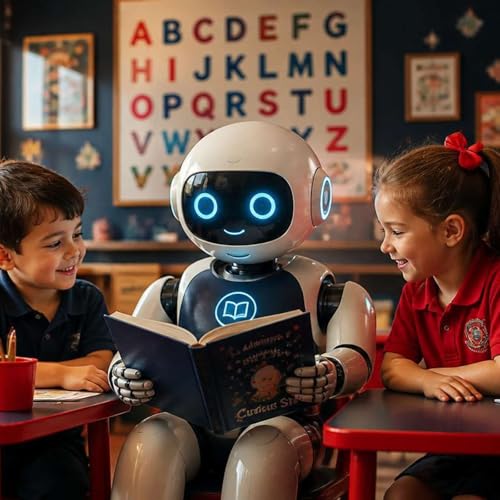
  • AI in 5: Group Projects with a Droid: AI as a Thought Partner in High School PBL (May 4, 2026)
    May 4 2026

    What if the most productive member of every student group project... was an AI? In this episode of AI in 5, your AI Learning Guide JR unpacks how high school teachers can use AI as a structured thought partner in project-based learning — without turning it into a cheating shortcut.

    You'll hear how a College Board study found 84% of high school students are already using generative AI for schoolwork, and why that's a signal to act strategically, not panic. JR walks through three practical classroom moves: AI-assisted idea generation with constraints, AI-powered project planning, and AI as a first-round feedback reviewer. Plus three student guardrails — Visibility, Transformation, and Attribution — that keep authentic learning at the center.

    Backed by a 2025 Education Sciences study showing AI-enhanced PBL produces a large effect size (Cohen's d = 1.30) over traditional PBL, this episode gives you a concrete, one-step challenge to try before your next major project deadline.

    Guest voices: Sal Khan, founder of Khan Academy · Dr. Jessica Howell, VP of Research, College Board


    📚 APA CITATIONS (Show Notes)

    College Board. (2025, October 6). New research: Majority of high school students use generative AI for schoolwork. College Board Newsroom. https://newsroom.collegeboard.org/new-research-majority-high-school-students-use-generative-ai-schoolwork

    Khan, S. (2023, May). AI in the classroom: The world's best tutor [TED Talk]. TED Conferences. https://www.ted.com/talks/sal_khan_ai_in_the_classroom_the_world_s_best_tutor

    Tariq, R., & colleagues. (2025). The role of artificial intelligence in project-based learning: Teacher perceptions and pedagogical implications. Education Sciences, 15(2), 150. https://doi.org/10.3390/educsci15020150

    Send us Fan Mail

    Support the show

    Mehr anzeigen Weniger anzeigen
    7 Min.
  • The Friday Download: Graduation Requirements, Million-Dollar Bets, and the Great Phone Paradox (May 1, 2026)
    May 1 2026

    This week: Boston makes AI fluency a graduation requirement with $1M backing from tech entrepreneur Paul English. Stanford launches a grant program funding AI skeptics (yes, really). 31 states introduce 134 AI education bills with zero consensus. Plus: the bizarre paradox of being told to embrace AI while banning phones, and Rasmussen University's major platform switch to AI-native tools.

    **Sources:**
    - EdWeek: "Schools Are Urged to Embrace AI—and Ban Phones" (April 13, 2026)
    - Pursuit: "Latest AI in Education News: Policies and Innovations" (2026)
    - Multistate: "AI in Education Legislation: 2026 State Policy Trends" (April 8, 2026)
    - D2L/Rasmussen University announcement (April 20, 2026)

    Send us Fan Mail

    Support the show

    Mehr anzeigen Weniger anzeigen
    10 Min.
  • AI in 5: Scaffolding in AI: Building Smarter Learners One Step at a Time (April 27, 2026)
    Apr 27 2026

    Show Notes — "Scaffolding in AI: Building Smarter Learners One Step at a Time"

    What if every student had a tutor that knew exactly when to help — and exactly when to back off? That's the promise of AI scaffolding, and in this episode of AI in 5, The AI Learning Guide JR breaks it all down.

    Rooted in Vygotsky's Zone of Proximal Development, scaffolding is one of education's most powerful strategies. Add AI to the equation, and it becomes something extraordinary: personalized, real-time support for every learner simultaneously. Research shows AI-powered simulations improved student understanding by 35%, while AI handwriting scaffolds boosted letter formation for dysgraphia students by 40%. Stanford researchers found AI helps teachers generate tiered lessons — calling it a "tremendous thought partner."

    But there's a catch: the best scaffold is the one you eventually don't need. JR explores the risk of AI dependency and why intentional fading of support is the key to building real, lasting skills.

    Teachers stay essential. Learners stay in charge. AI just fills the gap.

    🎧 Listen now on your favorite podcast platform.

    📌 AI Innovations Unleashed | aiinnovationsunleashed.com

    REFERENCES

    Bloom, B. S. (1984). The 2 sigma problem: The search for methods of group instruction as effective as one-to-one tutoring. Educational Researcher, 13(6), 4–16. https://doi.org/10.3102/0013189X013006004

    Khan, S. (2023, March). AI in the classroom can transform education [TED Talk]. TED Conferences. https://blog.khanacademy.org/sal-khans-2023-ted-talk-ai-in-the-classroom-can-transform-education/

    Luckin, R. (2025, February). AI in assessment [Keynote address]. Rethinking Assessment. https://rethinkingassessment.com/rethinking-blogs/professor-rose-luckin-on-ai-in-assessment/

    Luckin, R. (2018). Machine learning and human intelligence: The future of education for the 21st century. UCL Institute of Education Press.

    Vygotsky, L. S. (1978). Mind in society: The development of higher psychological processes. Harvard University Press.

    Send us Fan Mail

    Support the show

    Mehr anzeigen Weniger anzeigen
    6 Min.
  • The Friday Download: Embrace the Bots, Ban the Phones: AI Literacy and Classroom Whiplash (April 24, 2026)
    Apr 24 2026

    Schools are trying to navigate a strange new reality: embrace AI, limit phones, and somehow teach students to use powerful tools responsibly. This week's Friday Download looks at the tension between AI adoption and phone bans, the U.S. Department of Education's new AI-related grant priorities, and the growing push for AI literacy in K–12 education. The episode covers why schools are urging AI adoption while simultaneously banning the devices students use most, why Boston Public Schools is treating AI fluency as a graduation-level expectation backed by a $1 million educator training grant, and how federal grantmaking signals are changing what districts prioritize. Teacher training, policy gray zones, and the fundamental question of whether schools should teach responsible AI use rather than pretend AI doesn't exist — it's all part of this week's whirlwind replay.

    Send us Fan Mail

    Support the show

    Mehr anzeigen Weniger anzeigen
    11 Min.