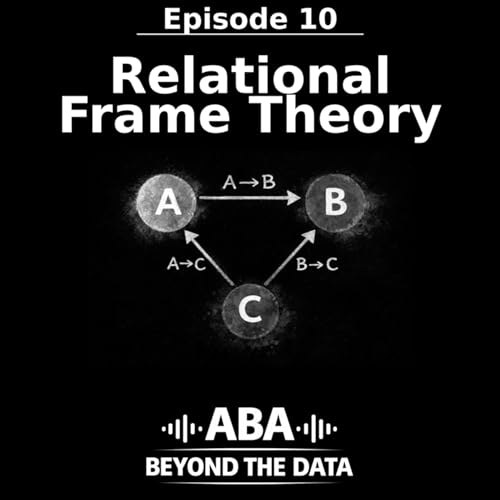
ABA Beyond the Data Titelbild

ABA Beyond the Data

ABA Beyond the Data

Von: J. L. Burton MA BCBA LBA
Jetzt kostenlos hören, ohne Abo

Nur 0,99 € pro Monat für die ersten 3 Monate

Danach 9.95 € pro Monat. Bedingungen gelten.

Über diesen Titel

ABA: Beyond the Data is an ACE-approved podcast where you can earn CEUs while exploring the practice of Applied Behavior Analysis from two unique perspectives. Hosted by Jay Burton, a seasoned BCBA and parent of two wonderful boys on the autism spectrum, this show blends professional expertise with personal experience. Each episode dives into real-world challenges, fresh ideas, and practical strategies designed to improve your clinical work while keeping humanity and compassion at the core of ABA.J. L. Burton, MA, BCBA, LBA Sozialwissenschaften Wissenschaft
  • Episode 10 - Relational Frame Theory
    Jan 12 2026

    How to Purchase CEUs

    1. Go to ⁠⁠⁠⁠⁠https://www.aba-ceus.com/get-ceus⁠⁠⁠⁠⁠
    2. Select the CEU episode you’d like to purchase and add it to your cart.
    3. At checkout, enter the three key words listed during the episode.
    4. Complete your purchase through our secure checkout.

    Your CEU certificate will be emailed to you within 24–48 hours.Each submission is individually reviewed and verified, so please allow time for processing and approval.

    If you have any questions, feel free to reach out to us anytime.


    Summary:


    Relational Frame Theory can sound like grad-school jargon, but this episode breaks it down in a practical, BCBA-friendly way. We’ll define RFT in plain English, explain the core ideas that make language “generative,” and show how relational learning helps explain common clinical patterns—brittle generalization, rigid rule-following, “scripted” social skills that fall apart with peers, and why certain words can become powerful triggers. You’ll hear how to use an RFT lens without turning your practice into a theory seminar: how to shift goal selection from isolated targets to relationships, program for flexibility as an outcome, vary language the way real life varies it, and coach families in a way that reduces power struggles and builds trust. We’ll also cover ethical guardrails so you stay firmly in scope while still being modern, compassionate, and evidence-informed.


    Sources:


    • Blackledge, J. T. (2003). An Introduction to Relational Frame Theory: Basics and Applications https://actmindfully.com.au/upimages/rft_blackledge.pdf
    • Gross, A. C., & Fox, E. J. (2009). Relational Frame Theory: An Overview of the Controversy https://pmc.ncbi.nlm.nih.gov/articles/PMC2779078/?utm_source=chatgpt.com
    • Gibbs, A. R. (2023). A Systematic Review of Derived Relational Responding Beyond Coordination in Individuals with Autism and Intellectual and Developmental Disabilities https://pmc.ncbi.nlm.nih.gov/articles/PMC10020770/
    • Kelly, A. D., et al. (2021). Acceptance and Commitment Training in Applied Behavior-Analytic Services https://pmc.ncbi.nlm.nih.gov/articles/PMC8320414/?utm_source=chatgpt.com
    Mehr anzeigen Weniger anzeigen
    1 Std. und 11 Min.
  • Episode 9 - Joint Attention
    Dec 23 2025
    How to Purchase CEUsGo to ⁠⁠⁠⁠https://www.aba-ceus.com/get-ceus⁠⁠⁠⁠Select the CEU episode you’d like to purchase and add it to your cart.At checkout, enter the three key words listed during the episode.Complete your purchase through our secure checkout.Your CEU certificate will be emailed to you within 24–48 hours.Each submission is individually reviewed and verified, so please allow time for processing and approval.If you have any questions, feel free to reach out to us anytime.Summary:This episode explores how to understand and teach joint attention—the foundation of social connection and early communication. It begins by breaking down what joint attention actually is: the back-and-forth coordination of attention between a person, another person, and something in the environment. From there, it looks at why this skill is so critical for language, play, and relationship development, and how it often presents differently in autism. The discussion then shifts into a practical, compassionate guide for assessment and teaching, focusing on both responding to and initiating joint attention in natural, meaningful ways. Using developmentally informed and behavior-analytic strategies, the episode highlights how to build authentic moments of shared engagement without turning it into an eye-contact drill—helping BCBAs and parents create more genuine, joyful social experiences.Sources:Carpenter, M., Nagell, K., & Tomasello, M. (1998). Social cognition, joint attention, and communicative competence from 9 to 15 months of age. Monographs of the Society for Research in Child Development, 63(4). Link PubMed+1Mundy, P., & Newell, L. (2007). Attention, joint attention, and social cognition. Current Directions in Psychological Science, 16(5), 269–274. Link PMC+1Mundy, P., & Sigman, M. (2006). Joint attention, social competence and developmental psychopathology. In D. Cicchetti & D. J. Cohen (Eds.), Developmental psychopathology (2nd ed., Vol. 1, pp. 293–332). Hoboken, NJ: Wiley. Chapter info Wiley Online Library+1Lasch, C. (2022). Responding to joint attention as a developmental catalyst. Development and Psychopathology, 34(4), 1561–1573. Link PMCJones, E. A., & Carr, E. G. (2004). Joint attention in children with autism: Theory and intervention. Focus on Autism and Other Developmental Disabilities, 19(1), 13–26. Link SAGE Journals+1Kasari, C., Freeman, S., & Paparella, T. (2006). Joint attention and symbolic play in young children with autism: A randomized controlled intervention study. Journal of Child Psychology and Psychiatry, 47(6), 611–620. PubMed PubMed+1Dube, W. V., MacDonald, R. P. F., Mansfield, R., Holcomb, W. L., & Ahearn, W. H. (2004). Toward a behavioral analysis of joint attention. The Behavior Analyst, 27(2), 197–207. Link PMC+1Klein, J. L., MacDonald, R. P. F., Vaillancourt, G., Ahearn, W. H., & Dube, W. V. (2009). Teaching discrimination of adult gaze direction to children with autism. Research in Autism Spectrum Disorders, 3(1), 42–49. Free full text or publisher page PMC+1Taylor, B. A., & Hoch, H. (2008). Teaching children with autism to respond to and initiate bids for joint attention. Journal of Applied Behavior Analysis, 41(3), 377–391. Free full text or Wiley version PubMed+1
    Mehr anzeigen Weniger anzeigen
    1 Std. und 7 Min.
  • Episode 8 - Parent Training
    Dec 9 2025

    How to Purchase CEUs

    1. Go to ⁠⁠⁠https://www.aba-ceus.com/get-ceus⁠⁠⁠
    2. Select the CEU episode you’d like to purchase and add it to your cart.
    3. At checkout, enter the three key words listed during the episode.
    4. Complete your purchase through our secure checkout.

    Your CEU certificate will be emailed to you within 24–48 hours.Each submission is individually reviewed and verified, so please allow time for processing and approval.

    If you have any questions, feel free to reach out to us anytime.


    Summary:


    Parent training is supposed to be the heart of good ABA, but in real life it can feel like the hardest part of the job. In this episode of ABA Beyond the Data, we dig into what the research actually says about ABA-based parent training, why outcomes are so mixed, and how parent stress and life context quietly shape adherence. We talk about using tools like the PSI-4 to actually measure caregiver stress, and we pull in work on compassionate care, engagement barriers, and practical enablers of behavioral parent training. You’ll walk away with a simple four-step “simple cycle” you can use to structure every parent meeting so it’s more honest, more sustainable, and more effective for families and for you as the BCBA.

    Sources

    • Bradshaw, J., Wolfe, K., Hock, R., & Scopano, L. (2022). Advances in supporting parents in interventions for autism spectrum disorder. Pediatric Clinics of North America, 69(4), 645–656. https://doi.org/10.1016/j.pcl.2022.04.002 ResearchGate

    • Pacia, C., Gunning, C., McTiernan, A., & Holloway, J. (2023). Developing the Parent-Coaching Assessment, Individualization, and Response to Stressors (PAIRS) Tool for Behavior Analysts. Journal of Autism and Developmental Disorders, 53(9), 3319–3342. https://doi.org/10.1007/s10803-022-05637-5 University of Galway Research

    • Raulston, T. J., Hieneman, M., Caraway, N., Pennefather, J., & Bhana, N. (2019). Enablers of behavioral parent training for families of children with autism spectrum disorder. Journal of Child and Family Studies, 28(3), 693–703. https://doi.org/10.1007/s10826-018-1295-x PMC

    • Taylor, B. A., LeBlanc, L. A., & Nosik, M. R. (2018). Compassionate care in behavior analytic treatment: Can outcomes be enhanced by attending to relationships with caregivers? Behavior Analysis in Practice

    Mehr anzeigen Weniger anzeigen
    1 Std. und 11 Min.
Noch keine Rezensionen vorhanden