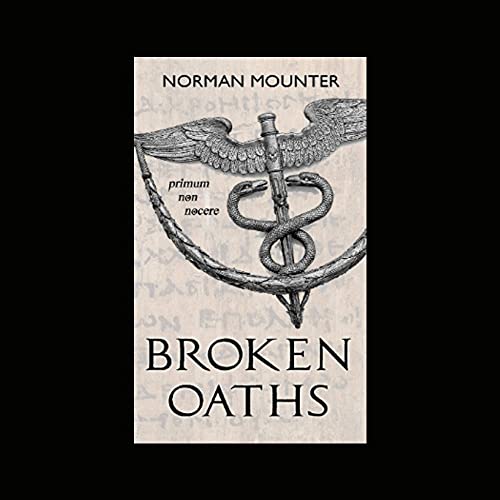
5th Podcast - Broken Oaths Titelbild

5th Podcast - Broken Oaths

5th Podcast - Broken Oaths

Jetzt kostenlos hören, ohne Abo

Details anzeigen

Nur 0,99 € pro Monat für die ersten 3 Monate

Danach 9.95 € pro Monat. Bedingungen gelten.

Über diesen Titel

In this podcast I get to interview a dear friend from my childhood in the colourful 70s. Norman is now a doctor, pathologist and a writer whose new book is about to be released. We reminisce about the past and he explains the story behind his grotesquely dark and potentially disturbing literature offering. In Jessica's gems she uses her curiosity about the English language to pull out some of the language from the interview and asks questions in order that I give some insights into terms like: To be trumped, to be freaked out, to be privileged and many more. www.englishonair.com Transcription of Interview: Just give us a little intro into where, you know, where the passion started. So for example, if we spoke about, if we spoke about history, I mean, where, where did the passion, where did that sort of come from? When I was a young boy, I, I used to be very interested in castles and things. And I remember my dad taking me to Dover castle for the first time. And that was, you know, really fascinating. And it began to make me feel this kind of connection with the past and wanting to know more about these, these artifacts and these buildings, particularly. And then I suppose from there, it kind of evolved into other areas of history that I learned at school. And I, I was always very, you know, very absorbed by history and it said, it's a strange one history because you know, it can really turn some people off. Speaker 1 (00:55): And I remember some people in my class being, you know, pretty much, well, you know, why are we learning this? This is complete waste of time and I don't need to know this, but for me it was about, um, a connection with the past. And I think having that understanding of the past, especially in terms of the chronology of the past, which I think is seriously lacking in schools these days, these days you tend to pick up a subject like,I don't know the Spanish Armada, Royal queen queen Victoria, but it's not really in any context. And, you know, you are someone when Magna Carta was signed or when the Spanish Armada happened. They they've got no idea. And I think for me, it was, it was about that sense of, yeah, things have happened over the last few millennia and we are basically living in a world at the moment that is just so much, it's so much entwined in the past. Speaker 1 (01:46): Everything we do, everything we, we say is all about other people, the developed language, the clothes we wear, how would, you know, how would we be here today? You know, talking to you, John, without people in the past have invented electricity and you know, all that kind of stuff. And for me to understand the past gives me not only a sense of orientation in the present, but it helps me to certainly as a writer, empathize with the characters and the backdrop to my novels, that help flesh out the characters, but also give it that kind of realism, not a realism that I can prove because I was never there, but a realism that feels real to me. And I think that's, that's the most important thing for me. It's it's can I, can I get inside this character and almost be there in a time machine, but not really. Speaker 1 (02:42): Hopefully my readers will be able to experience that as well, you know, go into that world that I, that I feel is, is real and, and see if they feel the same. Okay. Well, I mean your, your another passion, you became a doctor, um, long, long time ago now, but yeah, doctor, so you obviously developed an interest that deep interest in, in medicine at some point, knowing you as a boy, it wasn't a question of that, that you wanted to be a doctor from day one. No, absolutely not. I think for me, and it may be the same for other people, but particularly me, I even at school, I had no particular area where I said, you know, I must do this even up to my A levels, John, I was kind of, well, I'd like to do science A levels, but actually I love history so much and I love English so much. Speaker 1 (03:36): I must do those. So I ended up doing a kind of mixture of sciences and arts subjects at A level, but it wasn't really until my second year of a levels that I thought, you know what I think I want to do medicine. I felt that my, my interests were developing, particularly in the kind of biological sciences. I had a fascination for, uh, particularly physiology and the anatomy of the human body. I really wanted to kind of drill down on the fabric of the human body and really just, you know, just explore it like a new planet almost. And of course, very few degrees can allow you to do that apart from medicine medicine. Certainly when I trained, I felt very privileged because people would give their bodies to medical science and we were able to dissect these bodies over, over the course of the first two years and basically through their sacrifice, we could learn, as I say that the fabric of the human body. Speaker 1 (04:35): And I think for me, that was a massive, massive privilege for me. And also ...
Noch keine Rezensionen vorhanden