

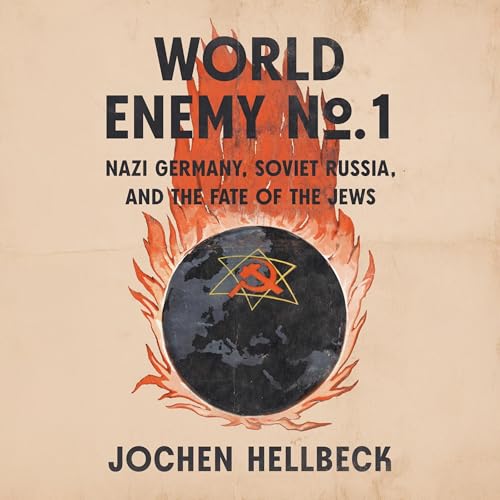
World Enemy No. 1
Nazi Germany, Soviet Russia, and the Fate of the Jews
Artikel konnten nicht hinzugefügt werden
Leider können wir den Artikel nicht hinzufügen, da Ihr Warenkorb bereits seine Kapazität erreicht hat.
Der Titel konnte nicht zum Warenkorb hinzugefügt werden.
Bitte versuchen Sie es später noch einmal
Der Titel konnte nicht zum Merkzettel hinzugefügt werden.
Bitte versuchen Sie es später noch einmal
„Von Wunschzettel entfernen“ fehlgeschlagen.
Bitte versuchen Sie es später noch einmal
„Podcast folgen“ fehlgeschlagen
„Podcast nicht mehr folgen“ fehlgeschlagen
30 Tage Audible Standard kostenlos testen
Danach 6,99 €/Monat. Monatlich kündbar

World Enemy No. 1
Gesprochen von:
Josh Bloomberg
Für 22,09 € kaufen
-
Gesprochen von:
-
Josh Bloomberg
-
Von:
-
Jochen Hellbeck
A major new history that transforms our understanding of World War II—tracing the conflict and its most infamous crime, the Holocaust, to Germany’s implacable hostility toward Soviet Russia
In the West, World War II is commonly understood as the Allies’ struggle against Nazism. Often elided, if not simply forgotten, is the Soviet Union’s crucial role in that fight. With this book, acclaimed historian Jochen Hellbeck rectifies this omission by relocating the ideological core of the conflict. It was not the Western powers but Communist Russia that Nazi Germany viewed as an existential threat—in fact, “World Enemy No. 1.” Jewish revolutionaries, the Nazis believed, had seized power in 1917 and were preparing the Soviet state to destroy Germany and the world. And so, on June 22, 1941, a German army of three million attacked the Soviet Union to exterminate “Judeo-Bolshevism,” Hitler’s cardinal obsession. While Europe’s Jews were expelled, exiled, and persecuted by the Nazis, Soviet Jews were immediately slated for elimination. The Soviet lands thus became ground zero for systematic extermination, which was only later extended to all Jews, igniting the Holocaust.
Hellbeck plumbs newly declassified archives and previously undiscovered sources—testimonies, diaries, and dispatches from soldiers and civilians, Soviet and German—to offer a unique history that takes account of both sides. He reconstructs the years leading up to the war when “Europe against Bolshevism” was the Nazis’ most fervid rallying cry, and documents their annihilatory ambitions on the battlegrounds in the East. Widely disseminated accounts of German atrocities mobilized millions of Soviet citizens to join a people’s war against the hated invaders. Hellbeck tracks the desire for revenge that drove the Red Army on its path of reconquest, an advance that further inflamed the belief in a murderous “Bolshevik Jew,” stirring the Germans to fight to the bitter end. Recounted here in vivid detail are the events at Babi Yar, the Battle of Stalingrad, the liberation of the concentration camps, and the arrival of the Red Army in the Nazi capital. Finally, Hellbeck reckons with the West’s persistent disregard of the Soviet Union’s incalculable contribution to winning the war—and its sacrifice of twenty-six million citizens—as anti-communism and the Cold War turned erstwhile allies into mortal enemies.
Hellbeck’s eye-opening work is an astonishing new reading of both the Second World War and how its history has been told.
Diese Titel könnten dich auch interessieren


adbl_web_anon_alc_button_suppression_t1
Noch keine Rezensionen vorhanden