

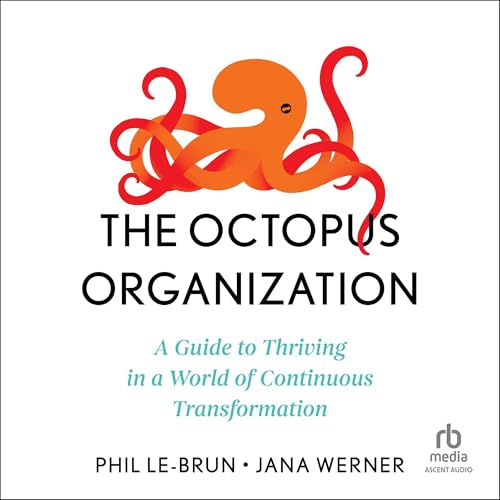
The Octopus Organization
A Guide to Thriving in a World of Continuous Transformation
Artikel konnten nicht hinzugefügt werden
Der Titel konnte nicht zum Warenkorb hinzugefügt werden.
Der Titel konnte nicht zum Merkzettel hinzugefügt werden.
„Von Wunschzettel entfernen“ fehlgeschlagen.
„Podcast folgen“ fehlgeschlagen
„Podcast nicht mehr folgen“ fehlgeschlagen
30 Tage Audible Standard kostenlos testen

The Octopus Organization
Für 18,94 € kaufen
-
Gesprochen von:
-
Mike Cooper
-
Von:
-
Phil Le-Brun
-
Jana Werner
Large-scale organizational transformations usually don't work. What originally starts as a way of improving an organization becomes an all-consuming distraction, a value-destroying set of activities that, even as it becomes clear they will fail, must be completed at any cost.
But there is a better way: becoming an Octopus Organization.
The octopus is everything you need your organization to be in these turbulent times: extremely smart, endlessly adaptable, and highly resilient. Its eight arms work beautifully in concert, but crucially, each arm can think for itself if it needs to work independently. Your organization can work as intelligently and as beautifully as these amazing creatures, if you change your operating model.
Authors Phil Le-Brun and Jana Werner, veteran executives and leaders in Amazon Web Services who've worked with hundreds of large firms, show you how to become an Octopus Organization in this hyperpractical manual of best practices from organizations that have left behind the old, broken model of large-scale change and adopted this modern, nimbler model of small-scale, continuous change.
©2026 Phil Le-Brun and Jana Werner (P)2026 Ascent AudioWhat Jana Werner and Phil Le-Brun describe is essentially the same thing I’ve been teaching and arguing for since the early 2000s: agility is not a process upgrade, it’s a fundamentally different way of thinking about organisations, decision-making, and responsibility. Distributed intelligence. Real ownership. Learning over control.
The contrast between the “organic” octopus and the “mechanical” tin man (from Alice in Wonderland) is spot on. I love it and have already started using it in conversations. It’s a powerful metaphor that avoids the usual fluffy animal analogies and actually clarifies something important: rapid adaptability does not come from central control, but from local autonomy with a shared intent. If that sounds obvious, it’s only because so many organisations still stubbornly do the opposite.
If I’m critical at all, then only in this sense: none of these ideas are groundbreakingly new. But that’s exactly the point. This book doesn’t invent a new model – it reconnects us with what agility always tried to say before it was diluted, commercialised, and misunderstood.
So far, this feels less like a “new management book” and more like a long-overdue course correction.
Why Organisations Need Fewer Gears and More Arms
Ein Fehler ist aufgetreten. Bitte versuche es in ein paar Minuten noch einmal.