

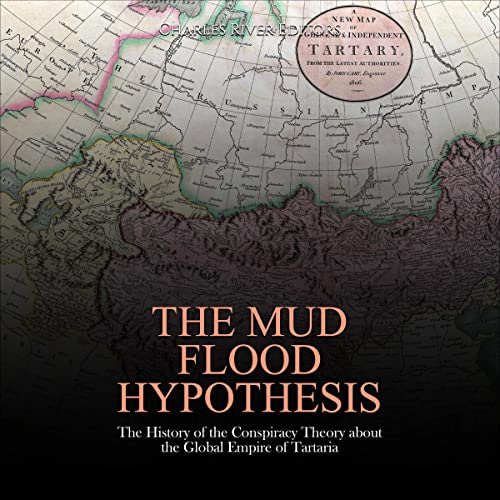
The Mud Flood Hypothesis
The History of the Conspiracy Theory About the Global Empire of Tartaria
Impossible d'ajouter les articles
Impossible d'ajouter le titre au panier.
Impossible d'ajouter le titre à la liste d'envies.
«Retirer de la liste d'envies» a échoué.
Échec de « Suivre le podcast »
Échec de «Ne plus suivre le podcast»
0,99 €/mois pendant 3 mois + 15 € de crédit Audible

The Mud Flood Hypothesis
Acheter pour 7,36 €
-
Lu par :
-
David Van Der Molen
The phenomenon of “conspiracy” or “fringe” theories has always been with people, which makes sense since captivating and entertaining hypotheses arouse the public interest with seemingly sound conclusions that are often based on incomplete, unrelated, or erroneous suppositions. However, with the correct tweaking, they often appear to propound airtight arguments. Conspiracy theories make good use of real or imagined individuals or organizations operating behind a curtain of secrecy manipulating the action.
Since the advent of the internet, there has been an explosion of such theories, easily mounted for a vast public viewership and fed from numerous sources of unknown origins. In recent years, theories such as the electric universe and plasma chronology, the motionless Earth, and life inside black holes constitute just a few. Recent phenomena include “star larvae,” stars as living organisms, a return to the flat earth theory, the expanding and contracting earth, aquatic bipeds, and our planet existing as a dead star. Science fiction has fed the airwaves with creatures living in the atmosphere, nefarious beings living disguised among us, and visiting time travelers from a distant century.
From time to time, a new theory about world history still makes an appearance, particularly interesting when based on a geological reality. A popular notion at present is the existence of a great empire covering the bulk of Asia and Russia until only one hundred years ago that was destroyed and covered up to enable the rise of present nations. This was accomplished by worldwide deluges of mud, modern energy weapons, and the erasure of an advanced architectural and technological civilization that was far beyond its time. Over the past four years, the theory has developed branch extensions that go off in seemingly all directions.
The “mud flood” hypothesis is centered around the ancient empire of Tartaria, or Tartary, as it existed two hundred years ago, a continent-wide showcase of advanced architecture, transportation, free energy, and wireless technology. Tartary is generally described as occupying a large portion of Asia and Russia, bounded by the Caspian Sea and the Ural Mountains, the Pacific Ocean and Bulgaria, and the southern borders of China, India, and Persia. At one point, it took up the vast bulk of the Russian continent.
Tartaria is a story in present circulation as a country that once seemed known to the world but is now forgotten. Tartaria, Tartary, or Grand Tartaria troubles online researchers as they look over old maps dating back as far as the fifteenth century. The intrigue began with a declassified document from the CIA in 1957, mentioning the deletion of the country’s history at the hands of communist attackers. The Khanate of Khazan (Bulgaria) was named Tatarstan, a republic of the Russian Federation that purportedly flew the same flag as ancient Tartaria. In a map of 1824, Chinese-Tartaria and China appear to coexist. By 1850, Mongolia begins to appear where independent Tartaria was before, while China expands to become an empire and Tartaria disappears from view.
The mud flood theory is used as an “observational explanation for a variety of perceived flaws in the historical records regarding Tartaria.” These historical flaws are tied to a global deluge of mud that caused cities and lands to sink into the earth, leading to a “consequential rewriting of history by various political authorities over the past two hundred years.”