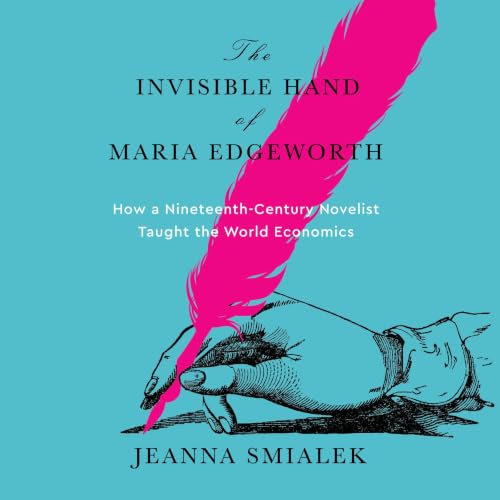
The Invisible Hand of Maria Edgeworth
How a Nineteenth-Century Novelist Taught the World Economics
Artikel konnten nicht hinzugefügt werden
Leider können wir den Artikel nicht hinzufügen, da Ihr Warenkorb bereits seine Kapazität erreicht hat.
Der Titel konnte nicht zum Warenkorb hinzugefügt werden.
Bitte versuchen Sie es später noch einmal
Der Titel konnte nicht zum Merkzettel hinzugefügt werden.
Bitte versuchen Sie es später noch einmal
„Von Wunschzettel entfernen“ fehlgeschlagen.
Bitte versuchen Sie es später noch einmal
„Podcast folgen“ fehlgeschlagen
„Podcast nicht mehr folgen“ fehlgeschlagen
Bist du Amazon Prime-Mitglied? Audible 60 Tage kostenlos testen
Aktiviere das kostenlose Probeabo mit der Option, monatlich flexibel zu pausieren oder zu kündigen.
Nach dem Probemonat bekommst du eine vielfältige Auswahl an Hörbüchern, Kinderhörspielen und Original Podcasts für 9,95 € pro Monat.
Wähle monatlich einen Titel aus dem Gesamtkatalog und behalte ihn.
Für 18,94 € vorbestellen
-
Gesprochen von:
-
Von:
-
Jeanna Smialek
“Smialek, with the analytical rigor and narrative drive that made her one of the finest economics journalists of her generation, has rescued Maria Edgeworth from a historical amnesia that was, as this book makes clear, far from accidental.” —Janet Yellen, Former Chair of the Federal Reserve and United States Secretary of the Treasury
At the end of the eighteenth century, Europe faced revolutions, famine, and war. It was out of this chaos that the field of economics was born—and while that founding has for centuries been attributed almost entirely to men, they were only part of the story.
Maria Edgeworth, known to her contemporaries as “the Great Maria,” was one of the most important authors of the Regency era, envied by Lord Byron, admired by Jane Austen, and read avidly by the British royalty. But she was more than just a novelist and a society fixture: She was also a covert economist, working just after Adam Smith and alongside her friends David Ricardo and Thomas Malthus. As the earliest economists established their philosophies on production and investment, Edgeworth published dozens of stories, many with lessons on finance, society, and trade tucked into their plots. Through her fiction, Edgeworth delivered new ideas to a broader public, stretching the boundaries of what a woman of her time could achieve and captivating an empire in the process.
Here, her tale is told alongside those of the men—and women—who invented a field that would reshape our world. Lively and original, The Invisible Hand of Maria Edgeworth brings this astonishing woman and her world vividly to life and rewrites the origin story of modern economics.
adbl_web_anon_alc_button_suppression_t1
Kritikerstimmen
“Jeanna Smialek, with the analytical rigor and narrative drive that made her one of the finest economics journalists of her generation, has rescued Maria Edgeworth from a historical amnesia that was, as this book makes clear, far from accidental. This is an impressive book about how ideas spread, how fields define themselves by deciding who belongs, and how much is lost when women are excluded from intellectual history.” —Janet Yellen, Former Chair of the Federal Reserve and United States Secretary of the Treasury
“Whoever thought economics could be such a joy to read? Maria Edgeworth may have written the novels, but Jeanna Smialek’s book brings them—and their world—to life. Take a fascinating voyage with Ricardo, Malthus, and Maria, from the age of the American, French, and Industrial revolutions to the Great Irish Famine, and learn some economics along the way.” —Claudia Goldin, Nobel Prize Laureate in Economics and author of Career and Family: Women’s Century-Long Journey Toward Equity
“Revelatory and riveting—an original perspective on the history of economic thought that will change how you see today’s economy, and a pleasure to read from start to finish.” —Jason Furman, Professor of Economics at Harvard University and Former Chair of the Council of Economic Advisers
"A captivating story of Maria Edgeworth, who with her friend Jane Marcet was among the most celebrated writers on political economy of the nineteenth century, at a time of revolutionary change in the politics, language, and literary form of economic ideas." —Emma Rothschild, author of Economic Sentiments: Adam Smith, Condorcet and the Enlightenment
“Lively biography of a woman who has been unjustly disappeared from the history of economics. . . . [Maria Edgeworth] emerges as a humane, politically aware thinker who deserves wider recognition, having been overlooked. . . . A welcome, and anything but dismal, contribution to the history of economics and 19th-century literature alike.” —Kirkus Reviews (starred)
“Whoever thought economics could be such a joy to read? Maria Edgeworth may have written the novels, but Jeanna Smialek’s book brings them—and their world—to life. Take a fascinating voyage with Ricardo, Malthus, and Maria, from the age of the American, French, and Industrial revolutions to the Great Irish Famine, and learn some economics along the way.” —Claudia Goldin, Nobel Prize Laureate in Economics and author of Career and Family: Women’s Century-Long Journey Toward Equity
“Revelatory and riveting—an original perspective on the history of economic thought that will change how you see today’s economy, and a pleasure to read from start to finish.” —Jason Furman, Professor of Economics at Harvard University and Former Chair of the Council of Economic Advisers
"A captivating story of Maria Edgeworth, who with her friend Jane Marcet was among the most celebrated writers on political economy of the nineteenth century, at a time of revolutionary change in the politics, language, and literary form of economic ideas." —Emma Rothschild, author of Economic Sentiments: Adam Smith, Condorcet and the Enlightenment
“Lively biography of a woman who has been unjustly disappeared from the history of economics. . . . [Maria Edgeworth] emerges as a humane, politically aware thinker who deserves wider recognition, having been overlooked. . . . A welcome, and anything but dismal, contribution to the history of economics and 19th-century literature alike.” —Kirkus Reviews (starred)
Noch keine Rezensionen vorhanden