

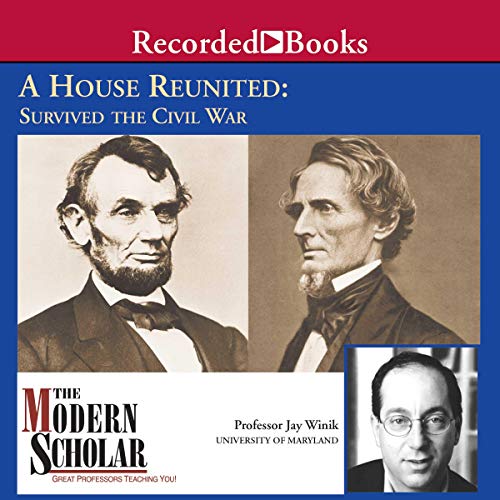
The Modern Scholar
A House Reunited: How America Survived the Civil War
Artikelen konden niet worden toegevoegd
De titel kon niet aan de winkelwagen worden toegevoegd.
De titel kon niet aan de verlanglijst worden toegevoegd.
Verwijderen van verlanglijst mislukt
'Podcast volgen' mislukt
“Podcast niet meer volgen” mislukt
€ 0,99 per maand voor 3 maanden + € 15 Audible-tegoed

The Modern Scholar
Koop voor € 16,83
-
Verteld door:
-
Jay Winik
-
Van:
-
Jay Winik
In this course, award-winning historian Jay Winik examines the climactic period near the end of this devastating conflict - a period that could have destroyed America, but saved it instead. It was a most precarious moment for the South. Atlanta had been overwhelmed, Columbia surrendered and burned, Charleston abandoned. The peace conference at Hampton Roads had been fruitless, and the British and French had refused to intervene. After striking harsh blows against the Union during the six bloodiest weeks of the war, the Army of Northern Virginia had wriggled free of its enemy's clutches and fallen back, assuming a defensive position around the cities of Petersburg and Richmond. Across the slim divide of trenches and water lay U.S. Grant's swelling and mighty Army of the Potomac. Southerners knew this was not the first time in history defenders had been cut to pieces and yet somehow found the will to prevail. They still had four armies in the field, and their guerrilla fighters and cavalry were second to none. Confronted by the prospect of losing everything, they hoped to find a leader who could rescue the south. In the trenches they believed there was such a man, and a weary Abraham Lincoln shared this thought. Robert E. Lee and the generals who looked to him for guidance were as aggressive as ever, not ready to give up or relinquish their Confederate identity. The war was not over, not by a long shot. It is the eve of April 1865. Even today, what followed in the remaining days of the Civil War seems almost miraculous. April 1865 is a month...
©2003 J Winik (P)2003 Recorded Books, LLC