

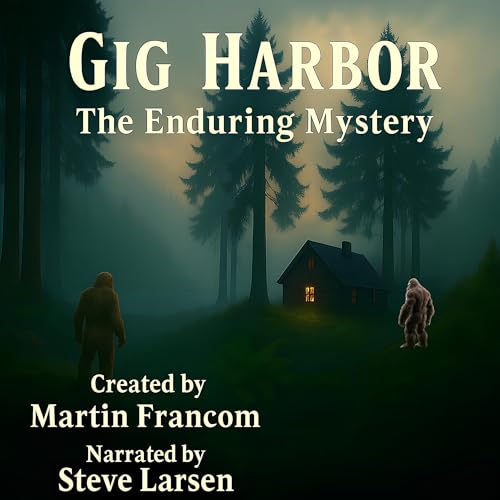
Gig Harbor
The Enduring Mystery
Artikel konnten nicht hinzugefügt werden
Der Titel konnte nicht zum Warenkorb hinzugefügt werden.
Der Titel konnte nicht zum Merkzettel hinzugefügt werden.
„Von Wunschzettel entfernen“ fehlgeschlagen.
„Podcast folgen“ fehlgeschlagen
„Podcast nicht mehr folgen“ fehlgeschlagen
30 Tage Audible Standard kostenlos testen

Gig Harbor
Für 15,78 € kaufen
-
Gesprochen von:
-
Steve Larsen
-
Von:
-
Martin Francom
In an era when fantasy novels often rely on epic battles and world-ending stakes, Gig Harbor: The Enduring Mystery offers something far more sophisticated: a meditation on the quiet heroism of ordinary people protecting extraordinary secrets. This remarkable debut weaves together Pacific Northwest history, environmental conservation, and elements of magical realism into a narrative that feels both timeless and urgently contemporary.
Plot and Structure
The novel follows the multi-generational alliance between Croatian immigrants, Native American communities, and the hidden Sasquatch populations of the Puget Sound region from the 1880s through World War II. At its heart is the relationship between Anah, a Native woman who becomes the guardian of ancient secrets, and the Croatian fishing community of Gig Harbor, who must choose between immediate prosperity and long-term preservation of something they barely understand.
The story has remarkable restraint in pacing, allowing relationships to develop organically across decades rather than rushing toward dramatic revelations. Each chapter feels like a complete story while contributing to the larger narrative arc, creating the satisfying density of a family saga combined with the focused tension of a conservation thriller.
Character Development
Anah emerges as one of the most compelling protagonists in recent historical fiction—a woman who carries impossible burdens with quiet dignity while navigating the complex dynamics of three very different cultures. Her evolution from curious child to wise guardian feels earned rather than imposed, rooted in specific historical pressures rather than generic character growth.
The Croatian immigrant families, particularly the Petrovich and Jerisich clans, are rendered with authentic complexity. These are not noble savages or simple working-class heroes, but real people making difficult choices with incomplete information, motivated by family loyalty, economic necessity, and slowly-developing environmental consciousness.
Perhaps most impressively, the Sasquatch themselves are treated as genuine characters rather than mystical plot devices. Their ancient wisdom exists alongside practical concerns about territory, family, and survival, making them feel like people rather than symbols.
Historical Authenticity
The novel's greatest strength lies in its meticulous attention to Pacific Northwest history. The author clearly understands the economic pressures that shaped early immigrant communities, the complex relationships between different ethnic groups, and the environmental challenges facing the region during this period of rapid development.
The integration of Native American perspectives feels respectful and well-researched, avoiding both romanticization and victimization narratives. The portrayal of Croatian immigrant culture is particularly rich, capturing the specific challenges of maintaining Old World traditions while adapting to New World opportunities.
Environmental Themes
While environmental conservation drives much of the plot, the novel avoids heavy-handed messaging by grounding ecological concerns in practical human relationships. The preserve that protects the Sasquatch communities serves multiple legitimate purposes—wildlife conservation, sustainable forestry, tourism development—making the protection feel organic rather than forced.
The book's most sophisticated insight is that effective conservation requires building institutions stronger than any individual advocate. By the novel's end, the Sasquatch are protected not by magical intervention but by carefully constructed legal frameworks, community traditions, and economic systems that make preservation profitable.
©2025 Martin Francom (P)2025 Martin Francom