

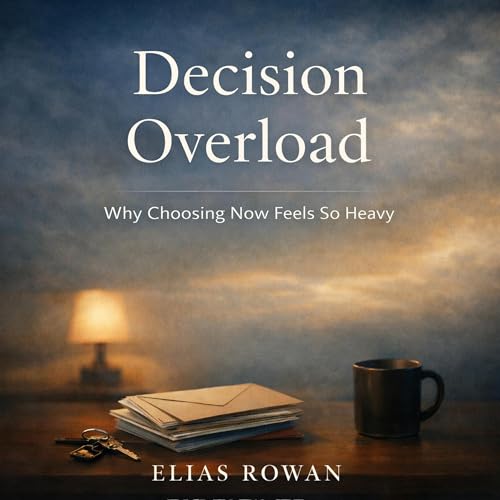
Decision Overload
Why Choosing Now Feels So Heavy
Artikel konnten nicht hinzugefügt werden
Der Titel konnte nicht zum Warenkorb hinzugefügt werden.
Der Titel konnte nicht zum Merkzettel hinzugefügt werden.
„Von Wunschzettel entfernen“ fehlgeschlagen.
„Podcast folgen“ fehlgeschlagen
„Podcast nicht mehr folgen“ fehlgeschlagen
30 Tage Audible Standard kostenlos testen

Decision Overload
Für 18,95 € kaufen
-
Gesprochen von:
-
David E Martin
-
Von:
-
Elias Rowan
Über diesen Titel
Decision Overload: Why Choosing Now Feels So HeavyBy Elias RowanChoosing today rarely feels dramatic. There is no crisis, no obvious conflict, no single decision that explains the fatigue. And yet, thinking feels heavier than it should.
Decision Overload: Why Choosing Now Feels So Heavy explores a quieter form of mental strain—one that does not come from indecision, anxiety, or poor judgment, but from continuous exposure to choice itself. In modern life, decisions rarely end. Options remain visible. Plans stay adjustable. Even after a choice is made, the mind often remains oriented toward what else could have happened.
This audiobook does not offer strategies, solutions, or motivational advice. Instead, it carefully describes the underlying mechanics of cognitive saturation: how micro-choices accumulate,how optionality keeps attention open,how completion no longer guarantees closure,and why mental fatigue can persist even when nothing is wrong.
Through calm, precise narration, Elias Rowan names patterns many listeners recognize but have never heard articulated—post-decision occupancy, latent capacity, cognitive residue, waiting without rest. These are not diagnoses. They are descriptions of how attention behaves in environments that rarely allow it to fully settle.
This is a book for listeners who feel mentally full without being overwhelmed.
For those who function well, decide efficiently, and still feel a low-grade cognitive heaviness they can’t quite explain.
For anyone who has noticed that choosing no longer brings relief.
The audiobook unfolds without urgency and without resolution. It does not attempt to fix the condition it describes. It simply makes the system visible—and lets recognition do the work.
©2026 Ivan Hagen (P)2026 Ivan Hagen