

Eighty-Five Seconds to Midnight: A World on the Brink
Artikel konnten nicht hinzugefügt werden
Der Titel konnte nicht zum Warenkorb hinzugefügt werden.
Der Titel konnte nicht zum Merkzettel hinzugefügt werden.
„Von Wunschzettel entfernen“ fehlgeschlagen.
„Podcast folgen“ fehlgeschlagen
„Podcast nicht mehr folgen“ fehlgeschlagen

Eighty-Five Seconds to Midnight: A World on the Brink
-
Gesprochen von:
-
Von:
Über diesen Titel
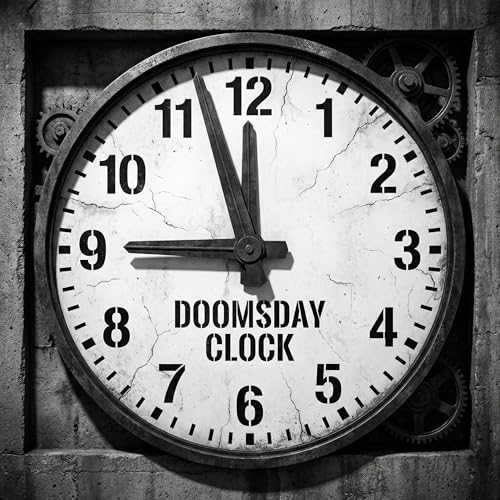
The Doomsday Clock has been moved to 85 seconds to midnight, marking the closest point to global catastrophe in its nearly 80-year history. On January 27, 2026, the Bulletin of the Atomic Scientists announced this adjustment from the previous setting of 89 seconds. This four-second advancement signifies an unprecedented level of peril for humanity, driven by a breakdown in international cooperation and a rise in aggressive nationalism.
One of the most critical factors behind this decision is the imminent expiration of the New START treaty between the United States and Russia. As the last remaining nuclear arms control pact, its end removes the framework for limiting deployed nuclear warheads and conducting on-site inspections. Scientists warn that this could lead to a runaway nuclear arms race for the first time in over half a century. Furthermore, the resumption of explosive nuclear testing after a 30-year pause and the modernization of nuclear arsenals by major powers like China, Russia, and the United States have exacerbated these risks.
Geopolitical instability has also played a major role. The continued war in Ukraine, border clashes between India and Pakistan, and rising tensions in the Middle East—specifically involving Iran and Israel—have created a dangerous environment. The Bulletin also highlighted unilateral military actions, such as the United States intervention in Venezuela resulting in the capture of Nicolas Maduro, and diplomatic crises like the pressure on Denmark regarding the status of Greenland. Experts describe these developments as a shift toward neo-imperialism and a zero-sum approach that undermines global security and trust.
Disruptive technologies, particularly artificial intelligence, represent a growing threat. The unregulated integration of AI into military systems and its role in supercharging disinformation have created what experts call an Information Armageddon. This spread of misinformation makes it increasingly difficult for societies to reach a shared reality or address existential threats effectively. Additionally, there are grave concerns regarding the misuse of biotechnology and the potential for man-made biological threats, especially given the lack of coordinated global plans to handle such emergencies and the rising risks associated with synthetic life.
The climate crisis continues to be a force multiplier for instability. Record-high atmospheric carbon dioxide levels, global sea-level rise, and intensifying extreme weather events show that humanity has not made sufficient progress toward environmental goals. The formal withdrawal of the United States from major international climate frameworks and the dismantling of environmental regulations have further hindered the collective action needed to prevent crossing irreversible tipping points.
The Doomsday Clock was established in 1947 by scientists who worked on the Manhattan Project, including Albert Einstein and J. Robert Oppenheimer. It serves as a metaphor for how close humanity is to self-annihilation through technologies of its own making. While the current setting is the most alarming ever recorded, the Bulletin emphasizes that the clock can still be turned back. Doing so requires serious diplomatic work, the re-establishment of arms control treaties, and a global commitment to fact-based decision-making. The history of the clock shows that when experts and the public demand action, progress is possible, as seen in 1991 when the clock moved to 17 minutes to midnight following the end of the Cold War. Today, however, scientists warn that every second counts and the world is running out of time.
Hosted on Acast. See acast.com/privacy for more information.
