

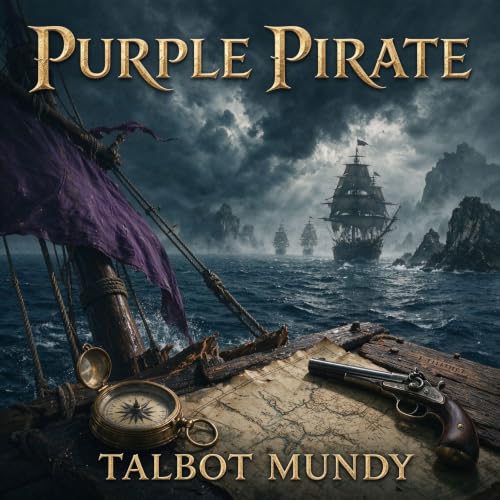
Purple Pirate
Artikelen konden niet worden toegevoegd
Sorry, we kunnen dit artikel niet toevoegen omdat je winkelwagen vol is.
De titel kon niet aan je winkelwagen worden toegevoegd.
Probeer het later opnieuw
De titel kon niet aan je verlanglijst worden toegevoegd.
Probeer het later opnieuw
“Uit verlanglijst verwijderen” mislukt.
Probeer het later opnieuw
“Podcast volgen” mislukt
“Podcast niet meer volgen” mislukt
€ 0,99 per maand voor 3 maanden + € 15 Audible-tegoed
Wordt automatisch verlengd voor € 6,99 per maand na 3 maanden. Maandelijks opzegbaar.
Aanbieding geldig tot 28 december 2026.

Purple Pirate
Verteld door:
AI Voice Kokoro TTS
Koop voor € 21,04
-
Verteld door:
-
AI Voice Kokoro TTS
-
Van:
-
Talbot Mundy

Dieser Titel verwendet virtuelle Sprachausgabe
Virtuelle Stimme ist computergenerierte Erzählung für Hörbücher.
Over deze titel
Purple Pirate (1935) is the last completed voyage of Tros of Samothrace, the British sea-captain Talbot Mundy had been writing about since 1925, and it opens in the throne-room of Alexandria in 43 B.C., with a queen who has just buried Caesar and a captain who wants his ships back. Almost every chapter is cut off with a fragment "From the Log of Lord Captain Tros of Samothrace", the captain's own ledger of debts, oaths and dead men, and the first of them sets the tone: a queen has no real friends, and Tros is not certain he is one of them.
Cleopatra needs corn; her sister Arsinoe needs a throne. Between the two of them Mundy lays a chain of errands that carries Tros out of Egypt and around the eastern Mediterranean: to Salamis, where his grain fleet is held by a treacherous admiral; to Jerusalem, where Herod bargains in the shadow of Cassius; to Crete, where four thousand invaders must be fed; and at last to the Italian coast, where Antony and Octavian are tearing the Roman world in half.
What the book is really about is command - how a captain holds a crew of Northmen, freedmen and Jews together, and what that costs him. Mundy's sea-fighting is precise and unsentimental, his politics are cynical, and his best scenes are arguments between people who both need the same ship. Even the child Caesarion, lisping "Twos of Samothwakee" at Tros's knees, is part of the machine. When Cassius is called "the coming ruler of the world", Tros answers with oars; when his men are called "comrades-in-arms", he means it as a debt.
adbl_web_anon_alc_button_suppression_t1
Nog geen reviews beschikbaar